Edward Seago was a leading figure in twentieth-century British landscape painting, working in both oil and watercolour to capture coastal and urban scenes, as well as landscapes encountered throughout his extensive travels.
Largely self-taught, his distinctive style combined the immediacy of late Impressionism with a keen observational eye, resulting in compositions that remain firmly rooted in the reality of the places he saw. Particularly sensitive to subtle shifts in colour, light and weather, Seago could evoke an atmosphere with remarkably fluid and spontaneous brushwork.
Edward Seago: Artist and Traveller
Born in Norwich in 1910, Seago developed an interest in art from an early age. Although largely self-taught as a painter, he became known for his ability to work rapidly and directly from the landscapes and cities around him.
Travel became an important part of his practice. From the landscapes and waterways of Britain to France and further afield, Seago painted the places he encountered rather than treating travel simply as a source of preliminary material.
This immediacy became central to his work. Changing skies, reflections on water, shifting weather and fleeting effects of light frequently became as important as the landscape itself.
Edward Seago's Painting Style
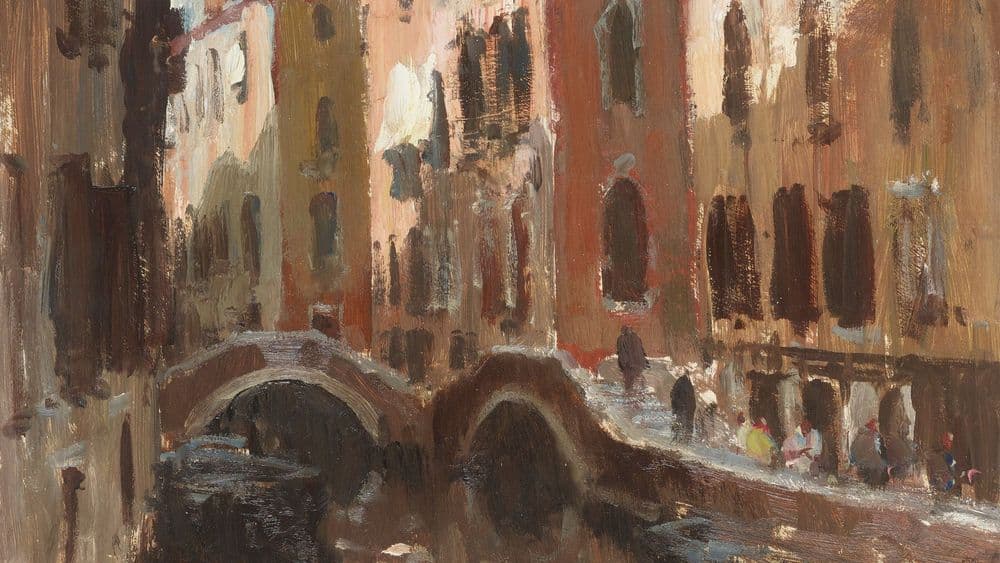
Seago worked extensively in oil and watercolour, developing a recognisable style based on fluid brushwork, careful observation and an instinctive understanding of atmosphere.
His paintings often appear spontaneous, but their apparent simplicity is underpinned by carefully balanced compositions. Buildings, boats and figures might be suggested with only a few marks, while expansive areas of sky or water establish the mood of a scene.
Rather than recording every detail, Seago concentrated on the qualities that gave a particular place its character: light, colour, weather and movement.
Coastal Landscapes and the Sea
The sea was a recurring presence throughout Seago's career. His paintings encompass beaches, harbours, estuaries, sailing boats and expansive coastal views, allowing him to explore the constantly changing relationship between water, sky and land.
Sailing also became closely connected with his artistic life. His yacht, Capricorn, served as both a means of travel and a floating studio, allowing Seago to approach and paint coastal landscapes from the water.
Edward Seago in France
France became an important subject for Seago during the 1950s and 1960s. Between 1951 and 1967, he made eight major painting expeditions to France, frequently travelling aboard Capricorn. Sailing across the Channel and along the Seine, he would stop at Dieppe, Honfleur and Rouen before reaching Paris, engaged in what he described as:
“an endless search for explanations and discovery.”
These journeys provided Seago with an extraordinary range of subjects, from harbours and river landscapes to the streets, gardens and monumental architecture of Paris.
Edward Seago's Paintings of Paris
Paris particularly fascinated Seago. The Champs-Élysées, Tuileries Gardens and Place de la Concorde became recurring subjects, providing him with the compelling combination of grand architecture, bustling city life and ever-changing light that so appealed to him.
Yet architecture was rarely the only subject. Seago frequently devoted substantial areas of his compositions to the sky, using broad and loosely worked passages of paint to capture transient clouds and changing atmospheric conditions.
Cars, pedestrians and distant buildings could be conveyed with only a handful of deft marks. The result was a Paris that felt animated rather than static, capturing both the physical character of the city and the movement of everyday life.
Evening in the Place de la Concorde, Paris
Evening in the Place de la Concorde, Paris is a particularly lively expression of Seago's fascination with the city.
Rather than concentrating on the monumental architecture of the square, Seago lowers the horizon and devotes much of the composition to an expansive evening sky. Broad, loosely worked passages of cream, grey and pale blue capture the luminous and transient quality of drifting clouds.
Against this soft modulation, the buildings bordering the square are rendered in silhouette with remarkable simplicity, their increasingly indistinct forms creating an almost abstract sense of aerial perspective.
The characteristic bustle of the Place de la Concorde has not been overlooked. Cars and clusters of figures animate the lower edge of the panel, their forms conveyed through deft dabs of paint. Seago's expressive brushwork lends the foreground an almost flickering quality, capturing the constant movement and vivacity of the city he so adored.
Edward Seago's Legacy
Seago's ability to combine close observation with remarkably economical brushwork established him as a distinctive voice within twentieth-century British landscape painting.
Whether working on the Norfolk coast, travelling through France or painting city streets, his principal concerns remained remarkably consistent: the experience of a particular place and the effects of light, weather and atmosphere upon it. His paintings continue to appeal to collectors for precisely this immediacy, capturing landscapes not as fixed views but as places subject to constant change.