Duncan Shanks was one of Scotland's most respected landscape painters, celebrated for quietly lyrical works that explored the changing colours, rhythms and atmosphere of the Scottish countryside.
Rather than depicting recognisable landmarks, Shanks sought to capture the experience of being immersed in a landscape, creating paintings that balance close observation with abstraction. His restrained palette, layered surfaces and subtle handling of light established him as a distinctive voice in post-war Scottish art.
Born in Gourock in 1937, Shanks studied at Gray's School of Art in Aberdeen before becoming a lecturer in drawing and painting at Edinburgh College of Art, where he taught for more than three decades. His influence extended well beyond his own practice, inspiring generations of Scottish artists through his commitment to careful observation and the discipline of drawing.
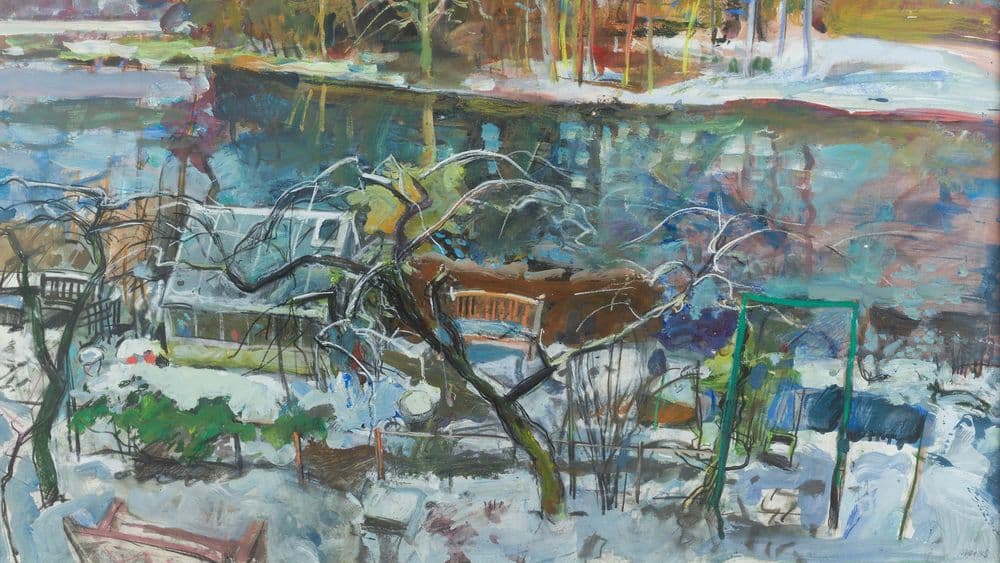
Although best known as a landscape painter, Shanks rejected literal representation. Working directly from sketches and prolonged engagement with the landscape, he distilled fields, rivers, woodlands and coastal scenery into rhythmic arrangements of colour, line and texture. His paintings evoke the shifting qualities of weather and season rather than specific places, encouraging viewers to experience landscape as memory and sensation rather than topographical record.
The Scottish Borders, East Lothian, Angus and the west coast of Scotland provided endless sources of inspiration throughout his career. Working across painting, drawing and printmaking, he developed a visual language that reflected the structure of the land while remaining deeply personal. His compositions reveal a profound understanding of natural pattern, whether the geometry of cultivated fields, the movement of water or the changing light across hillsides.
Shanks exhibited widely throughout the UK and was elected to the Royal Scottish Academy (RSA), the Royal Scottish Society of Painters in Watercolour (RSW) and the Royal Glasgow Institute (RGI). In 1995 he was appointed Officer of the Order of the British Empire (OBE) for services to art. His work is held in numerous public collections, including the Scottish National Gallery of Modern Art, The Fleming Collection, The Hunterian, the Royal Scottish Academy, the University of Stirling and many other public and private collections.