Dominique Zumbo was a French ceramicist of Sicilian origin, best known for his contribution to the revival of artistic pottery in the south of France during the late nineteenth and early twentieth centuries.
Born in Sicily, he was trained by his father, a potter, before the family relocated to France in 1879, settling in the region that would become a centre for artistic ceramics.
Zumbo initially worked with the celebrated ceramicist Clément Massier in Golfe-Juan, where he played an important role in the development and refinement of the metallic lustre glazes that became synonymous with French Art Nouveau pottery. The iridescent surfaces achieved by Massier's workshop attracted international acclaim and placed the Côte d'Azur at the forefront of contemporary ceramic production.
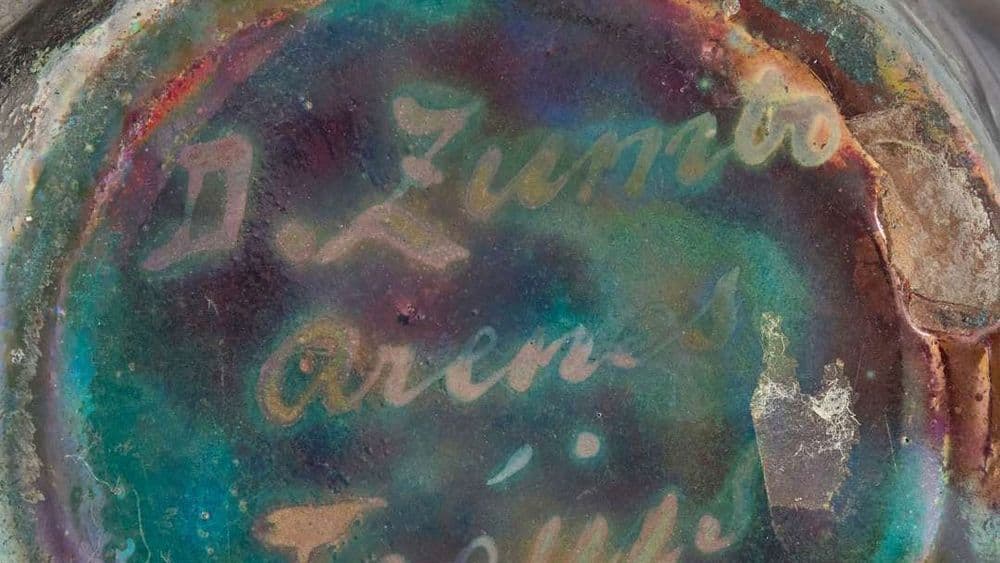
In 1892, Zumbo established his own pottery at Arènes, near the Roman amphitheatre at Fréjus in the Var region. There he developed a distinctive body of work characterised by richly coloured glazes, lustre effects and sculptural forms inspired by both nature and Symbolist aesthetics. His ceramics often combined technical experimentation with the decorative sensibilities of the Art Nouveau movement, reflecting the broader European fascination with organic forms and innovative surface treatments.
Zumbo's reputation extended beyond France. At the Turin International Exhibition of 1898, he was awarded both gold and silver medals, recognition that confirmed his standing among the leading ceramic artists of his generation. He also collaborated with notable artists and sculptors, including Jean Carriès, whose pioneering stoneware had a profound influence on French ceramics, and Rupert Carabin, the sculptor and designer associated with the Art Nouveau movement.