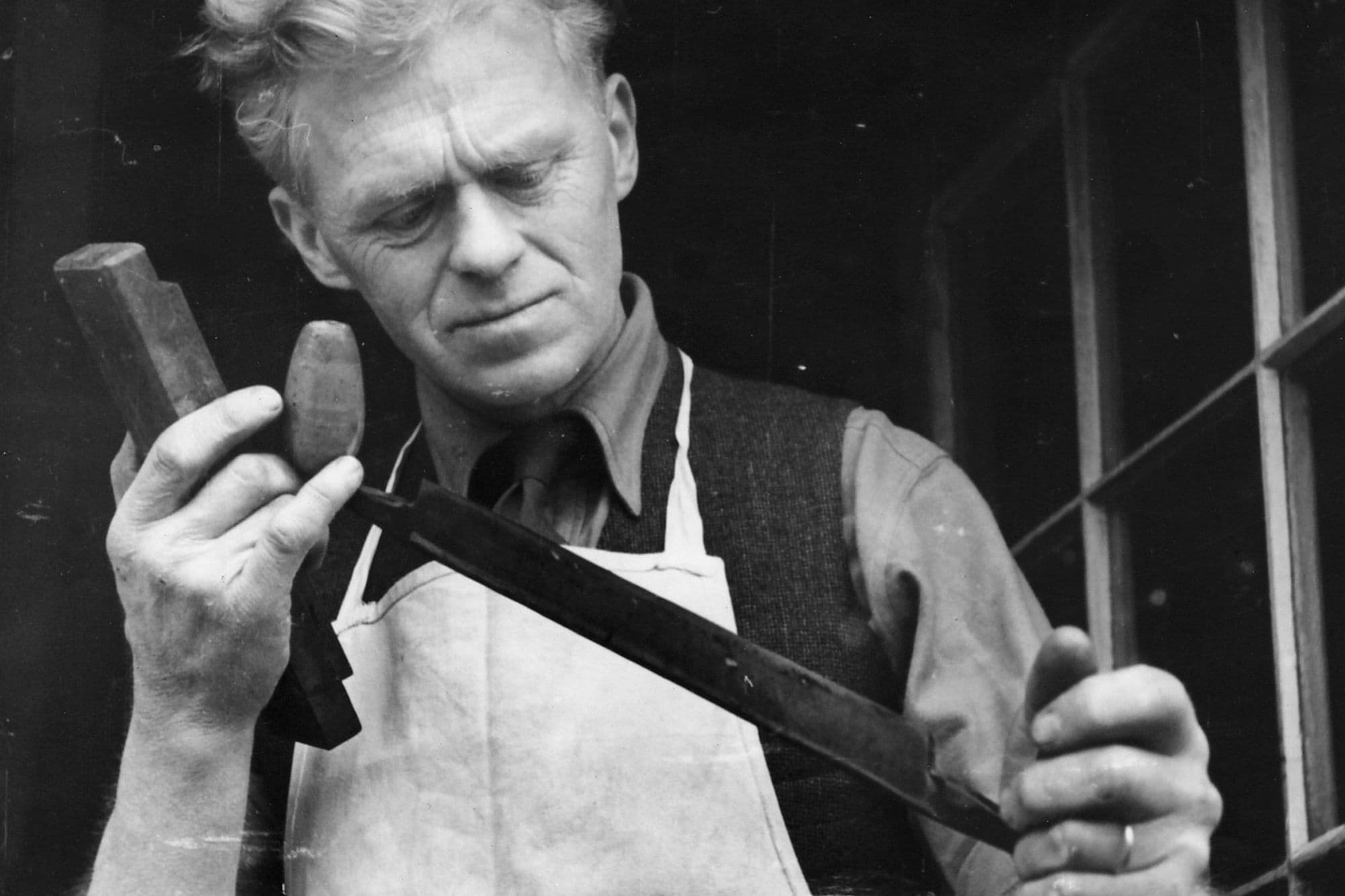
The architect C. R. Ashbee was a leading figure in the Arts & Crafts movement in Britain, best known as a designer, architect, and social reformer.
Deeply influenced by the ideas of John Ruskin and William Morris, Ashbee championed craftsmanship and community-based artistic production, seeking to restore dignity to labour in an increasingly industrialised society. His influence extended beyond Britain, notably shaping the ideals of the Wiener Werkstätte in Vienna.
In 1888, Ashbee founded the Guild and School of Handicraft in London’s East End. Conceived as a cooperative venture, it aimed both to raise standards of craftsmanship and to restore dignity and status to the craftsman. Ashbee sought to strike a balance between the isolated independence of the artist and the commercial workshop, where craftsmen often had little stake in their work beyond a weekly wage. In this way, the Guild combined craft production with the social ideals of the Arts and Crafts movement.
By the turn of the twentieth century, the movement had encouraged creativity across many fields, including silversmithing, jewellery and enamelling, stained glass, bookbinding, furniture making, and printing. The Guild became particularly known for its metalwork - producing jewellery, enamels, and hand-wrought copper and ironwork - while also employing stonemasons, woodworkers, and glass artists. Ashbee himself created many of the Guild’s furniture designs, and from around 1900 began designing chairs characterised by their simplicity of form, typically composed of solid elements softened by subtle curved features.
In 1902 Ashbee moved the Guild from London to Chipping Campden, hoping to offer his craftsmen a healthier and more harmonious way of life. That May, he and several Guild members travelled by train to Moreton-in-Marsh and cycled the final miles to the town. Over the summer, around fifty craftsmen and their families followed from London, bringing their tools and establishing workshops in the former silk mill on Sheep Street.
Initially the venture prospered, but by about 1904 sales began to decline. The Guild’s cooperative structure, which had worked more effectively in the city, struggled to adapt to the rural setting, and financial pressures led to its dissolution in 1907. Nevertheless, several craftsmen remained in Campden and continued working independently, ensuring the silk mill remained a centre for craft production.
The Guild’s brief presence thus marked both the end of Ashbee’s communal experiment and the beginning of Chipping Campden’s lasting association with craftsmanship and design. Ashbee himself remained in the town until 1919.