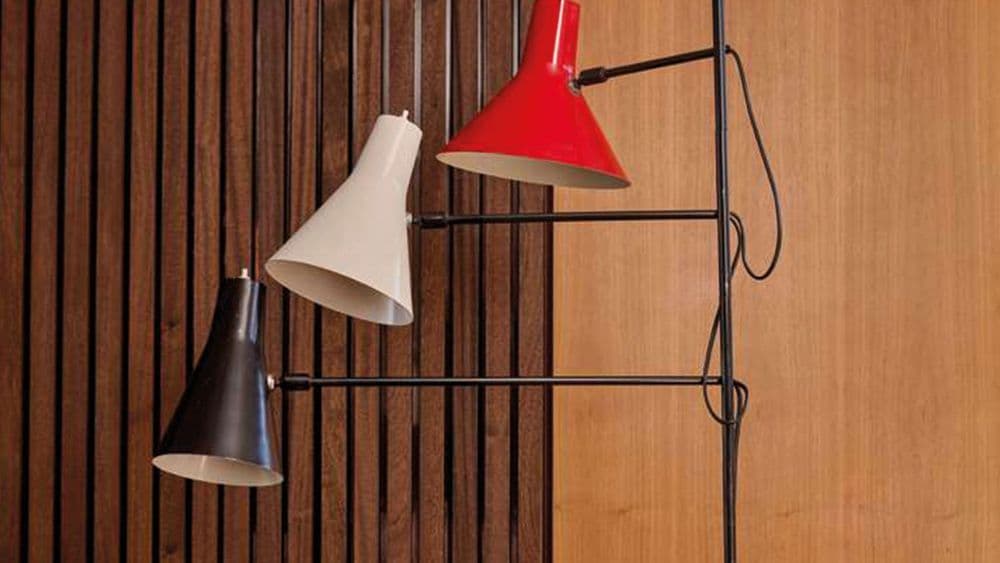
Although Bernard Schottlander is widely recognised for his large-scale sculptural works, his earliest creative achievements were in the field of lighting design.
Born in Mainz, Germany, he emigrated to Britain in 1939, settling in Leeds after fleeing the political climate of his homeland. There he worked initially as a welder and undertook wartime service before enrolling at the Leeds College of Art to study sculpture. He later continued his training in London at the St John’s Wood Art Centre and the Central School of Art and Design, graduating in industrial design in 1951.
That same year, Schottlander established a small workshop in Swiss Cottage, London, from which he began designing and fabricating lighting by hand. Working largely on his own, he produced a series of striking and inventive lamps that combined the precision of metalworking with the formal sensibility of sculpture. His early designs quickly attracted attention, and by 1952 they were prominently featured in an Architectural Review article highlighting innovative lighting being developed by contemporary British and European designers.
Schottlander’s early output included a number of distinctive multi-arm lamps produced in very small numbers, often assembled using carefully balanced metal frameworks and adjustable shades. The use of different coloured shades reflects the optimistic palette associated with post-war British design and recalls the aesthetic atmosphere of the Festival of Britain era.