Known For
Alphonse Mucha was one of the defining figures of the Art Nouveau movement, celebrated for his highly decorative posters, illustrations and designs featuring elegant female figures, flowing hair and intricate floral motifs. Rising to international fame through his collaborations with actress Sarah Bernhardt in 1890s Paris, Mucha's distinctive style became synonymous with the Belle Époque and continues to influence graphic design today.
Alphonse Mucha is universally acclaimed as one of the most significant Art Nouveau artists. Whilst best remembered for his posters - of elongated women with hair falling in intertwining arabesques, wearing long dresses, and embellished with flowering foliage - he was also a book illustrator, interior designer, sculptor, jewellery designer, and theatre set creator.
Born in Morovia, Alphonse Mucha studied at the Fine Art Academy in Munich before arriving in Paris in 1887. He was tutored at the Académie Julian by Jules-Joseph LeFebvre and Paul Laurens. His Parisian circle of friends included Paul Gaugin, Paul Sérusier and Les Nabis artists, August Rodin and the composer Frederick Delius.
He gained employment with printers and editors working as an illustrator. It was on New Year’s Day 1895 that his poster Gismonda (1894) first appeared and heralded his career breakthrough. The actress Sarah Bernhardt was depicted in embroidered garments with a floral headpiece, standing in front of mosaic tiling, an arch and cross behind her head and holding a palm branch that elevated her to saintly status.
1895 was also the year that Mucha signed a six-year contract with Sarah Bernhardt to design stage sets, costumes and posters for her business, and signed an exclusive contract with the printer F. Champenois. In 1897 he had his first solo exhibition at the Salon des Cent which showed the works of avant-garde artists and the following year he exhibited at the first Vienna Secession exhibition.
His spiritual journey was influenced by his friends the Swedish philosopher August Stringberg and the mystic and occultist Albert de Rochas and manifest itself more clearly when his _Le Pater_published in 1899. He had become a Freemason the previous year and Le Pater rather than reflecting the Catholic faith in which he was raised represents his own personal philosophical vision. The depiction is a seven-stage progressive journey from darkness to universal truth and the Supreme Being.
Mucha’s contribution at the 1900 Exposition Universelle in Paris was significant enough to earn him the accolade of Legion d’honneur, which he received the following year.
From the turn of the Century, he worked for his friend, the jeweller, Georges Fouquet, as well as in New York. However his attention increasingly turned to his native land, and he returned to Bohemia in 1910. From 1911 he worked in Prague on his Slav Epic a philosophical series that portrayed both his vision for his nation and his values. His life ended a few months after the German invasion of Prague in 1939.
Related Artists & Topics
Collectors interested in Alphonse Mucha may also wish to explore works by Sarah Bernhardt, whose theatrical commissions helped establish Mucha's reputation, as well as fellow Art Nouveau designers Charles Rennie Mackintosh and Talwin Morris.
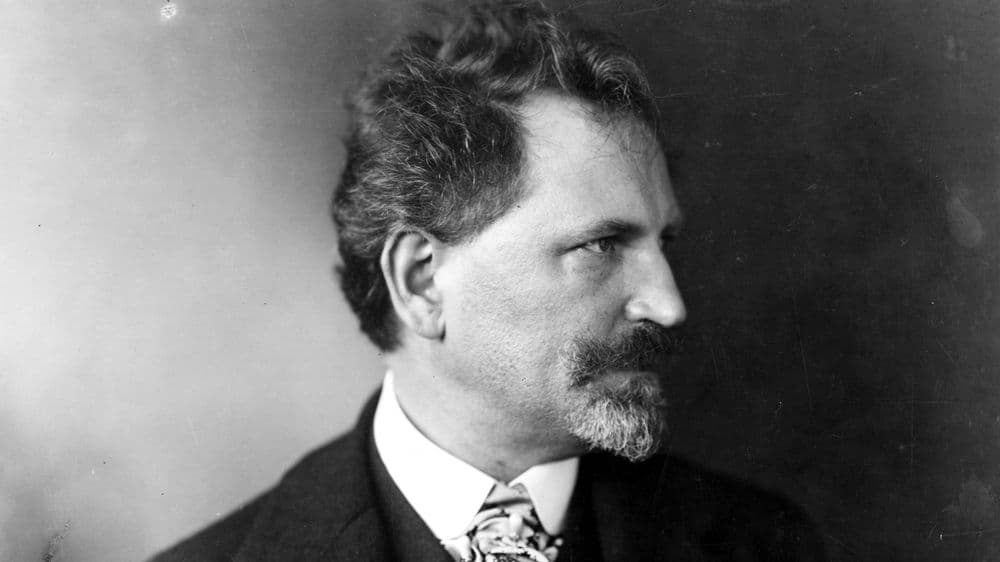
Illustrated: Image by George R. Lawrence Co., Chicago., Public domain, via Wikimedia Commons