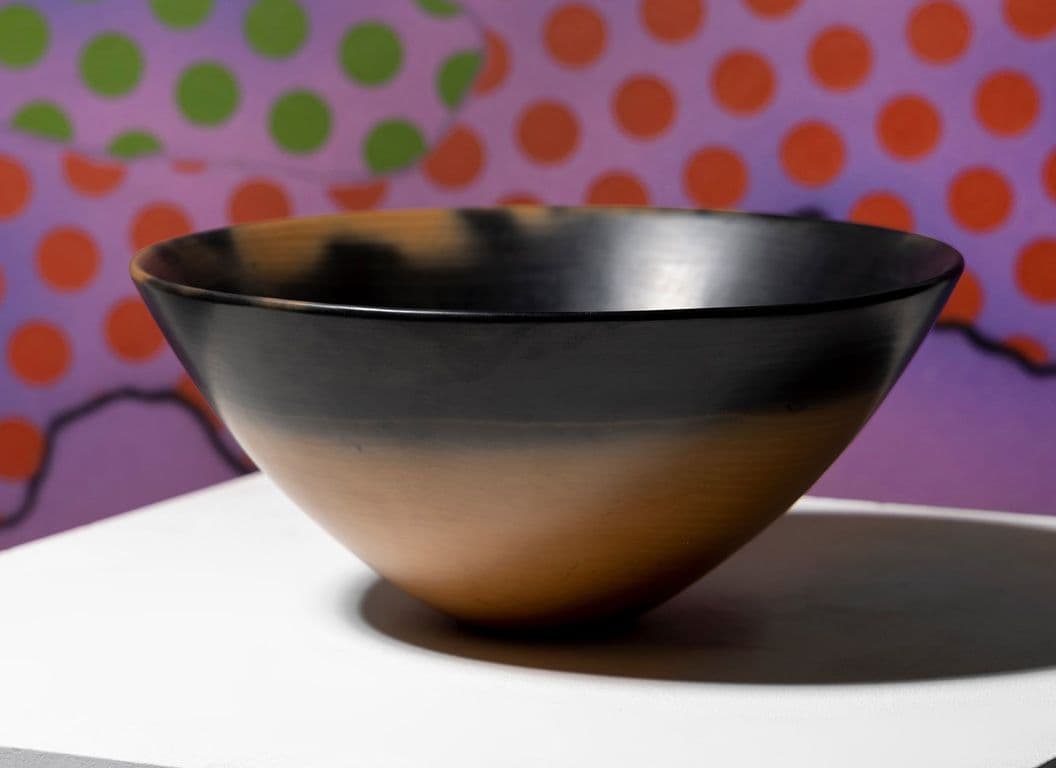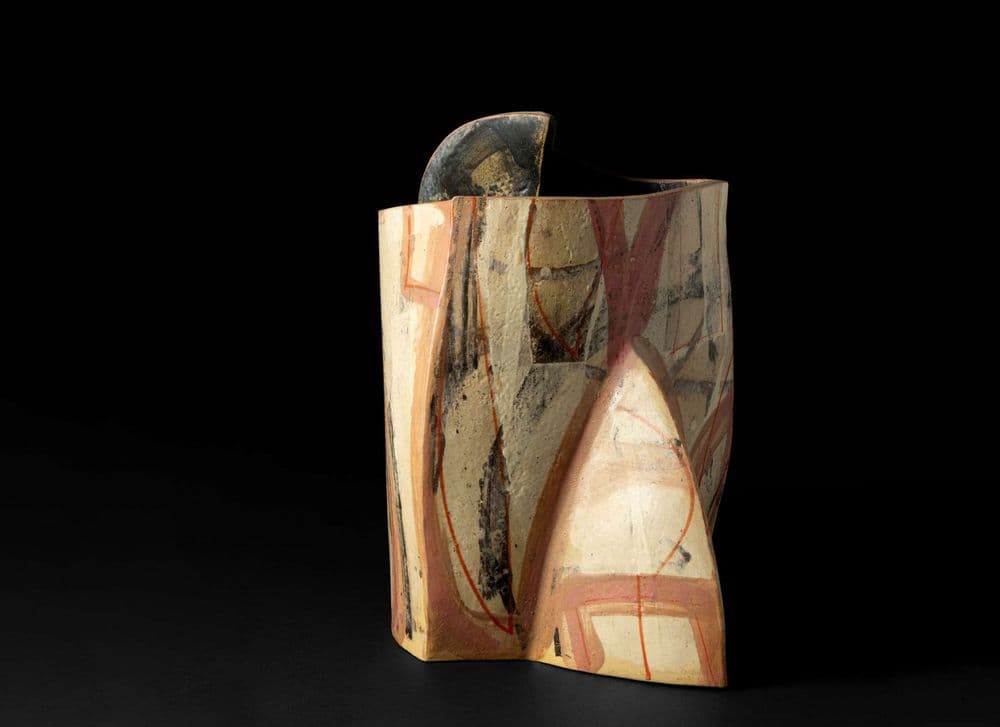
Alison Britton is a British studio ceramicist, renowned for her expressive, slab-built vessels that blur the boundaries between sculpture, painting, and function.
Alison Britton is a leading figure in British studio ceramics, internationally recognised for her distinctive, large-scale hand-built vessels that blur the boundary between sculpture and function.
Born in 1948, she studied at the Central School of Art and Design before completing an MA at the Royal College of Art in 1973, where she later became a longstanding tutor and influential voice in ceramic education.
Britton emerged in the 1970s as part of a radical generation of ceramic artists who challenged the conventions of functional pottery. Her work is characterised by its bold asymmetry, painterly surfaces, and architectural forms, often constructed from slabs of clay and animated by expressive brushwork and layered glazes. Drawing on influences from abstract painting, postmodern design, and Japanese aesthetics, Britton’s vessels are both physical objects and visual explorations of space, texture, and gesture.
A respected writer and theorist as well as a maker, Britton has contributed significantly to the discourse on contemporary ceramics. Her writings, including the influential collection Seeing Things: Collected Writing on Art, Craft and Design (2013), reflect her deep engagement with the visual arts and craft practice.
Her work is represented in major public collections including the Victoria and Albert Museum, the British Council Collection, and the Los Angeles County Museum of Art. In 1990 she was awarded an OBE for services to art, and she continues to influence new generations through both her practice and teaching.