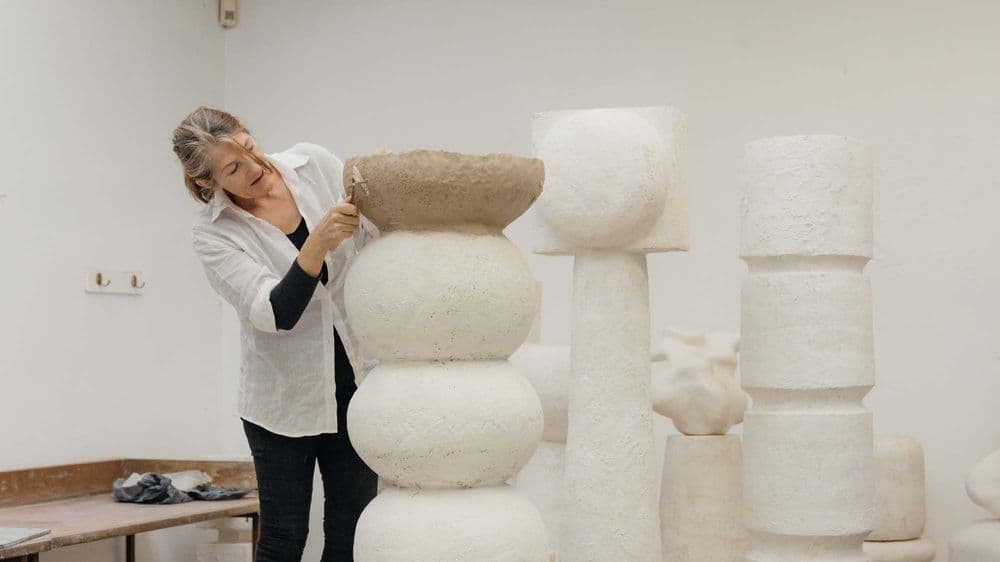
Abigail Ozora Simpson is a ceramic sculptor known for large-scale works that explore material, form and the relationships between objects. A self-taught artist, she has worked with clay for more than 27 years and is particularly interested in how the ancient history of ceramics can meet the possibilities of sculpture.
Clay remains Simpson's primary material. She works with rough, gritty sculpture clay as well as soft, smooth and fragile porcelain, and has increasingly introduced other materials into her practice. Contrasts are central to her work, from rough and smooth surfaces to strong and delicate forms, while vertical structures recur throughout her sculpture.
Simpson often works with groups of objects, considering their physical and emotional relationships and the effect of placing individual sculptures together. Presence is important to her practice, and she seeks to create objects that move beyond their physical form to generate sensation and atmosphere.
The process of making is equally significant. Simpson works directly with her materials through repetitive processes including mixing, wedging, scoring, slipping, coiling, pinching and scraping. She describes the artist's hand as crucial to her work, with the physical act of making forming an important part of the finished sculpture.
In 2019, Simpson participated in Artists Rooms with Richeldis Fine Art and Encounter Contemporary, creating an installation of 17 works. She has also collaborated with Ralph Pucci International and cellist Rubin Kodheli on a performance staged within a sculptural setting.
In 2024, Simpson was awarded a QEST Scholarship in Ceramic Sculpture to support a one-year Master's in Sculpture at the Royal College of Art. The scholarship was intended to enable her to develop her use of materials beyond clay, including wood, plaster and resin, and to produce more ambitious sculptural work.
Illustrated: Image supplied by the artist with thanks. Photographer: Maureen Martinez-Evans