From the Beggarstaffs to Printmaking
Nicholson began in collaboration with his brother-in-law, James Pryde, designing posters for theatres and commercial products under the pseudonym J. & W. Beggarstaff.
Although critically admired for their innovative approach, with stark silhouettes and minimalist compositions, these same idiosyncrasies meant that advertisers often found them too avant-garde for widespread commercial appeal.
Nicholson nevertheless recognised the possibilities offered by a society in which popular imagery was increasingly sought after and began his printmaking journey afresh with the help of publisher William Heinemann.
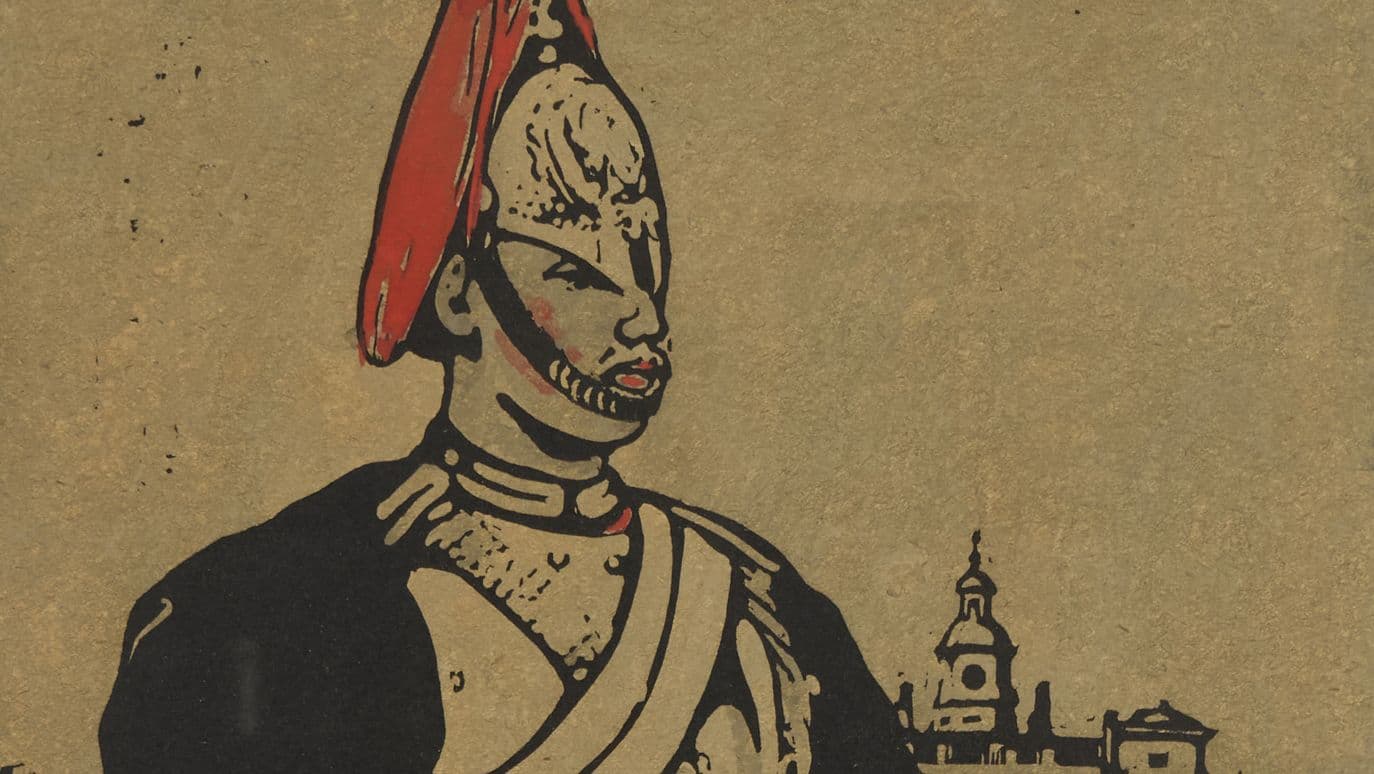
Working primarily in woodcut, Nicholson developed a visual language which was both bold and engaging. There followed a sequence of portfolios including An Alphabet (1897 - 98), An Almanac of Sports (1898) and London Types (1898), which met with great commercial success.
What Is a Woodcut?
Woodcut is a relief-printing process in which areas of a block of wood are carved away, leaving the intended image raised. Ink is applied to this remaining surface before the image is transferred onto paper.
The technique has a history spanning continents, centuries and cultures. From early woodblock printing in Asia to its development in Europe, generations of artists have turned to the medium, learning from the techniques of the past and adapting them for their own purposes.
Albrecht Dürer produced one of his most famous prints, The Rhinoceros (1515), as a woodcut, while centuries later Edvard Munch used colour woodcuts to very different effect in works including Two Human Beings. The Lonely Ones.
William Nicholson's Woodcut Style
Nicholson’s approach drew on the flattened decorative qualities of Japanese woodcuts, as well as the dissemination of lithographic poster design through Europe by artists such as Henri de Toulouse-Lautrec.
He notably printed from the coarse-grained side of the woodblock, lending his prints a rich, textured quality. His work also reflected aspects of the Art Nouveau movement, particularly in the bold black outlines of his figures and restrained use of colour.
The result was remarkably economical. Nicholson could suggest a figure, occupation or personality with surprisingly little information, using silhouette, outline and a few carefully selected areas of colour.