How Is Pâte-sur-Pâte Made?
The delicacy of pâte-sur-pâte disguises just how laborious it is to produce. The decorator begins by applying liquid clay to the surface of the ceramic body. Rather than creating the design in a single application, the slip is built up gradually, layer upon layer. White slip was frequently used against a coloured ground, allowing the finished design to stand out from the body of the vessel.
Once these layers have been established, the artist works back into the surface, carefully carving and modelling the slip. Areas where the slip remains thick appear more opaque, while thinner areas allow more of the coloured ground to show through. This creates the characteristic sense of depth and translucency associated with pâte-sur-pâte.
The effect can resemble a cameo, but rather than being cut from layers of stone or glass, the image has been constructed and modelled from clay. It was exceptionally demanding work. A complex piece could take weeks, or even months, to complete.
Marc-Louis Solon and the Development of Pâte-sur-Pâte
The artist most closely associated with pâte-sur-pâte is Marc-Louis Solon (1835-1913). Solon mastered the technique while working at the Sèvres porcelain factory in France. Following the outbreak of the Franco-Prussian War in 1870, he left France for England and subsequently joined Minton at Stoke-on-Trent. His arrival would have an important influence on British ceramics.
At Minton, Solon developed some of the finest examples of pâte-sur-pâte decoration and passed his skills to other decorators. The technique became closely associated with the factory and with the elaborate classical and allegorical subjects for which Solon's work became known.
Albion Birks and Pâte-sur-Pâte at Minton
Among Solon's pupils at Minton was Albion Birks, who became an accomplished pâte-sur-pâte decorator in his own right. Birks spent almost 60 years working at Minton and produced a considerable body of work using the technique. His ability was such that examples by Birks and Solon can sometimes be confused.
Signed pieces are therefore particularly useful. Two early 20th-century Minton vases handled by Lyon & Turnbull provide an excellent opportunity to see Birks's work at close quarters.
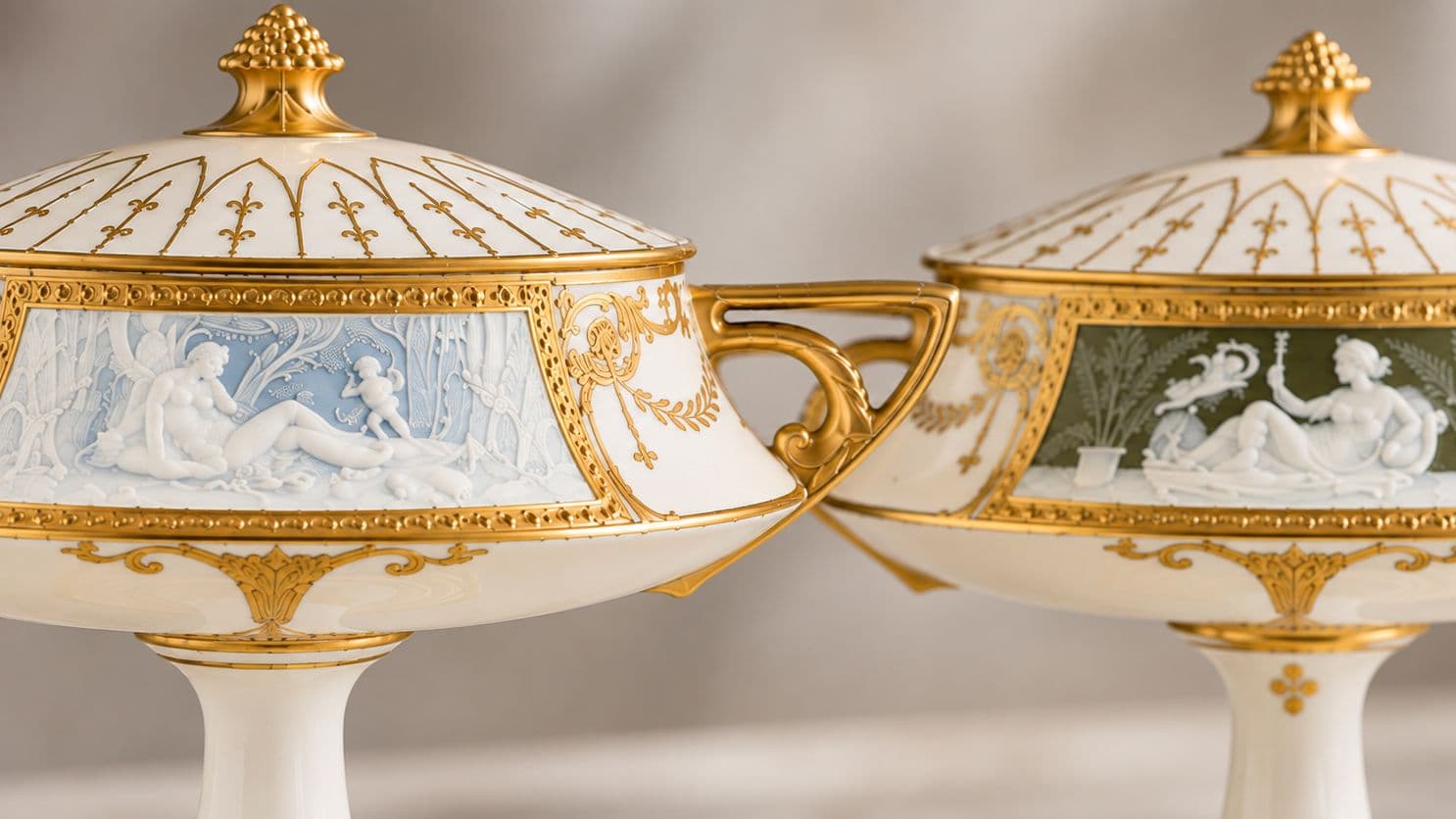
Both combine pâte-sur-pâte decoration with forms influenced by the Art Nouveau period. On one, the classical goddess Diana is shown sleeping in a wooded landscape. On the other, a reclining Venus appears with Cupid flying overhead carrying a garland of flowers.
Look closely and the layers of decoration become visible. The varying thickness of the white slip creates highlights, shadows and translucent passages across the figures, giving the scenes remarkable depth despite their shallow relief.
How Can You Identify Pâte-sur-Pâte?
The characteristic white-on-colour appearance is a useful starting point, but pâte-sur-pâte should not be confused with decoration that has simply been painted or applied to the surface.
Look for depth within the white decoration. The technique relies upon differing thicknesses of slip, so areas of a figure may move from relatively opaque white to remarkably fine, translucent passages.
The decoration should also have a modelled quality when viewed closely. Figures, drapery, foliage and other details have been worked into the layers of slip rather than simply painted onto the vessel.
Classical and mythological subjects are frequently encountered, particularly on important Minton examples. Factory marks and signatures can provide further clues.