Quick answer: The Radium Girls were factory workers employed to paint luminous watch dials and instrument gauges during the early twentieth century. Unaware of the dangers of radium, many suffered severe health problems after repeatedly ingesting radioactive paint. Their legal battles transformed workplace safety and changed how luminous watches were manufactured.
Who Were the Radium Girls?
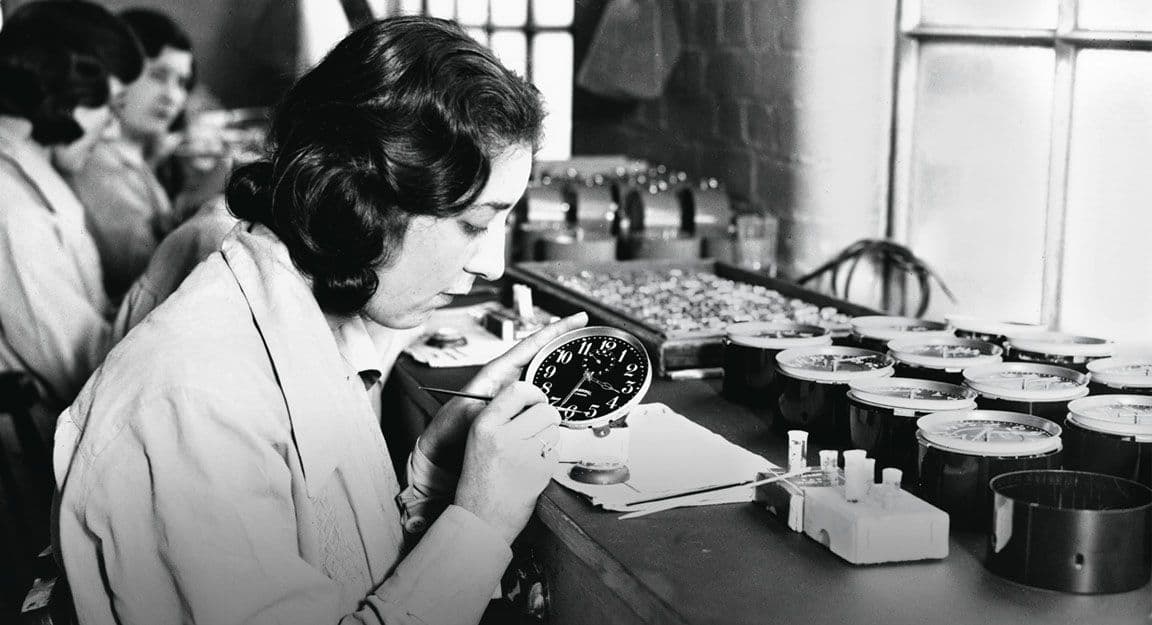
Women have long played a part in the watchmaking industry, first gaining admission to the Geneva Watchmaker’s Guild in 1690. Valued for their dexterity, women were tasked with intricate jobs such as assembling fusee chains. It wasn’t until the mid-nineteenth century however that employment opportunities expanded significantly.
Due to competition from America, the Swiss watchmaking industry was forced to transform from dispersed cottage production to mass factory production, and factories required workers. In 1843, the first watchmaking school for women opened in Geneva and by the middle of the twentieth century almost half of workers in the Swiss watchmaking industry were women. Not only were women valued for their fine motor skills, but they were also a cheap form of labour and were often paid by piece to encourage rapid work.
As Dr Francesco Garufo, curator at the Musée d'Histoire in La Chaux-de-Fonds, explains:
"There was an average salary for qualified workers, another for semi-qualified and unqualified workers, and another for women."
Illustrated above: Esther Mateo Kate Moore, CC BY-SA 4.0, via Wikimedia Commons