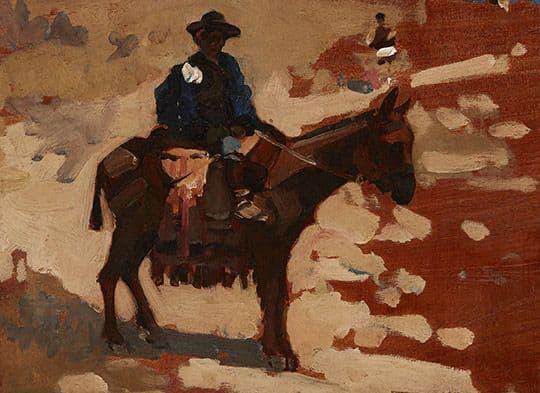
Melville travelled through Spain on many occasions from 1890 onwards. A notable barge trip on the Ebro river with Frank Brangwyn in 1892, for instance, led to sketches in the hillside towns on its banks, while other trips delivered paintings of bullfights, dancers and street scenes in Ronda, Seville, Córdoba, Granada and Toledo.⁴
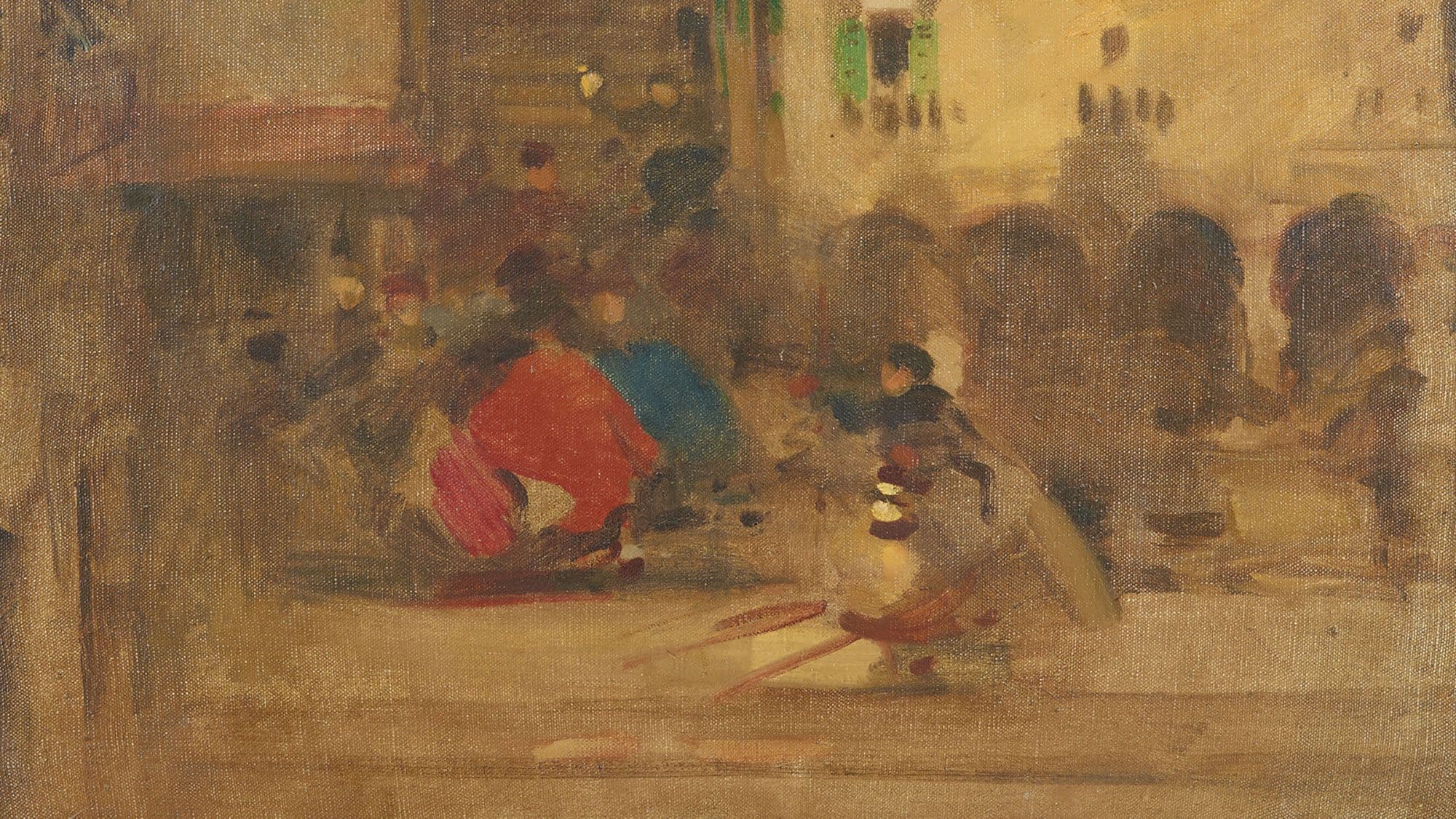
While further research may reveal a precise location for the present work and its companion, it is also entirely possible that the theatrical ensemble, hinted in the Simpson title, was intended.⁵ We could almost be looking at a stage set involving figures in capes and bicorne hats beckoned by the man with a lantern at a door on the flight of steps. Other figures are smudged in behind the Maja in the right foreground bearing a lighted lantern, and, glowing in the sky, an orange tower at the top of the steps has caught the firey evening sun. Melville states these details with impressive economy. He grasps and simplifies their essential shapes.⁶
There is flourish, without brazenness. A golden gloom envelops all. Here, as elsewhere, as his friend, Robert Macaulay Stevenson observed,
In a word, though he paints like a painter, and well at that, he seems never to lose sight that his art is the grave and serious expression of the mind of a man, not a mere material display of technical ability.⁷
Melville lived at a time when ‘Hispagnolism’ was a vibrant strand in British visual culture with its own extensive literature.⁸ While Thomas Cook was boasting new extensions to Spain’s rail network, supplied from Scottish engine works, the country itself was largely unscathed by modernity.⁹ Hence its romance for the artist-traveller. And while some were satisfied with a single visit to the Prado and a trip to a bullfight, Melville engaged in depth with Spanish culture recording its landscapes and regional types. If colourful folk were arriving in the local square to attend a carnival masquerade, he would wish to be there.
We are grateful to Professor Kenneth McConkey for writing this catalogue entry.