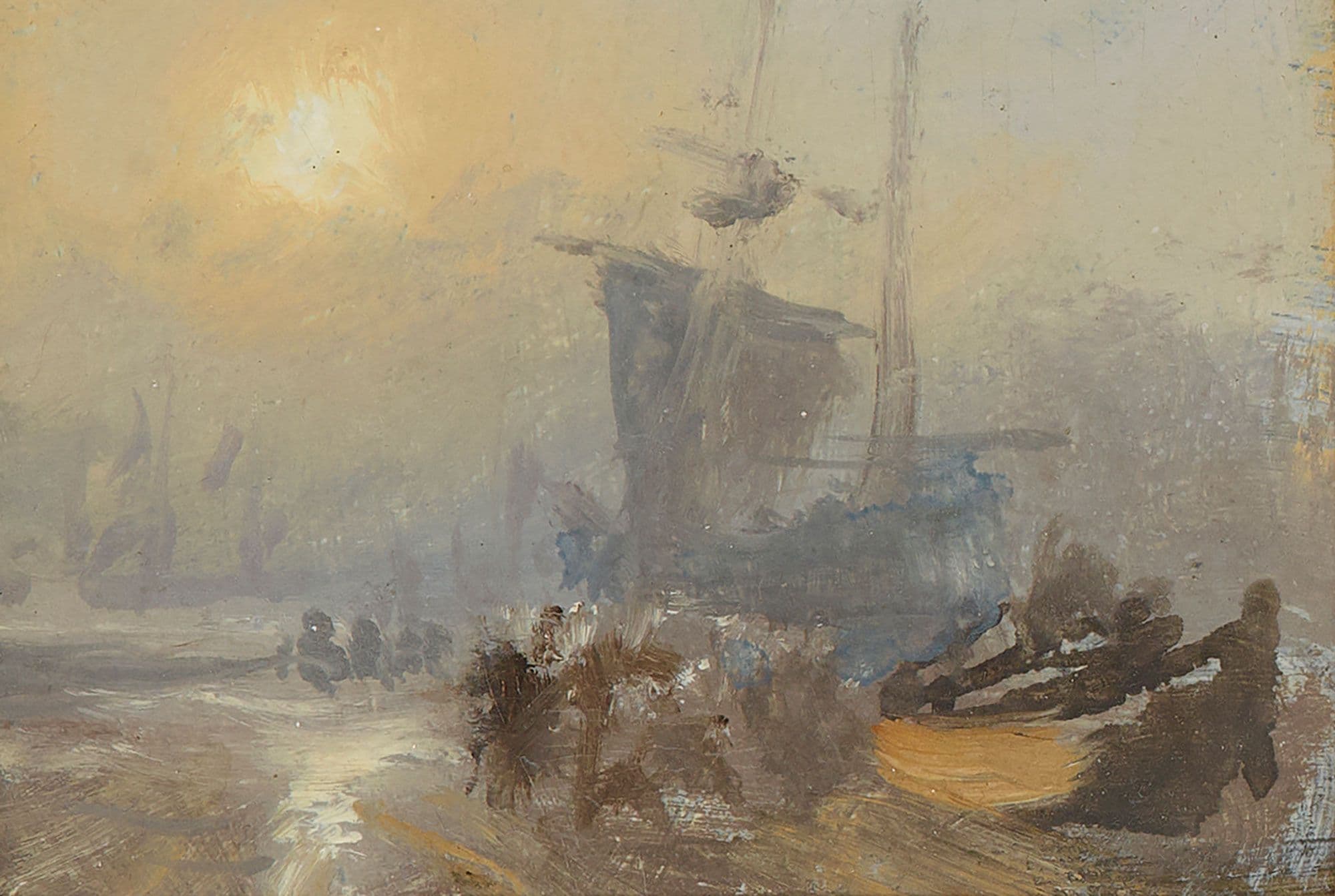
The first panel, likely a sunrise, shows a coastal scene characteristic of Bough’s lifelong interest in the small East Coast harbours. Ships in the middle distance and a rowing boat in the foreground create depth, while the luminous handling of light recalls works such as Dysart on the Fife Coast (1862), though the brushwork in this work is far more radical and experimental.
The second panel presents a summery pastoral landscape: rolling foothills, water to one side, and loosely rendered cattle. It recalls compositions such as Bough’s Borrowdale views and reflects his enduring fascination with mountainous terrain, from the Lake District to the Scottish Highlands. The scene was likely inspired by sketches made during his extensive travels in 1862.
In the third panel, an autumnal mood prevails. Mist drifts across a valley beneath distant, snow-capped peaks. Bough rarely painted wintry subjects, making this atmospheric treatment particularly striking, as he balances delicacy with dramatic impact.
The final panel shifts to urban Edinburgh, depicting a rain-soaked Princes Street animated by a military parade. Quick diagonal strokes suggest bayonets, lending energy and movement to the foreground. The viewpoint corresponds to known sketches by Bough and situates the scene near his George Street studio, with St Giles’ Cathedral visible in the distance.
The ensemble is documented in an 1863 letter from Bough to Macbeath, in which he describes “four sketches in the one frame” intended for the latter’s daughters, Anne, Helen and Eliza. With characteristic humour, Bough proposed that the panels should belong to whichever daughter married first. Anne eventually fulfilled this condition in 1874, becoming the rightful owner.
Bough’s warm relationship with the Macbeath family is well attested in his correspondence from 1862 to 1877. He frequently stayed with them in London and maintained an affectionate interest in the daughters, whom he dubbed “the three Graces.” His letters reveal both familiarity and playfulness, offering a glimpse into the personal context behind this extraordinary and highly individual work.
The inscription on the work reads,
“Sam Bough to the Misses Macbeath - Memorandum by the donor. This picture is to be the property of the first Miss Macbeath who changes her surname by the Holy Contract of Matrimony - and it is earnestly entreated by Mr B. that the young ladies wont [sic] fall out and fight about it.”