Ruyi Sceptres in Buddhism and Daoism
During the Tang and Song dynasties, ruyi sceptres took on a new role as ritual implements in Buddhist and Daoist ceremonies.
With a renewed interest in Confucian ideology from the Song period, sceptres became increasingly associated with Daoism. Their heads were often rendered in the form of the lingzhi fungus, itself an important Chinese symbol associated with longevity and immortality.
The ruyi subsequently became increasingly ornamental, produced in a wide range of forms and materials and used as a secular symbol of good fortune as well as a ceremonial object.
Ruyi Sceptres During the Ming and Qing Dynasties
By the Ming dynasty, ruyi sceptres were often exchanged as gifts among members of the official gentry.
Their status became particularly significant during the Qing dynasty, especially from the reign of the Yongzheng Emperor onwards. Ruyi could be bestowed by the emperor upon officials and loyal subjects as marks of favour and recognition.
Foreign dignitaries could also receive them. In 1793, during the first British embassy to China, the Qianlong Emperor presented ruyi including a famous jade example associated with King George III and members of the embassy.
Both the Yongzheng and Qianlong emperors were depicted holding ruyi, but Qianlong was particularly associated with them and assembled an extensive collection. A number were subsequently included in the Royal Academy of Arts exhibition China: The Three Emperors, 1662–1795 in London in 2006.
Jade Ruyi Sceptres
Jade was particularly suited to the auspicious and prestigious nature of the ruyi, although exceptionally large examples required substantial pieces of high-quality stone.
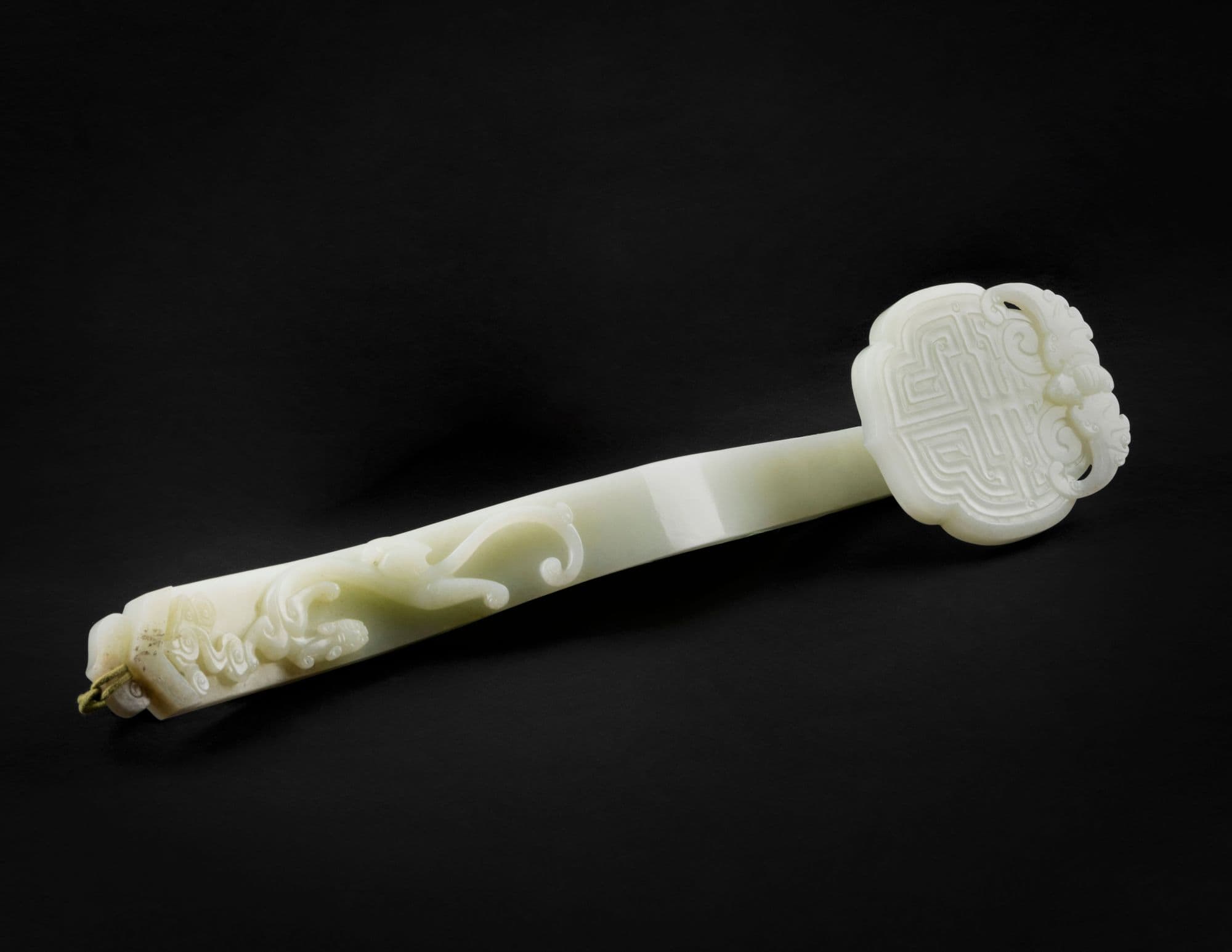
A large pale celadon jade 'chilong and bat' ruyi sceptre handled by Lyon & Turnbull demonstrates the remarkable quality achieved by Qing dynasty craftsmen.
Dating to the 18th century, the sceptre was exceptional for both its scale and the quality of its pale celadon jade, enhanced by areas of russet staining. Its finely carved decoration combines several auspicious motifs.
What Do the Symbols on a Ruyi Sceptre Mean?
The decoration found on ruyi was rarely arbitrary. Motifs could reinforce the auspicious meaning of the object itself.
On the 18th-century jade example above, a bat and shou character appear together on the head of the sceptre. Together they form an auspicious rebus for Fu Shou, conveying wishes for happiness, prosperity and longevity.
Bats are particularly significant within Chinese art and symbolism because the Chinese word for bat, fu, is a homophone associated with good fortune. The shou character represents longevity.
Comparable Qing dynasty jade sceptres decorated with bats and shou characters are held in the collection of the National Palace Museum, Taipei.
Another comparable example, dating to the Qianlong period, featured five bats surrounding a stylised shou character. Formerly in the collection of His Highness Maharaja Sir Padma Shumshere Jung Bahadur Rana and gifted by Chiang Kai-shek in 1945, it was later sold at Sotheby's London in 2013.
Ruyi Sceptres in Different Materials
Not all ruyi were carved entirely from jade. A 19th-century Qing dynasty example handled by Lyon & Turnbull combined hongmu with silver wire and three spinach-jade plaques. Two plaques were decorated with hardstone-inlaid figures in garden settings, while another depicted antiquities. The wooden shaft was further embellished with different forms of the shou longevity character.
Such objects demonstrate how ruyi could bring together several prestigious materials and decorative techniques within a single work.