Bracelets, Chains and the Art of Display
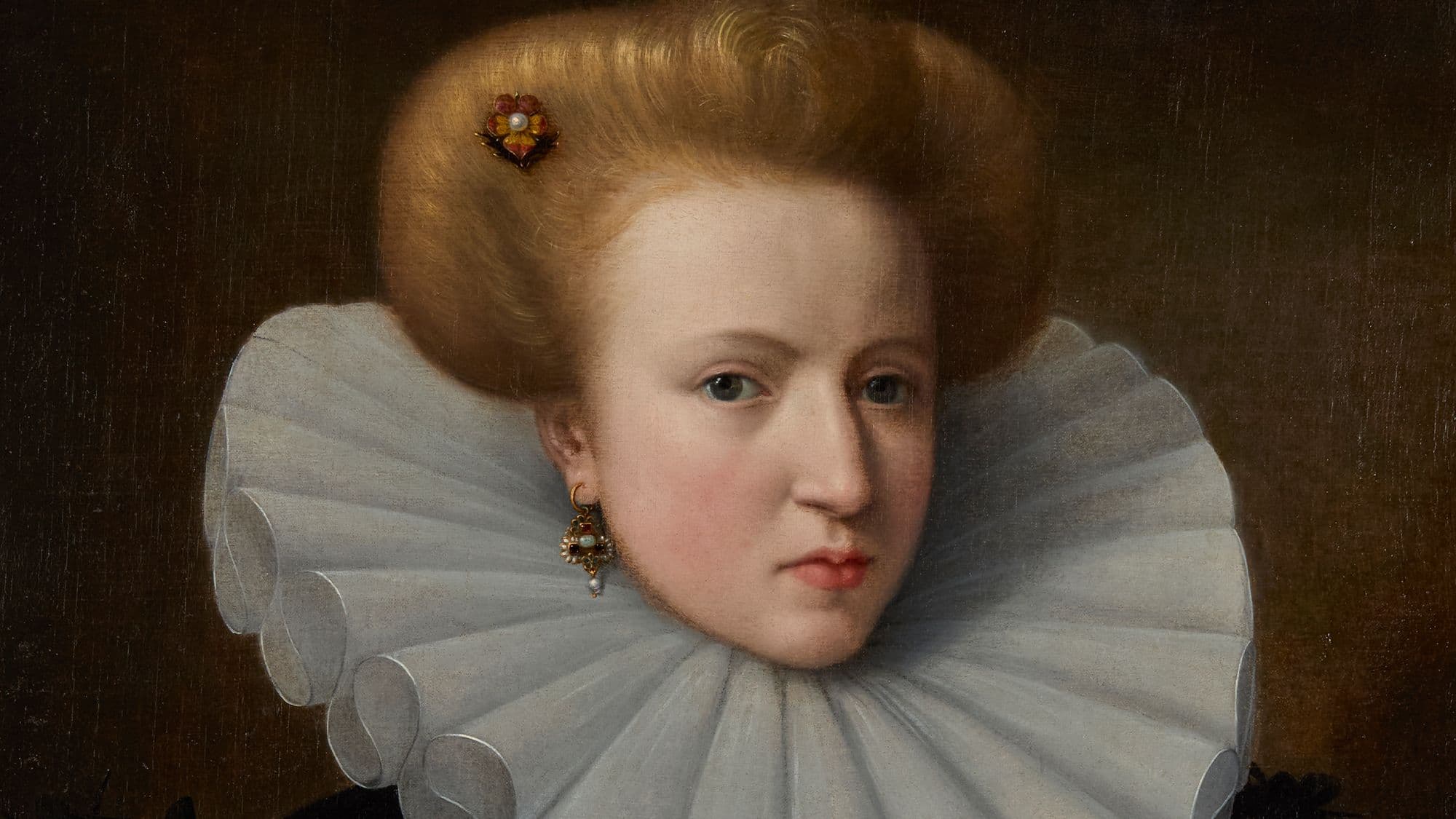
The rich accessories of the sitter certainly support her noble status, with jewels fashionably adorning her figure at every opportunity. The angle and pose of the sitter mean that the adornment to only one ear is visible, and the same can be said of her wristwear, with a gold bracelet peeking out from below the lace cuff at her wrist. As with earrings, the fashion in Renaissance Europe was to wear bracelets in pairs, with such wristwear worn by men and women alike. Some relics of the time can still be seen as a pair, the most lovely cased together within fitted boxes.
To the centre of the portrait, and perhaps the most intriguing of the noblewoman’s jewels is a lengthy knotted gold chain emerges from below the collar of the sitter, held aloft in her hand and terminating in an impressive oval pendant. Heavy chains were a popular feature of the time, often arranged neatly in place. It is believed that springs were utilised to maintain the position of chains on the chest, though few have survived the ravages of time.
The careful placement of the chain within the hand of a sitter is a purposeful artistic device, utilised skilfully to draw our eye to the chain and pendant, indicating its significance. Of a similar vein, Van Dyke can be seen posing with his gold chain symbolically raised in the celebrated Self-Portrait with Sunflower.
The Pendant: Craftsmanship and Symbolism
Whilst the finer details of the pendant worn by our sitter are unclear, the beauty and intricacy of the piece are unmistakeable. The centre of the pendant appears to bear the illustration of an animal – perhaps a lamb or a horse – and may be a work in enamel, a cameo, or even a pearl.
The lamb of God, known as the Agnus Dei, seems the most likely subject matter of the motif. The fashion of adornment with such Catholic devotional imagery in the region can be attributed in no small part to the influence of the Spanish Empire, which impacted all aspects of life in Europe - political, religious, cultural and artistic - during the reign of the Habsburg dynasty (1516-1700).
The Agnus Dei motif was a recurrent symbol of the time, typically depicted as a lamb bearing a cross or banner, and appeared on pendants, lockets, and other personal ornaments crafted in gold and enamel. More than just a beautiful accessory, or a showcase of craftsmanship, such a piece could further serve to function as a symbol of faith and a marker of cultural identity.
The central motif is set within colourful details which look to be enamel, within an outer border with pearl details and a delicate pearl drop. The commissioning of such a piece would in itself signify the wealth of the sitter, and the artist and sitter would understandably have gone to great lengths to bring it to the attention of the viewer. Surviving examples of Renaissance pendants such as that illustrated are both rare and prized, with examples now best spotted in museum collections, such as the Fettercairn Jewel in the National Museum of Scotland.