How Patek Philippe Became Known for Complications
Complicated watches have been part of Patek Philippe's identity since its earliest years. Among its important achievements was the creation of an early perpetual calendar wristwatch in 1925. During the following decades, the company developed watches combining increasingly sophisticated functions, including chronographs and perpetual calendars.
This period helped establish a field in which Patek Philippe, Audemars Piguet and Vacheron Constantin would become closely associated with the highest levels of Swiss complicated watchmaking.
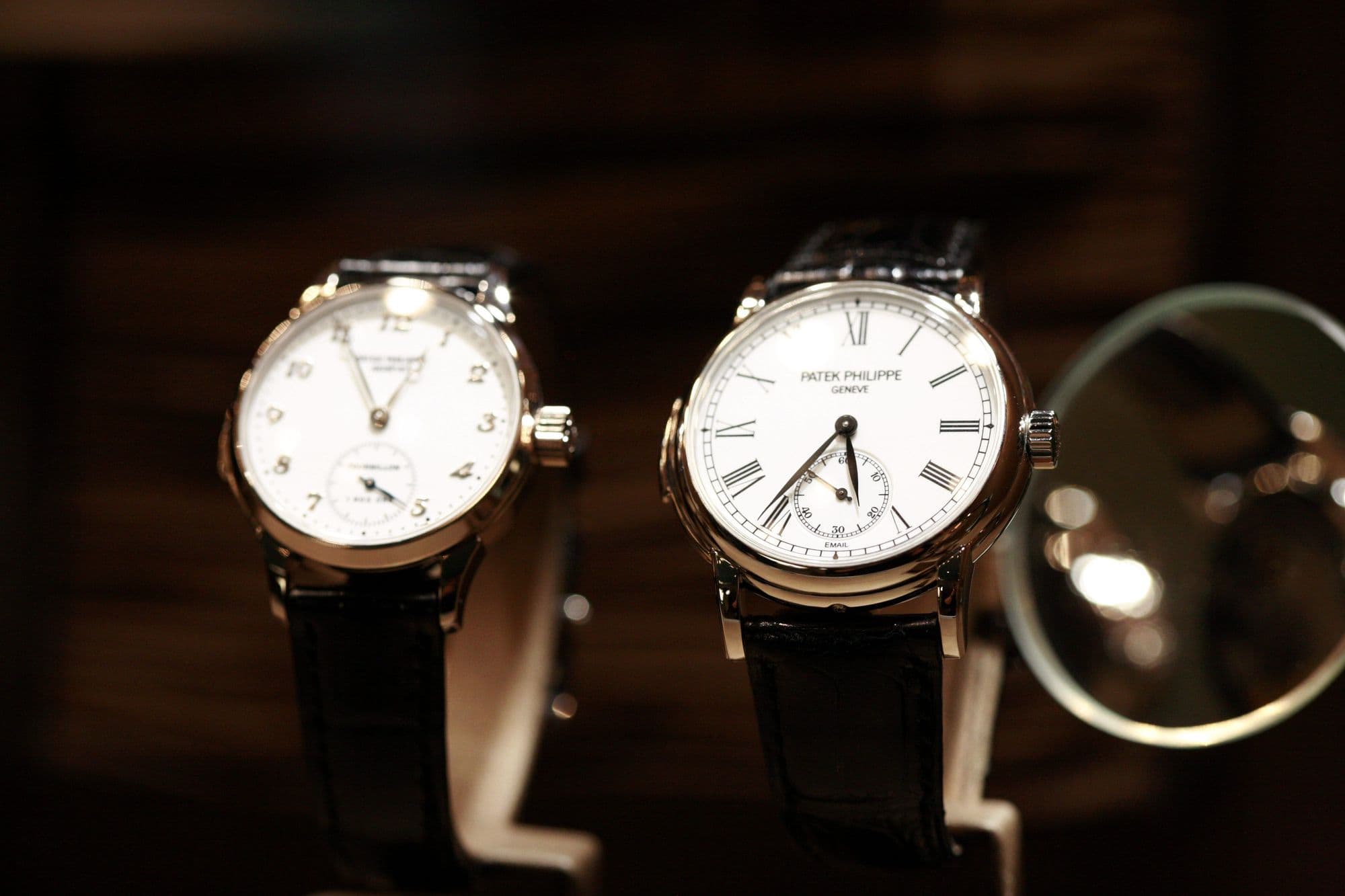
Today, minute repeaters, perpetual calendars, split-seconds chronographs and astronomical indications remain an important part of Patek Philippe's Grand Complications collection.
The Golden Age of Patek Philippe Watches
For many collectors, the 1940s and 1950s represent a particularly important period of Swiss watchmaking. Patek Philippe produced some exceptional watches during these decades, from complicated wristwatches to comparatively simple rectangular dress watches.
The quality of the manufacture's rectangular watches from this period are particularly interesting, many of which used the Calibre 9-90. Decades later, surviving examples can still demonstrate the quality of Patek Philippe's movement construction during this period.
For collectors today, however, reference alone does not determine desirability. The condition of the case, originality of the dial and movement, previous restoration and provenance can all significantly affect how a vintage Patek Philippe is assessed.
How the Nautilus Changed Patek Philippe
By the 1970s, Swiss watchmaking looked very different. Audemars Piguet had introduced the Gérald Genta-designed Royal Oak in 1972, challenging conventional ideas about what an expensive Swiss watch should look like.
Four years later, Patek Philippe introduced Genta's Nautilus Ref. 3700. Launched in 1976, the Nautilus combined stainless-steel construction with an integrated bracelet and a case design inspired by a ship's porthole. Its original advertising emphasised the unusual versatility of such an expensive steel watch, positioning the Nautilus as something that could move between formal and sporting environments.
That concept now seems familiar. In the 1970s it was considerably more radical. The Nautilus went on to become one of Patek Philippe's most recognisable watches and an important part of the modern luxury sports watch market.
How Patek Philippe Surpassed the Graves Supercomplication
Patek Philippe returned to the pursuit of extreme mechanical complexity for its 150th anniversary in 1989. The result was Calibre 89. Containing 33 complications and 1,728 components, Calibre 89 surpassed the Henry Graves Supercomplication that Patek Philippe had completed more than half a century earlier. Its functions extended far beyond conventional timekeeping and demonstrated how far mechanical watchmaking had developed since the Graves watch of 1933.
There is a pleasing symmetry to the achievement: the company that had produced one of the great complicated watches of the early 20th century ultimately surpassed its own benchmark.
The Advertising Campaign That Changed Patek Philippe
Not every important moment in Patek Philippe's history happened at a watchmaker's bench. In 1996, Patek Philippe launched its Generations advertising campaign with London agency Leagas Delaney.
Its central idea was simple: a Patek Philippe was presented not simply as something purchased and owned, but as something looked after before eventually passing to another generation. The campaign connected particularly well with something already inherent in mechanical watches: they can outlive their original owners.
That idea remains closely associated with Patek Philippe decades later and helps explain why provenance, family ownership and original documentation can carry such interest when older watches appear at auction.
What Defines Patek Philippe?
Looking across nearly two centuries of Patek Philippe, there are several recurring characteristics.
- Technical ambition: From Jean Adrien Philippe's keyless winding system to the Graves Supercomplication and Calibre 89, innovation has repeatedly shaped the company.
- Understated design: Watches such as the Calatrava demonstrate that importance does not necessarily depend upon complexity.
- Movement quality: Well-preserved vintage movements can reveal an exceptional standard of construction decades after they were produced.
- Independence: The Stern family's ownership since 1932 has given Patek Philippe unusual continuity among major Swiss manufacturers.
- Versatility: The arrival of the Nautilus showed that the company's identity could extend beyond traditional dress watches and complications.
Which Patek Philippe Watches Are Most Important to Collectors?
There is no single Patek Philippe model that defines the entire manufacture. The Calatrava represents its tradition of restrained dress watches. The Nautilus represents its impact on the luxury sports watch. Vintage perpetual calendars and chronographs demonstrate its expertise in complicated wristwatches, while pieces such as the Ref. 3960 show how Patek Philippe has used commemorative and limited production watches.
For collectors, individual references can differ enormously in rarity and value. Condition, originality, case material, dial configuration, provenance and accompanying documentation can all matter. Understanding the reference is therefore only the beginning.