A Collection Built with Patience
Great collections are rarely assembled quickly. For the collector behind A Passion for Glass, acquiring a piece could be the culmination of a lengthy search. Rather than buying simply to fill a gap, he waited for the right model in the right colour and condition. That approach shaped the collection for more than 30 years.
Each prospective acquisition was subjected to careful consideration. Design and rarity mattered, but so too did the sharpness of the moulding, richness of colour, quality of finish and overall condition. If an example did not meet those standards, the search continued.
Consequently, the collection is not intended to represent Lalique through sheer breadth. Instead, it reflects the collector's pursuit of particularly accomplished examples of individual designs.
The Many Faces of Lalique Glass
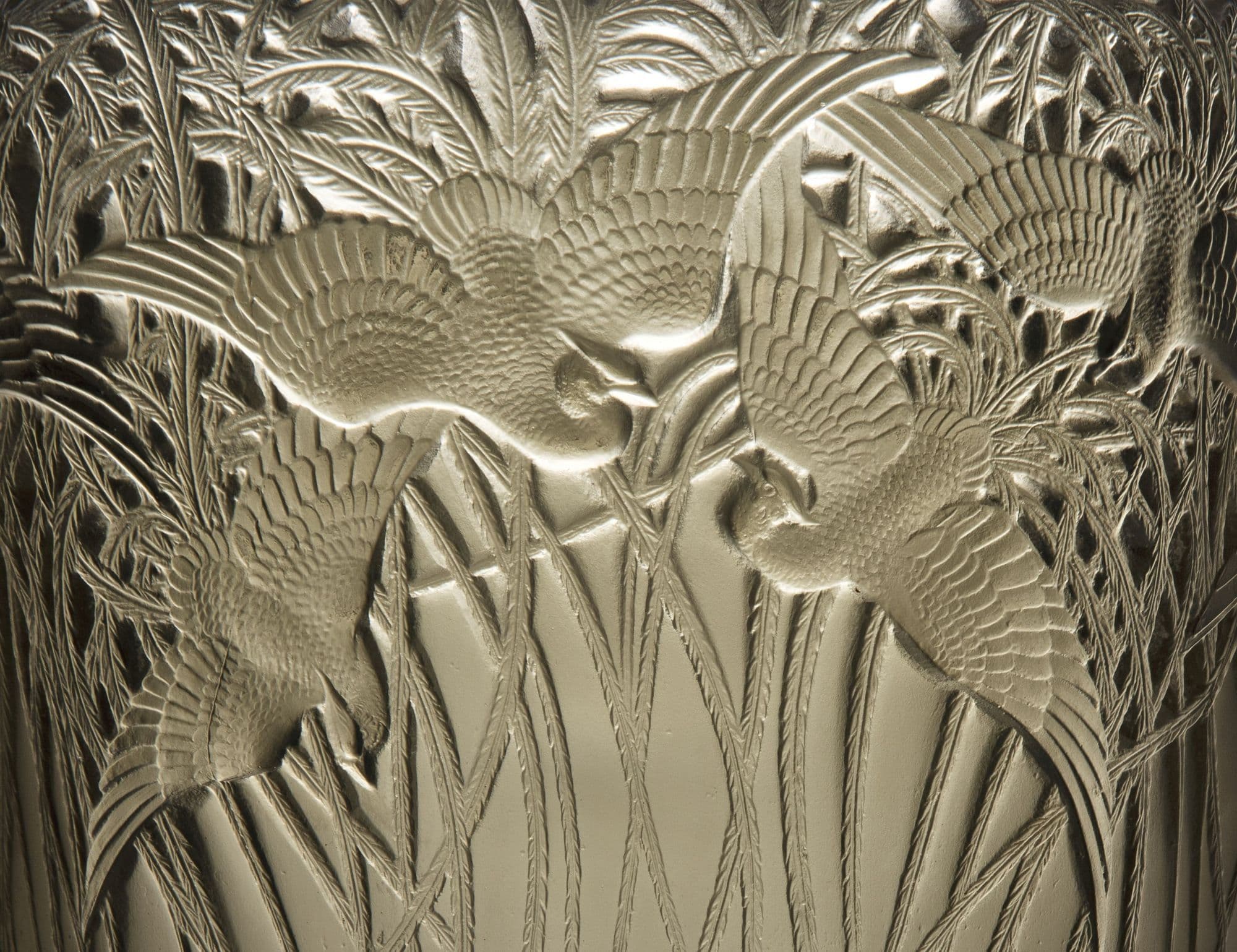
The collection demonstrates the extraordinary variety René Lalique achieved in glass. Clear and frosted works reveal the precision of his moulded designs, while staining brings definition and contrast to their surfaces. Elsewhere, opalescent glass transforms as light passes through it, and strongly coloured examples demonstrate another side of Lalique's experimentation with the material.
Nature, one of Lalique's richest sources of inspiration, appears repeatedly. Flora and fauna are translated into surfaces that can be delicate, highly stylised or dramatically sculptural. Across the collection, these designs appear not only on vases but on smaller and more intimate objects, from scent bottles and boxes to car mascots, statuettes and timepieces. Together, they demonstrate why Lalique's work cannot be understood through one form or technique alone.
The Search for the Right Example
Perhaps the most revealing aspect of A Passion for Glass is the way individual pieces were acquired. There was genuine anticipation attached to finding them. A purchase might follow a long period waiting for a particular model to appear, followed by careful consideration of whether that example was sufficiently good to join the collection.
When the right piece finally emerged, it represented much more than another acquisition. It was the end of a search. That distinction is important. Experienced collectors often become increasingly selective as their knowledge develops. Subtle differences in colour, definition, staining and condition begin to matter enormously.
For Joy McCall, Lyon & Turnbull's Lalique & Design specialist, the collection demonstrates why two examples of the same Lalique model should never automatically be regarded as equivalent.
The strength and distribution of colour can alter the character of a design considerably, particularly in opalescent and coloured glass. The definition of moulded decoration is equally important: crisp detail can allow the complexity of Lalique's design to be appreciated as originally intended.
Condition must also be considered alongside rarity. An especially scarce model may remain highly desirable despite imperfections, while collectors presented with several examples of a more readily available design can afford to be much more selective. Staining, finish, signatures and other details can all contribute to understanding an individual piece.
Above all, the collection demonstrates the importance of looking at the object itself rather than collecting by model number alone.
Highlights from the Collection
Several works from A Passion for Glass demonstrate the exceptional standard the collector sought.
The Tortues vase, no. 966, designed in 1926, combines clear and frosted glass with grey and blue staining. Its sculptural surface helped make it one of the outstanding works from the first offering of the collection, selling at Lyon & Turnbull for £22,860 including premium.
Another important example was the Aras vase, no. 919, designed in 1924. Executed in deep amber glass with white staining, its rich colour and commanding form exemplify the more dramatic side of Lalique's interwar production. It realised £20,320 including premium.
The Serpent vase, no. 896, also designed in 1924, uses clear and frosted glass with grey staining to transform the coiled serpent motif into the structure and surface of the vessel itself. It also sold for £20,320 including premium.
At a more intimate scale, the Pervenches box, no. 82, designed in 1929 in cobalt blue glass with white staining, realised £3,302 including premium.
These objects are very different in scale, colour and purpose, yet each reflects the same principle that guided the collection: waiting for an example worthy of acquiring.
More Than Three Decades of Connoisseurship
Ultimately, A Passion for Glass is as much a story about collecting as it is about Lalique.
Over more than three decades, knowledge, patience and personal taste shaped a group of works chosen individually and deliberately. Each acquisition represented another successful search, but also another refinement of the collector's understanding of the field. Seen together, the collection reveals the rewards of that approach.
It is not simply an assembly of Lalique objects. It is a record of sustained connoisseurship and of the pleasure that can come from waiting, sometimes for years, for precisely the right piece.
For a collection formed through the pursuit of excellence, that feels like an appropriate legacy.