
In the Victorian age, Edinburgh continued to grow. The New Town was flourishing, the professional classes were growing, and with them came a demand for auctioneers who could handle everything from elegant townhouses to fine collections. It was during this period that William Lyon, son of founder Jonathan Lyon, made a choice that would set the course for the company we know today as Lyon & Turnbull.
OUR 200 YEAR HISTORY
A Growing Firm | Lyon & Turnbull in the Victorian Age
25 November 2024
Lyon & Turnbull
From Dowells to Independence
By the 1850s, William Lyon had already proved himself capable. He had worked alongside his father Jonathan in the family business and later with the respected Edinburgh firm Dowells, where he gained experience in higher-value sales and the fast-paced world of property auctions.
But in 1863, Lyon took a bold step. He ended his partnership with Dowells and looked to the future. His decision opened the door to an alliance that would define the next chapter of his career.
Meeting William Elliot Turnbull
Around this time, William Lyon joined forces with another ambitious auctioneer, William Elliot Turnbull. Born in Roxburghshire in 1830, Turnbull had started at Dowells as a clerk before working his way up to partner. He brought with him a keen eye for business, a drive for expansion, and a strong network in Edinburgh’s professional community.
Together, the two Williams shared both ambition and complementary skills, a recipe for a partnership that would last well beyond their lifetimes.
George Street Hall: A New Saleroom
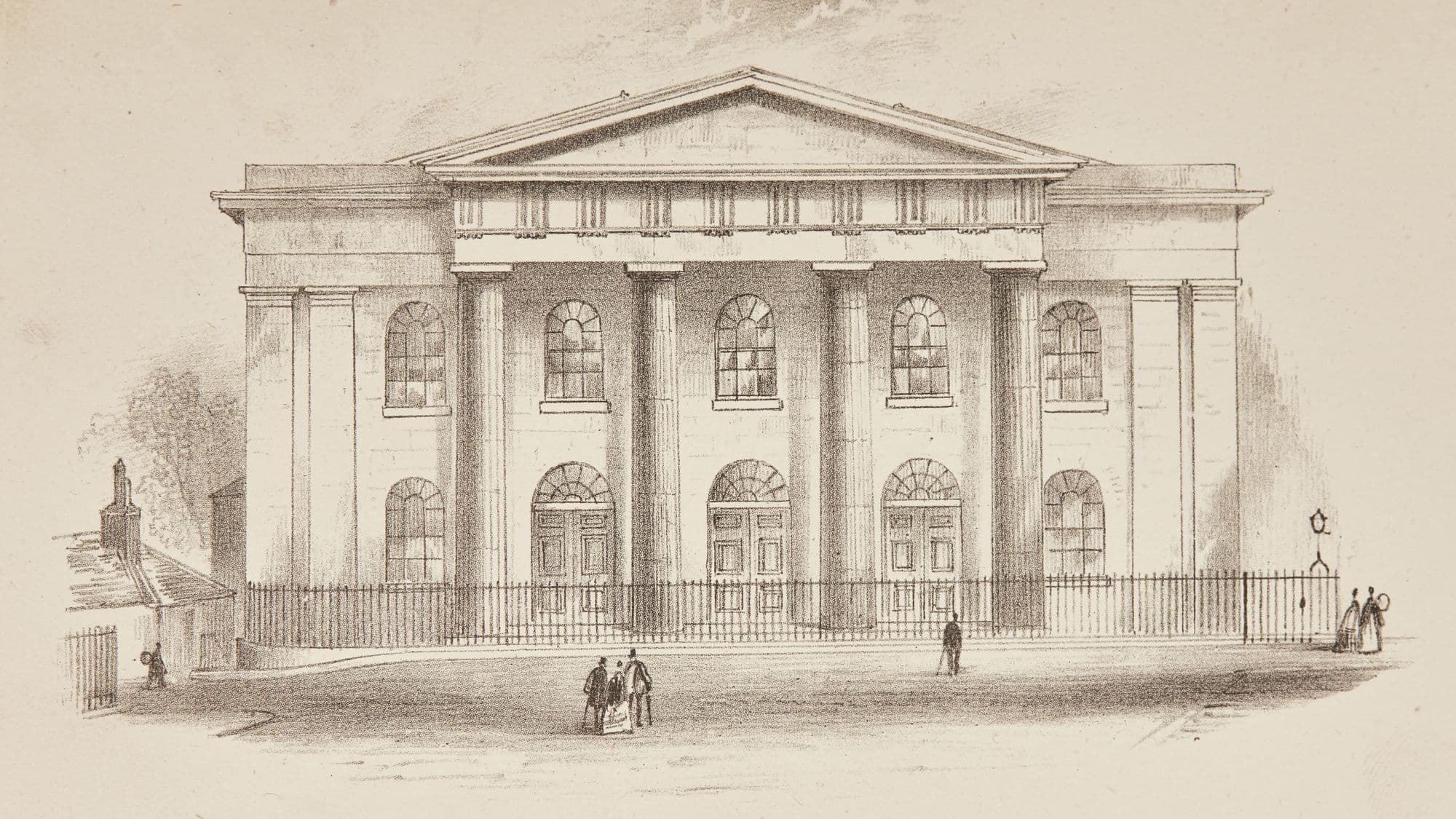
One of the defining moments in the firm’s early development came in 1864, when Lyon & Turnbull leased George Street Hall at 51 George St as its saleroom. The hall had previously been unavailable due to military use, but once the threat that required its occupation had passed, the space became available. Lyon & Turnbull adapted it for auctions, and remarkably the gallery remained largely unchanged for more than a century, until the firm finally left the building in 1999.
...the most unique and recherché collections of ornamental and decorative art ever exposed for public competition in this city.
Collections by Lyon & Turnbull in 1868
Edinburgh & Beyond
Edinburgh may have been home, but Lyon & Turnbull was never isolated. International dealers, including London-based curiosity specialists like Benjamin Benjamin, regularly consigned objects to the firm.
In these early decades the firm handled a remarkable variety of objects, reflecting the Victorian enthusiasm for collecting and curiosity. The sale of Benjamin Benjamin's collection in 1868 was described as “one of the most unique and recherché collections of ornamental and decorative art ever exposed for public competition in this city.”
Among the highlights was an ebony cabinet inlaid with ivory and carved with medallions showing scenes from the life of Adam and Eve alongside mythological pictures attributed to Albano. The catalogue emphasised their quality to reassure buyers, reflecting how Victorian collectors in Edinburgh and London alike expected the very highest standards.
Unusual objects passing through the saleroom often attracted press attention. In 1875, newspapers reported that Lyon & Turnbull had auctioned what was described as a relic of the famous explorer Dr David Livingstone - a small tin basin and two saucers said to have been used during his travels in Africa.
Jewels with International Provenance
Precious stones also featured prominently. In 1859, Lyon & Turnbull sold a dazzling collection of jewels and pearls, including forty-four large Oriental pearls weighing 735 grains, which fetched £780.
Such lots drew buyers from across Britain, with London dealers, including the eminent Rothschild, travelling north to attend. For a Scottish firm, attracting these kinds of bidders showed not only reach but reputation.
A Transnational Marketplace
These auctions reveal something important: Lyon & Turnbull’s salerooms were not just Edinburgh affairs. They were stages where global trade, European decorative arts, and Scotland’s appetite for collecting came together.
Far from being confined to its city of origin, the firm played a transnational role, connecting Scotland’s collectors to the wider world long before modern transport and communication made it commonplace.
Continuing Down the Generations
By the 1880s the next generation had joined the business, with both sons of the two Williams entering the firm. Expansion continued in 1887, when Lyon & Turnbull purchased 50–54 Thistle Street as warehouse premises and the adjoining Thistle Street Hall as an additional sale room.
To link the new buildings with the George Street premises, a bridge was constructed across South West Thistle Street Lane, a bridge still exists today, quietly connecting the two sites as it has for well over a century.
Some of the objects sold during this period also carried powerful historical associations. In 1888, the firm sold a gold cross pendant set with pearls and rubies, reputed to be a relic of Mary, Queen of Scots. It was purchased by the wine broker Francis Gibson for £55.
Around the same time the firm sold a study for Painting the Legend by George Paul Chalmers for thirty-eight guineas. Today that work forms part of the collection of the National Galleries of Scotland, showing how objects that once passed through the auction room can later find their way into national collections.
When William E. Lyon died in 1895, his obituary described him as not only a capable businessman but a man of courtesy and amiability who was widely admired. Under his leadership the firm had grown considerably and had even opened its own Fine Art Gallery.
The Legacy of the Two Williams
The importance of the Lyon-Turnbull partnership cannot be overstated. It combined Lyon’s practical experience and established reputation with Turnbull’s drive and modern vision. Together, they laid the groundwork for a business that would not only survive for generations but still thrives today, nearly two centuries later.
[Years 1826 - 1900]