Within its hubbub he discerned the plaintive sounds of the oud (lute) and bendir (snare drum), drawing him to one of the oldest of Eastern subjects, with a strong appeal to western collectors. He knew from his friends, Harrington Mann, Joseph Crawhall and Arthur Melville that the dance rituals accompanying such sounds, were strictly private, yet unlike other North African towns, in cosmopolitan Tangier – of great strategic importance to the ‘Great Powers’ of Europe and North America – more relaxed attitudes were sometimes possible.
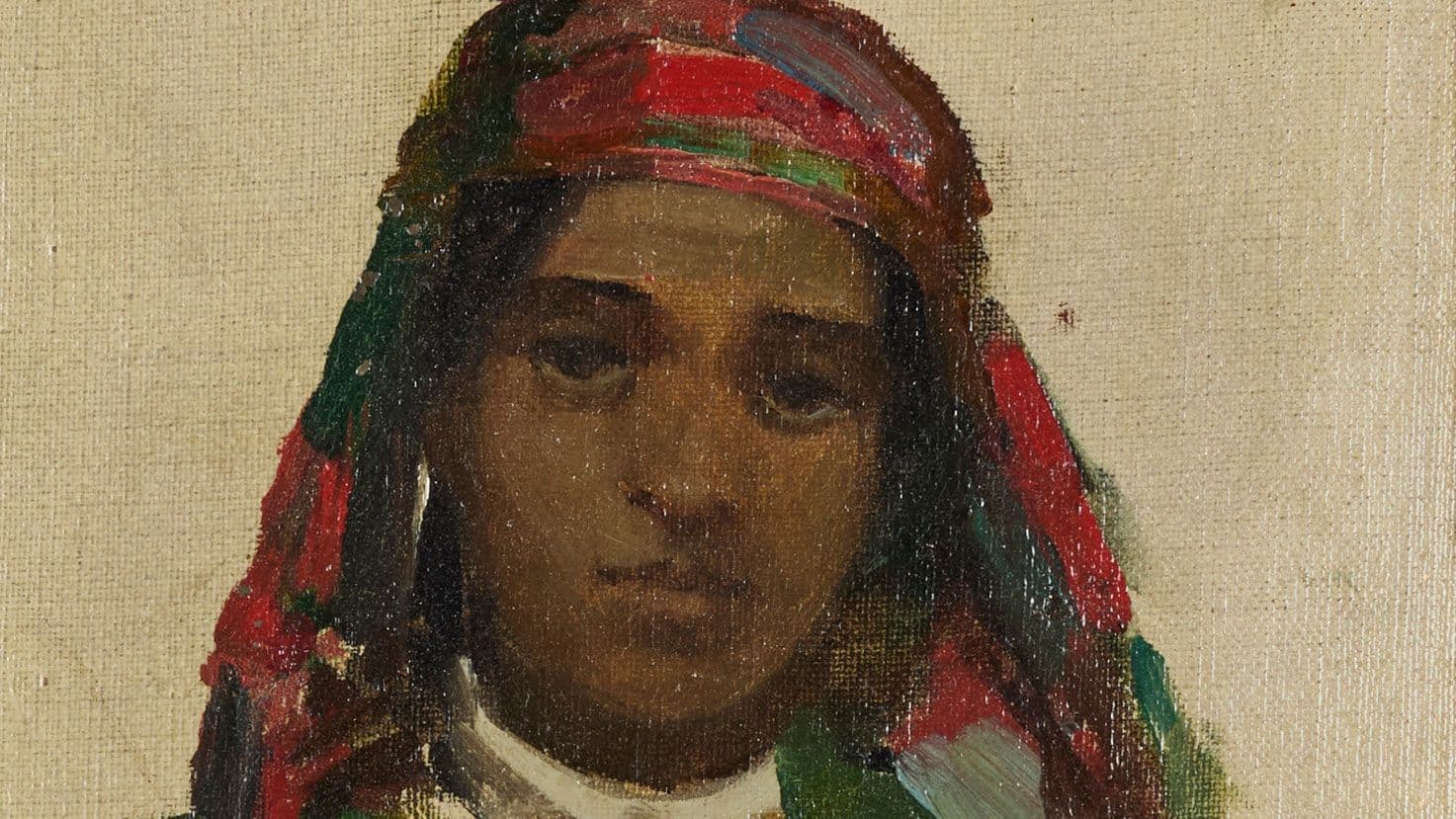
Young women would furtively shed their modesty, remove their face-veils and pose for the painter. Speed, nevertheless, was of the essence, for this remained a covert activity with possible jeopardy.² Lavery’s objective, discussed with his Glasgow dealer, Thomas Lawrie, was to paint A Moorish Dance (Private Collection), a large canvas for the Royal Academy summer exhibition in 1893. For this he required eye-witness notes of musicians to accompany the principal dancer. Two groups of sketches supported this project in the 1892 visit – one in which the dancer is dressed a white jellabiya, while in the second she wears a green kaftan trimmed in gold brocade, as in A Moroccan Girl.³
There is great satisfaction in the ‘blocking-in’ of costume, and the mastery with which the girl’s features are caught in a trice. The richer palette of greens and golds was preferred for the Academy painting, while in October 1893 all the recent sketches – fifty in total, shown as ‘pictures of Spain and Morocco’ – were brought together for an exhibition at Lawrie’s Gallery in St Vincent Street, Glasgow. A critical success, The Glasgow Herald praised the ‘charm of truth and spontaneity’ in the works, concluding that the show’s accumulated effect ‘was a liberal education’.⁴ A Moroccan Girl is likely to have been one of the fifty.⁵
We are grateful to Professor Kenneth McConkey for writing this catalogue entry.
- Selwyn Brinton MA, ‘An English Artist in Morocco’, The Connoisseur, vol. XIX, no. 73, September 1907, p. 37, describing Lavery in Morocco.
- Elsewhere in Morocco an unveiled model betrayed to the authorities was cast into prison; see Kenneth McConkey, Towards the Sun, The Artist Traveller at the Turn of the Twentieth Century, 2001 (Paul Holberton Publishing), p. 161.
- See Kenneth McConkey, John Lavery, A Painter and His World, 2010 (Atelier Books, Edinburgh), pp. 60-63, 220 (notes 63 & 64, listing other studies). The Academy painting was subsequently reworked c. 1910.
- The catalogue or handlist for this exhibition appears not to have survived, although it was reported fulsomely in The North British Daily Mail, 5 October 1893, p. 2 and The Glasgow Herald, 6 October 1893, p. 3.
- Whilst not inappropriate, it is likely that A Moroccan Girl is not the original title of the present work.
Ilustrated above: M0KC0B Tangier, from the south west, Morocco, c.1900. Public domain sourced / access rights from Pump Park Vintage Photography / Alamy Stock Photo