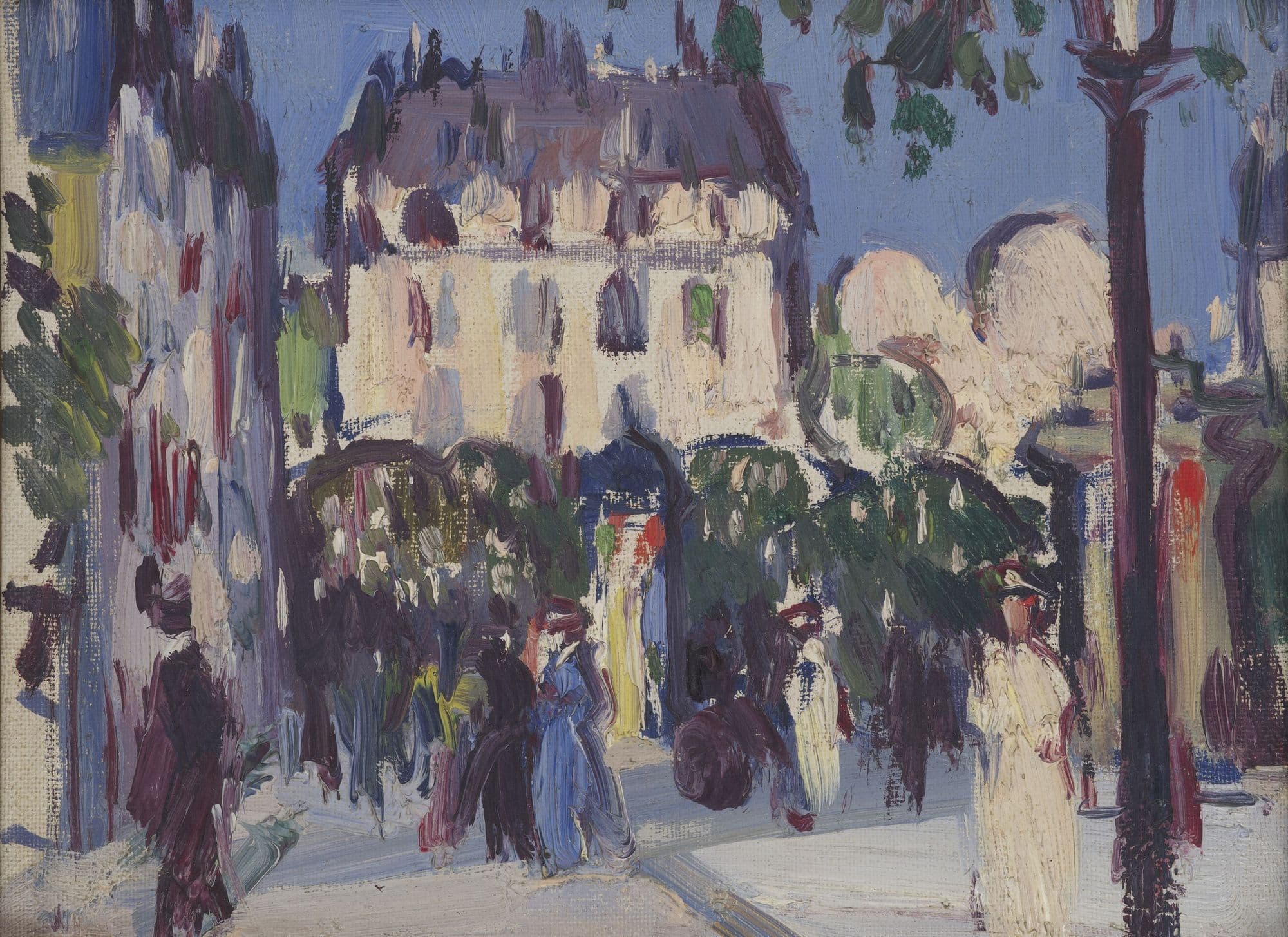
Place de l’Observatoire by the Scottish Colourist John Duncan Fergusson is a gem of a painting from a celebrated series of street scenes that he made after moving to Paris in 1907. It formerly belonged to the important collector Dr Jim Thomas Rankin Ritchie (1908-98) of Edinburgh and was on loan to the National Galleries of Scotland for over 20 years. This December it will feature in our upcoming Scottish Paintings & Sculpture auction.

‘The Scottish Doyen of Modern Art’: Place de l’Observatoire by John Duncan Fergusson
27 November 2025
Alice Strang
Born in Leith near Edinburgh, Fergusson settled in the French capital following the start of his relationship with the American artist Anne Estelle Rice (1877-1959). He declared ‘Paris is simply a place of freedom’ and rented a studio in Montparnasse, the renowned artists’ quarter. As seen in Place de l’Observatoire, Fergusson became swept up in the inspiration of Paris’s pre-First World War art world, as he absorbed and evolved the latest developments in the works of artists including Pablo Picasso, André Derain and Henri Matisse. The present work and its fellows were painted spontaneously, in situ, as Fergusson gloried in his new surroundings; those seen here depict an area near the Observatory founded by Louis XIV in 1667 on the Left Bank of the Seine.
Deft brushstrokes outline people, trees, buildings and street furniture, such as the anchoring lamp post on the right of the composition. Highlights of colour including the blue of the full-length dress of the woman at the centre of the image, provide rhythm across the work’s surface. The leaves which enter from the upper right partner with the depth of view realised behind them to create a sophisticated perspective in which buildings are seen from the side as well as straight on, whilst the scene is illuminated throughout by the idyllic blue sky. Passages such as the short strokes of green at the far left and the suggestion of foliage across a mid-vertical, verge on the abstract, revealing Fergusson’s newfound confidence and innovative approach to his work. This was to result in his election as a Sociétaire of the progressive Salon d’Automne in 1909, in recognition of his contribution to the modern movement.
Jim Ritchie was a teacher, writer and film-maker. He began collecting in 1928 when he visited Fergusson’s solo exhibition at Alex. Reid & Lefèvre in Glasgow and purchased several works directly from the artist. Their relationship developed, not least as related in a story enjoyed by friends and family alike about how:
…having skipped school because of a migraine, his mother hoping that art might allay it, told him of a sale of pictures in Glasgow and he duly attended. When leaving the saleroom with his purchases tucked under his arm, J. D. Fergusson stopped him and asked what he had bought and on seeing all four of his works, remarked, ‘that’s a very good one, that’s a very good one, that’s a very good one, and that’s a very good one’…[Ritchie’s mother]…was more succinct in her remark to her son about his extravagance, ‘for goodness sake, dinnae take another heidache’.
Margaret Longstaff, ‘Reflections from the Golden City’, Scottish Book Collector, 1998
From this starting point Ritchie amassed a distinguished collection of modern Scottish art, including examples by Fergusson’s fellow Scottish Colourists F. C. B. Cadell and S. J. Peploe and Fergusson’s wife Margaret Morris, as well as many other leading artists of the twentieth-century including John Bellany, Elizabeth Blackadder, Robert Colquhoun, Joan Eardley, William Gillies, Robert MacBryde, William MacTaggart and Robin Philipson.
It is thought that Ritchie acquired Place de l’Observatoire when it was included in Fergusson’s last lifetime solo exhibition, held at the Annan Gallery, Glasgow in 1957. It consisted of 43 paintings, covering the artist’s career from Tandstickers (Toothpicks) of 1898 to the recently completed Fruit and Flowers at ‘La Fauvette’ of 1957. Place de l’Observatoire was number 33 and can be seen in installation photographs of the exhibition, held in the Fergusson Archive of Culture Perth & Kinross. It was presented in a similar, if not the same, frame as it is currently, as part of an arrangement of six paintings, including the related Boulevard Raspail of 1907, A Pink Rose of 1902 and images of Royan and Cassis.
For the most part these pictures, which have been brought from the artist’s private collection and have a certain sentimental value, are mainly representational in style…The smaller paintings done in Paris and the South of France before the First World War make a most interesting collection. The harmonious hanging of the show is not chronological in order, but aims at grouping contrasting and kindred subjects that please the eye, and at the same time bring out the artist's love of colour…For the most part the artist has concentrated on joyous reflections of summer days in the city, the country, or at the seaside, and to all of these he imparts his own distinctive personality. The viewer gets to know his style and for confirmation finds the artist's signature on the back of the picture. (The Scotsman, 7 May 1957)
The Scotsman’s review of the exhibition described Fergusson as ‘the Scottish doyen of modern art’
From 1997 to 1998 the Scottish National Gallery of Modern Art held an exhibition of Scottish Colourist works from Dr Ritchie’s collection. After his death the following year, The Blue Fan by Cadell was bequeathed to the National Galleries of Scotland (acc.no.GMA 4290). Place de l’Observatoire was on long-loan to the Galleries from 2001 until 2025 and was included in many collection displays, including The Intimate Colourist of 2010, as well as the touring Fergusson retrospective exhibition of 2013 to 2014. Other Parisian street scenes from the series can be found in the collections of Culture Perth & Kinross, the Royal Academy of Music, London and Manchester Art Gallery.
Illustrated Top:
Place de l’Observatoire in Fergusson’s exhibition at the Annan Gallery, Glasgow, 1957 | Photo- Annan Photographer, Glasgow, courtesy Culture Perth & Kinross Museum & Galleries
John Duncan Fergusson in his Paris studio c1910 | Courtesy of Culture Perth & Kinross Museums and Galleries 1993-786