The area, of mixed residential and light industrial use, was overcrowded and dilapidated. However, Eardley was drawn to its vibrancy and closeknit community. In the early 1960s she explained in an interview:
"The community feeling is rapidly disappearing in Glasgow … I do feel that there is still a little bit left. I try still to paint Glasgow as long as there is this family group quality. I’ve known about half a dozen families well I suppose during the period of time I’ve worked in Glasgow … some children I don’t like … most of them I get on with … some interest me much more as characters … I watch them moving about and do the best I can … They just let out all their life and energy … and I just watch them and I do try and think about them in painterly terms … all the bits of red and bits of colour and they wear each other’s clothes … they are Glasgow – this richness that Glasgow has – I hope it will always have – a living thing, intense quality – you can’t ever know what you are going to do but as long as Glasgow has this I’ll always want to paint."
(quoted in Fiona Peason, Joan Eardley, Edinburgh, 2007, p.31).
Eardley became a familiar sight in the Townhead area, taking multiple photographs and making numerous sketches which she worked up into paintings in her studio. She established a happy rapport with the local children, whom she depicted in an unsentimental yet affectionate way.
The critic Cordelia Oliver, who studied with Eardley at Glasgow School of Art, explained:
The vicinity of her east-end studio supplied her with the richest vein of subject matter that any painter – any painter, this is to say, who could tackle it – could have wished for, in the amazingly colourful street life of urchins and loafers and bookies and the contrast between the sombre, sooty grey stone (albeit ‘frescoed’ as one critic said ‘with chalk scrawlings’) the brave bedraggled paint of shop fronts and the glint of sun on window. But, above all, her subject was the working-class Glasgow child whom she made live as no one before her. The artist herself, gentle by nature … was taken for granted by the shy, dour, giggling, hopping, skipping, baby-minding and comic-reading raggle-taggle hordes she constantly drew … It was this that made her able to light the spark that always flies between painter and sitter in the making of a fine portrait.
(Cordelia Oliver, ‘Introduction’, Joan Eardley RSA (1921-1963): A Memorial Exhibition, Glasgow, 1964, p.2)
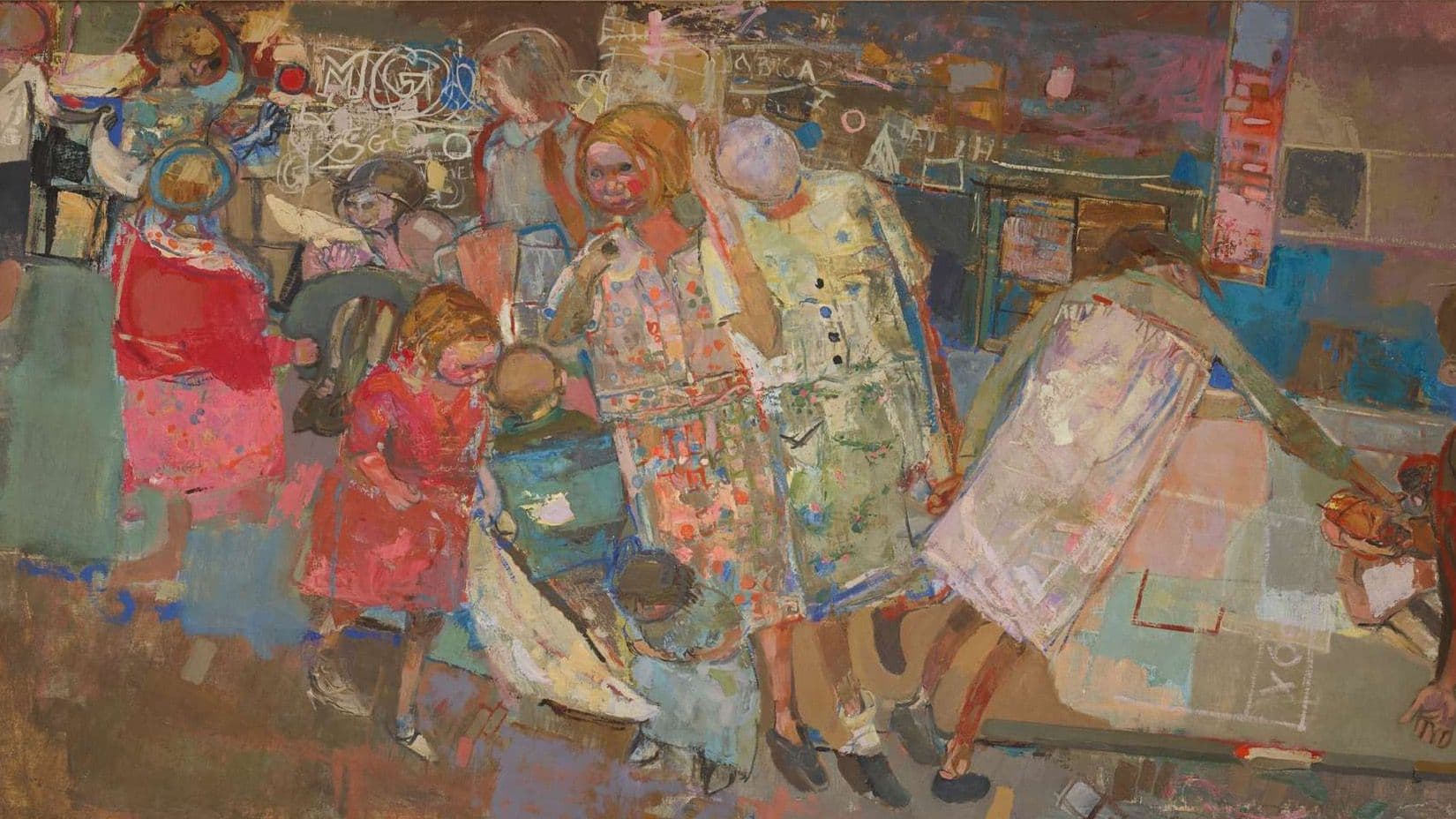
Glasgow Back Street with Children Playing is a triumphant realisation of Eardley’s deep connection with the neighbourhood, its vibrant community of young residents and their life upon its streets. Painted on a monumental scale (99.5 x 177 cm / 39 ¼ x 69 ¾") and in a horizontal format to reflect that of the scene depicted, it is the result of nigh on a decade of careful study and observation and often daily interaction with her subjects.
The painting reads like a twentieth-century version of an Italian Renaissance fresco, such as those Eardley saw on her travels. A rich and bustling street scene plays out before the viewer’s eyes, as children of various ages engage in games, squabbles and other activities and intrigues. Some draw with chalk on the walls of the surrounding buildings, having marked out hopscotch on the pavement, others observe their peers or are absorbed in reading, older siblings watch over younger ones and the cropped composition signals their world extending beyond the confines of the board on which the work is painted. The colour of the children’s clothes blends with that of their urban surroundings, whilst Eardley’s technique varies from layering to picking out pattern, from suggesting to defining form. The result is an image full of youthful exuberance and thoughtfulness, which transports the viewer to their own childhood.