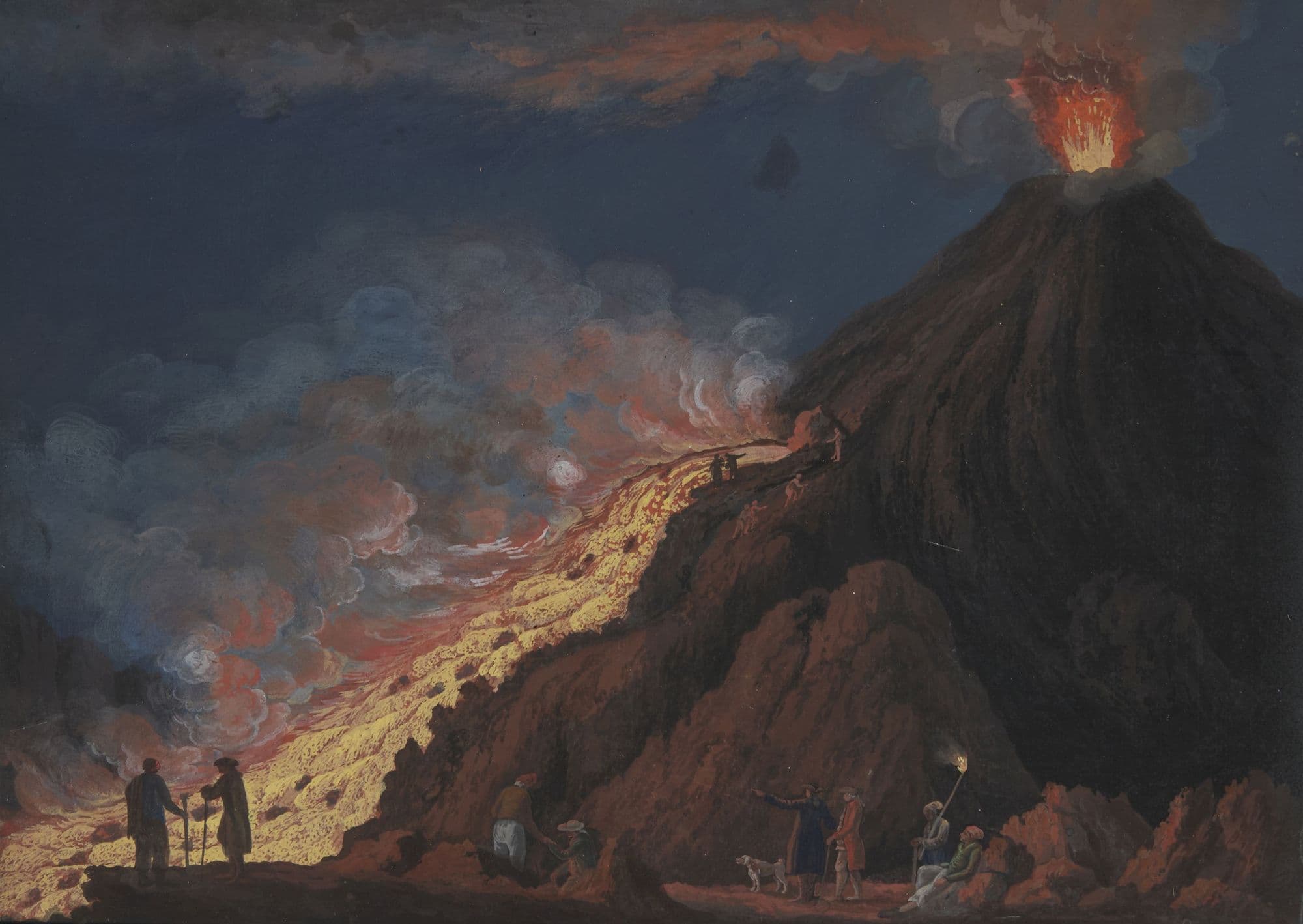
This dramatic painting by Jacob Philipp Hackert will be offered at auction in the May edition of Five Centuries. It captures one of the most celebrated natural spectacles of the 18th century, combining scientific observation with the visual drama that so captivated Grand Tour audiences.
FINE ART
A Vision of Vesuvius | Jacob Philipp Hackert
17 March 2026
Romey Clark
The 1774 eruption of Mount Vesuvius in Italy was one of the most dramatic and widely recorded volcanic events of the eighteenth century. The eruption coincided with the height of the Grand Tour, a cultural journey undertaken by wealthy European and British travellers who visited classical sites across the continent. During this period, travellers frequently collected souvenirs to commemorate their experiences. Among the most prized were paintings, which were displayed in their homes upon their return as visual proof not only of their travels but also of their refined artistic taste and cultural education.
There were certain subjects which proved especially desirable to Grand Tour patrons. Among the most popular were views of Mount Vesuvius in eruption, which combined the drama of the eruption with the prestige of visiting one of Europe’s most famous landmarks. Artists working in Italy responded to this demand by producing multiple versions of similar compositions depicting the volcano’s activity. The German landscape painter Jacob Philipp Hackert (1737–1807) was one such artist, creating several variations of Vesuvius erupting, including the present example.
Hackert first travelled to Italy in 1768 and remained there for the rest of his life. His interest in Vesuvius was likely strengthened by his friendship with Sir William Hamilton (1730–1803), the British ambassador to the court of Naples and one of the most important early students of volcanic activity. Hamilton’s fascination with Vesuvius is well documented, as he is said to have climbed to the volcano’s crater no fewer than fifty-eight times in order to observe and record its eruptions.
According to the biography of Hackert written by his friend Johann Wolfgang von Goethe, the artist personally witnessed the eruption of January 1774. Demonstrating considerable courage, Hackert observed the event closely enough to produce a series of live sketches and studies of the eruption. These drawings later served as valuable reference material, which he consulted when painting views of the dramatic scene after returning to Rome. There is a very similar version of this work in the Gemäldegalerie Alte Meister in Kassel, dated 12 January 1774. This therefore allows us to conclude that the present work also depicts this spectacular event.
Hackert’s depiction is notable for its dramatic immediacy. Flames and molten lava burst violently from the crater while thick clouds of smoke billow upward into the night sky. By positioning the viewer close to the action, Hackert moves away from the more traditional panoramic views of Vesuvius. Instead, he offers a more concentrated and immersive vision of the eruption itself. This compositional decision allows him to incorporate figures in the foreground—most likely Grand Tour travellers accompanied by local guides—who observe the spectacle from the slopes of the volcano.
Hackert’s painting therefore functions not only as a dramatic record of a natural event but also as a reflection of eighteenth-century travel culture. By combining first-hand observation with a composition designed to appeal to Grand Tour patrons, the artist captures both the scientific curiosity and the adventurous spirit that surrounded Mount Vesuvius during this period.
An Upcoming Highlight
Offered in Lyon & Turnbull’s forthcoming Five Centuries auction this May, this painting stands as a compelling example of Hackert’s ability to unite empirical observation with theatrical effect. It embodies the fascination with natural phenomena that defined the Enlightenment era, while also serving as a vivid reminder of the cultural ambitions and experiences of Grand Tour travellers in 18th century Europe.