Between 1919 and 1926, Hunter spent part of each spring and summer in Fife, which is bordered by the Firth of Tay, the Firth of Forth and the North Sea. It is not known what first drew him to the region, but its fertile countryside, picturesque architecture and coastal villages became a rich source of inspiration. As his biographers Bill Smith and Jill Marriner have written:
“He came upon an important source of inspiration through his fortuitous discovery of Fife and the possibilities inherent in its colourful landscape and rural architecture ... Subsequently he would go to Fife in any season. It was there that he made the break to paint en plein air. The artistic ground he gained as a result marked an important turning point in his development in terms of modern colour.”
(Bill Smith and Jill Marriner, Hunter Revisited: The Life and Art of Leslie Hunter, Atelier Books, Edinburgh, 2012, p.79).
Amongst Hunter’s favourite places to paint were the villages of Upper and Lower Largo in the East Neuk of Fife. The name ‘Largo’ derives from the Gaelic word meaning hillside. Hunter was particularly drawn to Lower Largo’s harbour and beach, where modest fishing boats, mooring posts and colourful local figures provided ideal subjects for his increasingly expressive style.
Works such as Boats and Figure, Largo and Figures on the Pier, Largo were likely painted directly from life, given their intimate scale and spontaneous handling. Particular attention is paid to the vertical rhythm of mooring posts, the pull of ropes and the movement of water, conveyed through energetic brushwork and vivid highlights of colour, especially red. These paintings passed through the hands of the renowned dealer Alexander Reid, in whose Glasgow gallery, La Société des Beaux Arts, Hunter received his first solo exhibition in 1913. Reid played a significant role in promoting Hunter’s career, championing him alongside his fellow Colourists in exhibitions staged in London and Paris, whilst his son, A. J. McNeill Reid, later organised a solo exhibition at the Ferargil Galleries in New York in 1929.
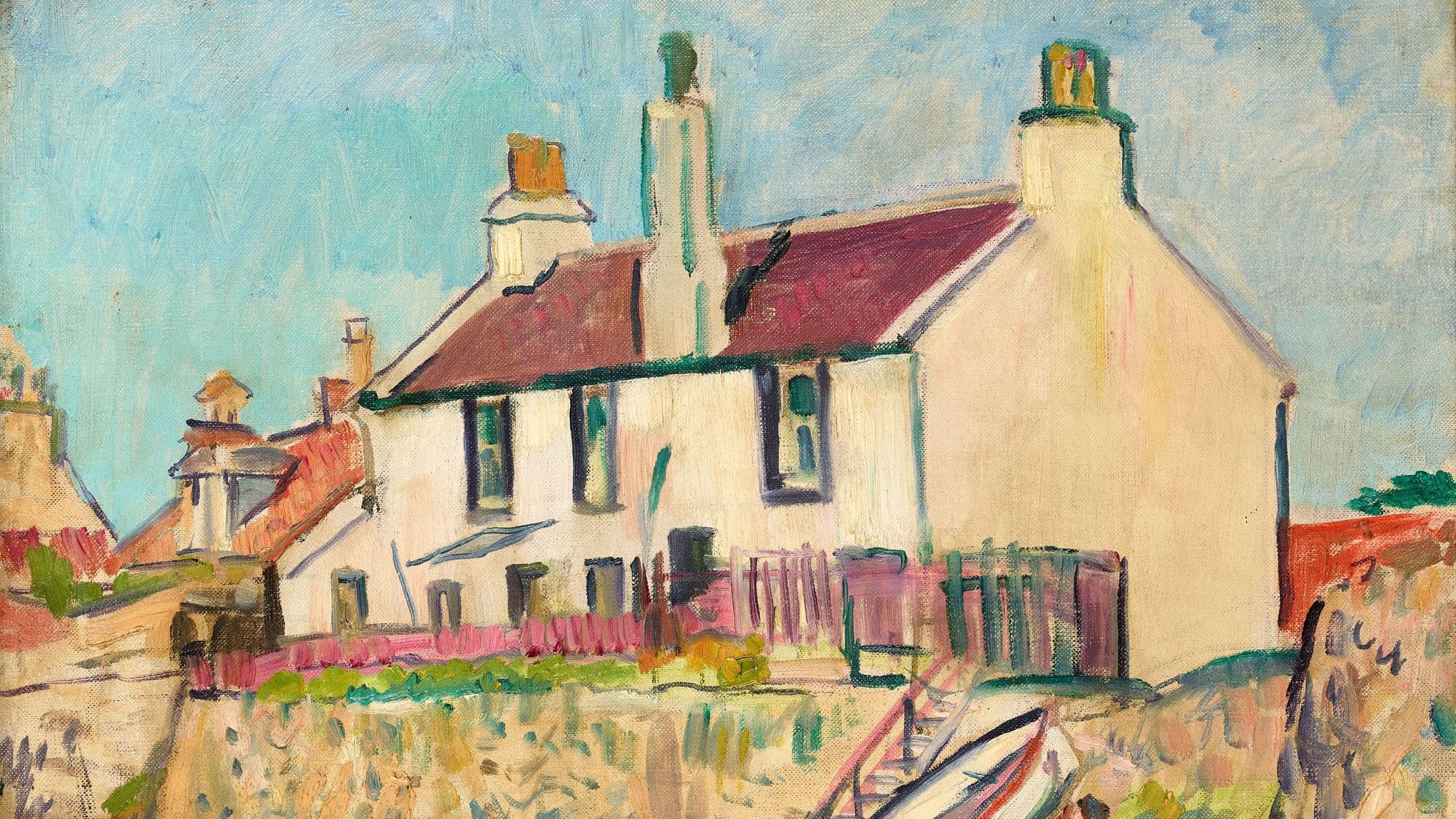
The scene depicted in the present painting is from Lower Largo beach, with the harbour lying just beyond view to the left. The titular house is named after Daniel Defoe’s fictional character Robinson Crusoe from the 1719 novel of that name. Crusoe was inspired by Alexander Selkirk, who was born in Lower Largo in 1676.
Hunter’s clarity of design leads the eye from the rocky foreground to the simplified forms of the house, whose silhouette stands boldly against a brilliant blue sky. He paid particular attention to the textures and patterning of rocks, seaweed and weather-beaten stone walls, whilst a seated figure quietly enjoys the coastal scene in the lower right of the composition.