A Shattered Image of Post-War Man
Eduardo Paolozzi’s Shattered Head was made in the midst of a remarkable decade-long burst of creativity for the artist, during which he transformed himself from enfant terrible of British sculpture to major international star. His work was being collected by the world’s most important museums and he featured in some of the most ground-breaking shows of the 1950s, not least Peter Selz’s seminal New Images of Man at MoMA in New York in 1959.
Here Paolozzi’s distressed human figures, seemingly collaged out of the wreckage of war and welded together with the angst of the nuclear future, were shown alongside the likes of Giacometti, Richier, Dubuffet, Bacon, de Kooning, Pollock and Westermann, amongst others. Just to list these artists’ names is to encapsulate all the ideas swirling around in Paolozzi’s sculptures of the era and in Shattered Head in particular.
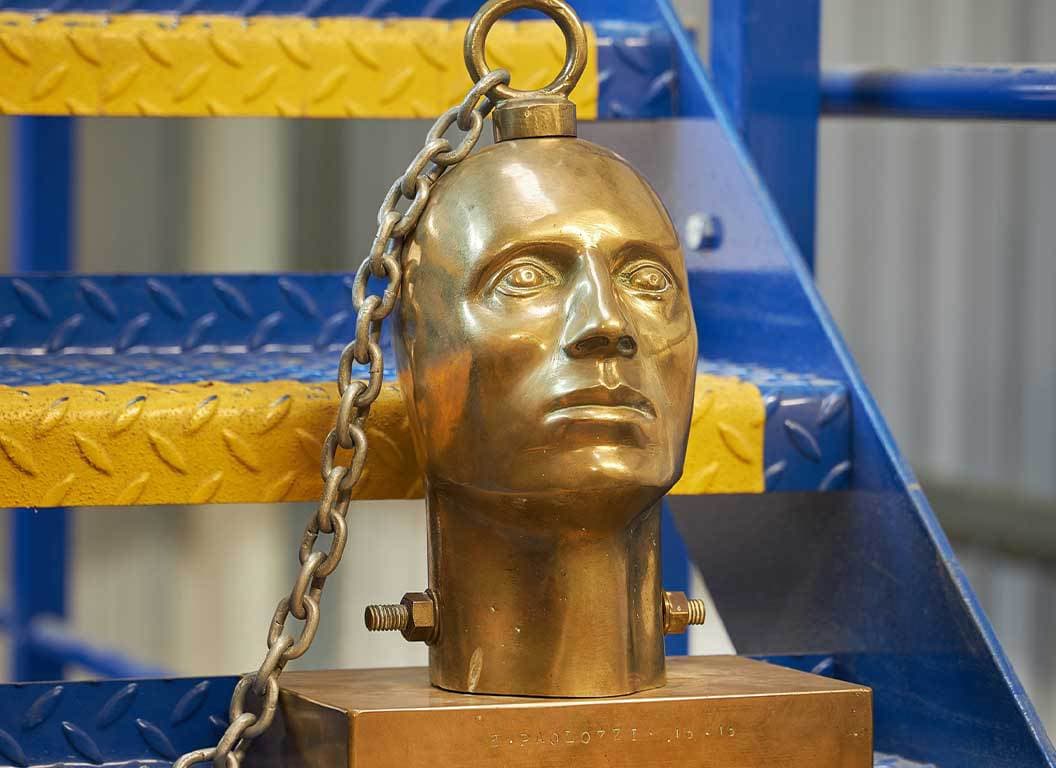
It is the ultimate image of existential crisis, Ginsberg’s contemporaneous Howl made flesh. Except the head is not a rendition of the flesh. Initially it appears to be a human head, covered perhaps in bandages, ravaged by atomic fallout or napalm, but these ‘bandages’ are in fact its sole substance, these molten metal strips are substitute for both skin and bone. This is a person made from debris, an android from a used future and a shattered past.
The Hanover Gallery and a Pivotal Moment
Shattered Head featured in Paolozzi’s 1958 solo exhibition at Erica Brausen’s Hanover Gallery, at the time very much the crucible for all that was avant-garde in British Art. The show itself was a tour de force, with almost every work eventually acquired by a major museum. Each sculpture was unique, assembled by Paolozzi from a combination of scrap metal, found objects or sheets of bronze cast from wax impressed with junk. As a result, works from this highly significant moment in his career are very hard to find.
Shattered Head was one of the few that Paolozzi made in an edition. It is small but extremely powerful, a shape-shifting image that reveals itself differently each time, sometimes more human, sometimes less: a man looking to the skies that threaten with unseen violence whilst being pulled back towards the bomb-crater that birthed him, a cipher for the world of the late 1950s but also perhaps today.