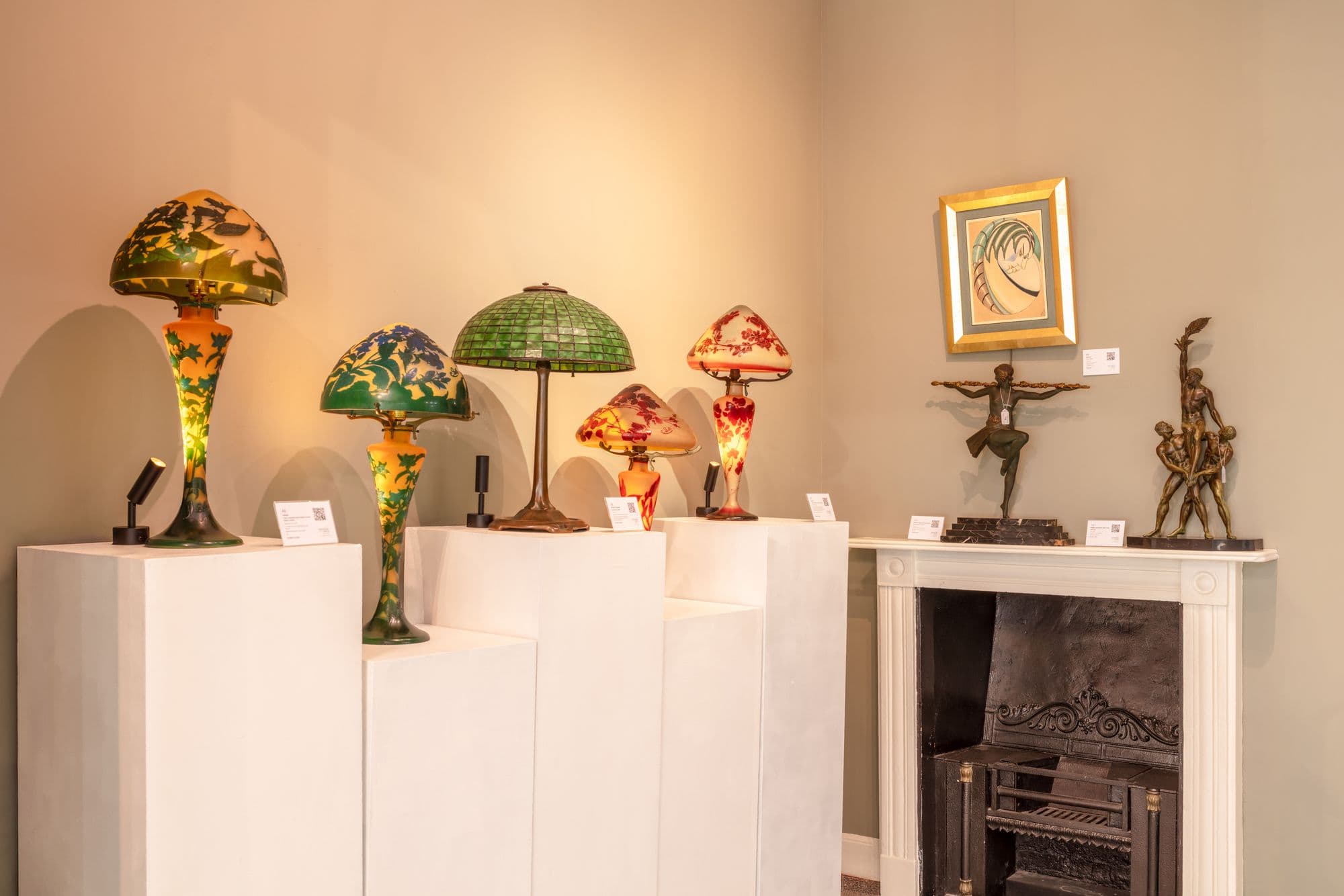
Lighting Beyond Glass
Decorative lighting was not limited to glass. Metalwork played an equally important role in the development of early twentieth-century design.
Edgar Brandt is best known for his ironwork, combining traditional craftsmanship with contemporary industrial methods. His work helped define the transition from the natural forms of Art Nouveau to the more geometric language of Art Deco.
René Lalique and Art Deco Design
No discussion of decorative lighting would be complete without René Lalique. By the 1920s and 1930s, designers were embracing geometry, symmetry and abstraction, and Lalique became one of the movement's leading figures.
His lighting designs drew on both natural and geometric forms, creating objects that functioned as sculpture as much as sources of light. The passion flower, a recurring motif in his work, provided a natural framework for exploring pattern and structure.
Daum and the Art Deco Interior
Daum, another important French glassmaker, also adapted to changing tastes during the Art Deco period. Deeply acid-etched cameo glass lamps became a feature of fashionable interiors, combining practical illumination with strong decorative presence.
These designs demonstrate how lighting had become an integral part of interior decoration rather than a purely functional necessity.