English slipware has an enduring appeal. Rustic, practical and highly individual, these glazed earthenware vessels belong to a long tradition of vernacular pottery made for the domestic interior. Their simple materials and direct methods of decoration give them a character that can feel remarkably immediate, even when a piece has survived for generations.

The Enduring Appeal of English Slipware
5 September 2026
Katherine Wright
“I am drawn to all things vernacular, domestic and rustic, be it furniture, ceramics or kitchen utensils,” says specialist Katherine Wright. “Slipware has a strong appeal for me because of its simple charm and craftsmanship. You can understand how it was made and see its close connection with the earth.”
Katherine Wright, Senior Specialist
How English slipware was made
Many dishes were formed by laying a slab of clay over a convex mould. Once the clay had dried sufficiently to hold its shape, the dish could be removed from the mould and decorated with slip - clay mixed with water to form a liquid that could be poured, brushed or trailed across the surface.
Potters developed a rich vocabulary of slip decoration. Techniques included slip trailing, marbling, sgraffito - in which a design is scratched or incised through a layer of slip - and combing.
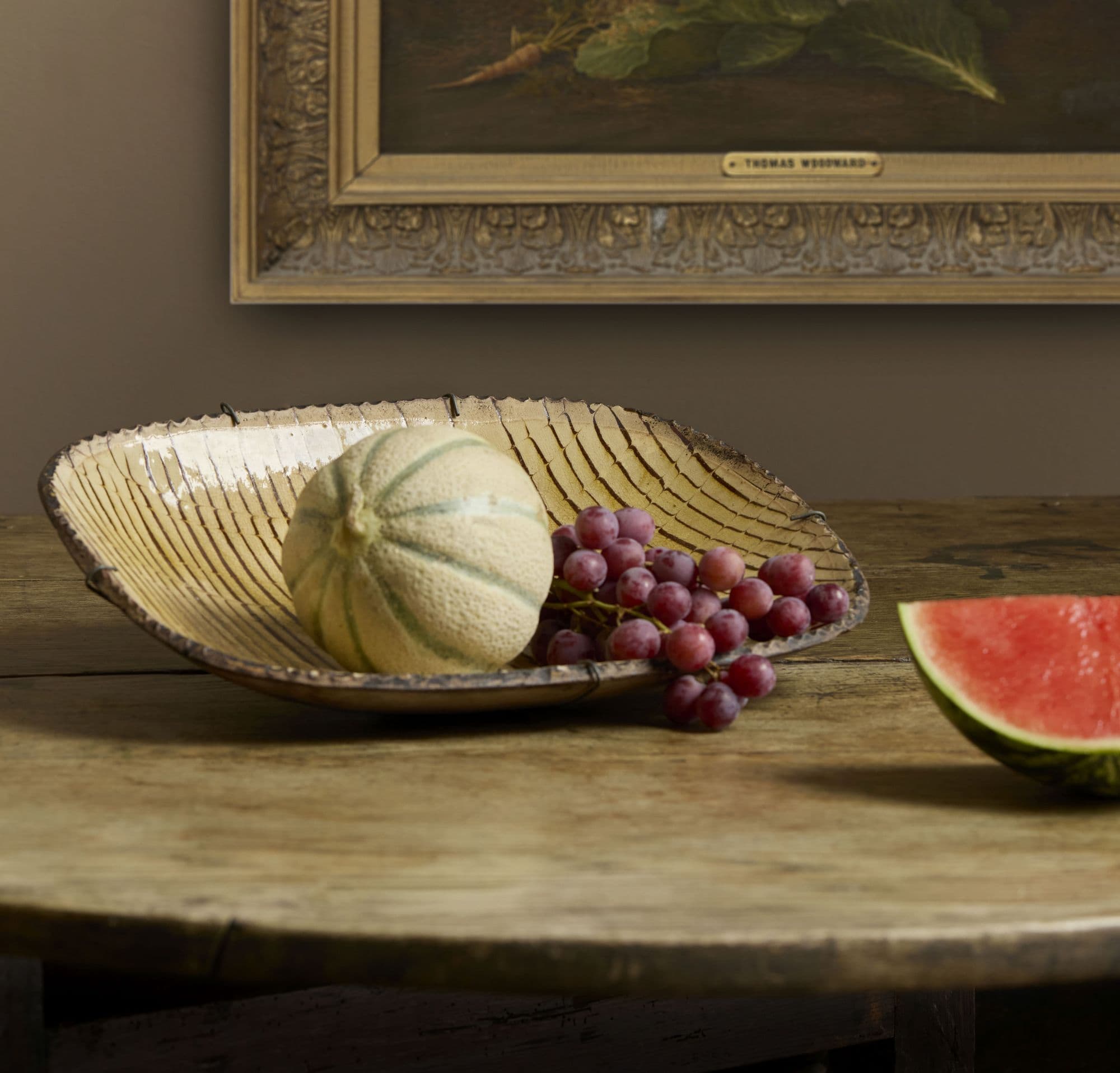
Combed slipware is particularly distinctive. Contrasting slips, often in cream and shades of brown, were applied to the surface of the vessel. While still fluid, a pointed implement or comb was drawn through them, pulling the colours together to create rhythmic lines, waves and feathered patterns. The process was relatively straightforward, but small variations in the movement of the potter’s hand ensured that every finished piece was different.
Some dishes were given an additional decorative flourish in the form of a crimped or “pie-crust” rim, lending even an everyday household object a pleasing sense of finish.
Staffordshire and beyond
Slipware is closely associated with Staffordshire, one of the great centres of English pottery production, but it was by no means confined to a single region. Related wares were produced in different parts of Britain, with potters, techniques and decorative ideas travelling between established pottery-making communities.
Local materials were fundamental to their character. The clay body could be sourced relatively close to the pottery, and the warm reds and earthy browns visible on surviving examples are an important part of their visual appeal.
On many dishes, the decorated face is glazed while the reverse remains comparatively plain, revealing the colour and texture of the earthenware body beneath.
Pottery made to be used
Unlike ceramics created principally for display, much traditional slipware was functional. Dishes and bowls belonged in kitchens and on dining tables, where they could be used in preparing, cooking or serving food.
Their decoration therefore combined beauty with utility. The glazed surface helped make the porous earthenware body more suitable for domestic use, while transforming an ordinary household vessel into something colourful and distinctive.
This marriage of function and decoration is central to slipware’s appeal today. These were objects of everyday life rather than precious possessions intended to remain untouched.
The marks of the maker and the user
Handmade slipware often preserves small irregularities that would be considered imperfections in an industrially produced object. Fingerprints may survive in the clay. A combed line can wander slightly. The thickness of a rim can vary, while slips and glazes may pool differently across the surface.
Such variations are part of the character of the ware. They reveal something of the speed, skill and physicality involved in its manufacture and mean that ostensibly similar dishes are rarely identical.
Age and use add another layer. Scratches, worn glaze, small chips and other signs of handling can provide tangible evidence of an object’s domestic history.
As Katherine Wright explains: “They often have signs of wear and use that link us to their past history. They are tactile, pleasing to the hand and the eye. You can sometimes see fingerprints in the clay and variations in the pattern-making, so that no two pieces are the same.”
The enduring appeal of English slipware
The attraction of 19th-century English glazed earthenware slipware lies partly in its lack of pretension. Made from local earth and decorated through simple, expressive techniques, it sits comfortably alongside country furniture, folk art and other objects associated with the vernacular interior.
Yet its apparent simplicity can disguise considerable skill. A successful combed pattern depends upon the consistency and colour of the slips, the timing of their application and the confident movement of the potter’s hand. The resulting decoration can be spontaneous and vigorous while remaining remarkably harmonious.
For collectors today, these qualities make slipware much more than an example of historic pottery production. Each surviving dish or bowl is both a useful object and an individual record of its making: shaped by hand, decorated at speed, fired in a kiln and subsequently marked by years of domestic life.
It is this combination of earth, craftsmanship, utility and individuality that gives English slipware its lasting appeal.