The Radiance of Jade: Chinese Jade from a Distinguished Private Collection, England
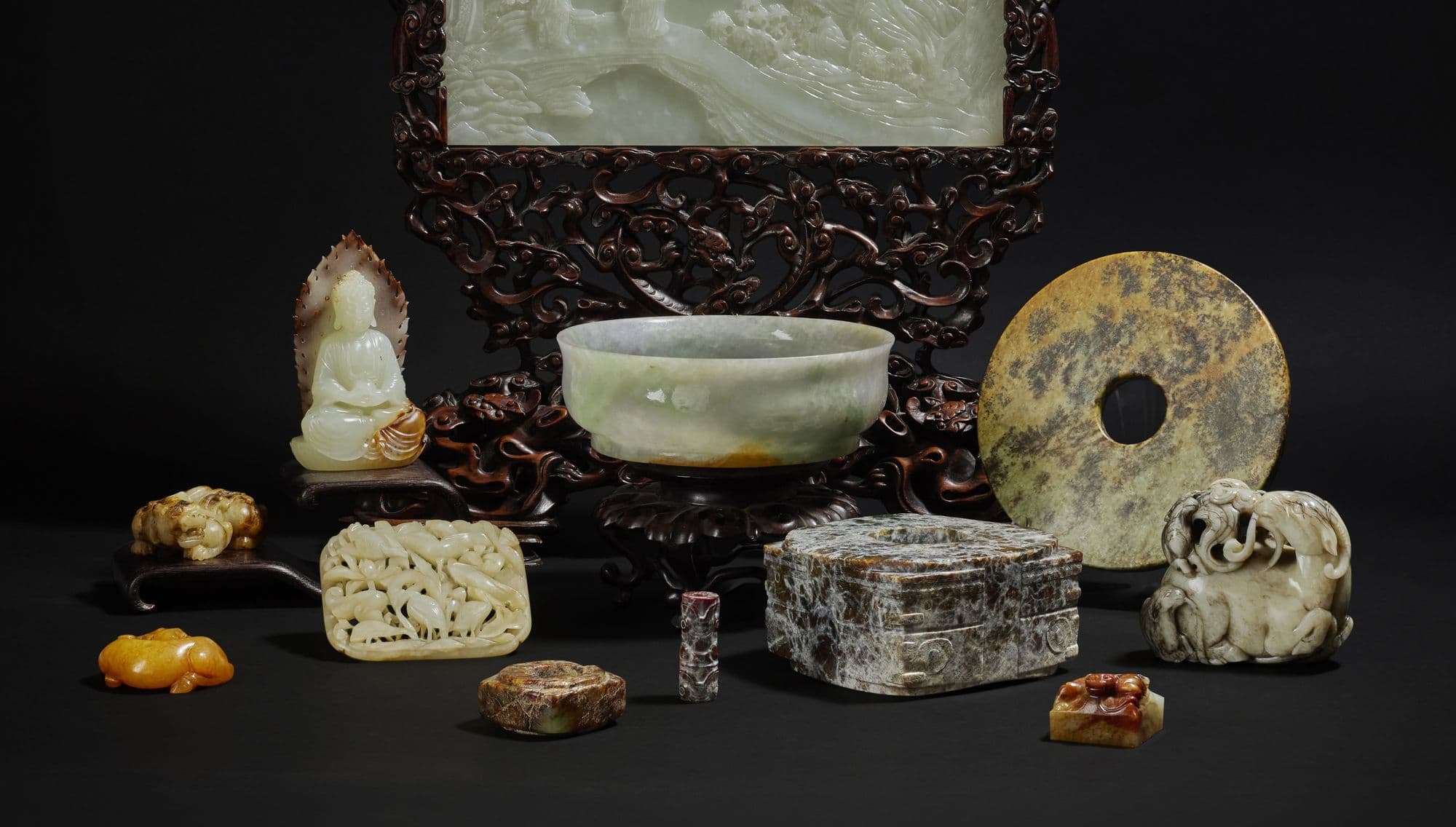
This exhibition presents a distinguished private collection of Chinese jades spanning five millennia, from the Neolithic period to the Qing dynasty. Tracing the evolution of jade carving across China’s major cultural and historical periods, the collection reveals the exceptional craftsmanship and enduring symbolic significance of this revered material.
Early highlights include a Neolithic disc with mottled green and russet inclusions (no. 1), a substantial Liangzhu culture cong (no. 2), a Shijiahe-style eagle hair ornament (no. 5) and a Shang dynasty collared disc (no. 6), reflecting jade’s ritual and cosmological importance in ancient China. Han dynasty works, including a rare white jade ‘crouching tiger’ seal (no. 8), a finely carved ‘cicada’ pendant (no. 9) and a powerful bixie (no. 10), exemplify the period’s fascination with protective symbolism and transformation.
Later masterpieces demonstrate the continued refinement of jade carving, from a Ming dynasty white jade ‘three rams’ carving (no. 16), ‘crane and lotus pond’ belt plaque (no. 15) to three agate ‘phoenix’ plaques possibly dating to the Liao dynasty (no. 12). Qing dynasty highlights include a pair of large white jade ‘immortal’ table screens (no. 18) and a Mughal-style white jade bowl and ring (no. 21). One of the most distinctive pieces is a Zhou dynasty celadon jade cong with russet inclusions, bearing a later Qing dynasty inscribed ‘Yi Jin Zhai’ mark (no. 7). Yi Jin Zhai was the studio name of Yongxing, Prince Cheng, the eleventh son of the Qianlong Emperor, reflecting the Qing dynasty's admiration for antiquity.
With distinguished provenances associated with R. H. R. Palmer, the Idemitsu Museum, Sir James Stewart Lockhart and Eskenazi, these works offer a compelling insight into jade’s enduring role in Chinese art as a medium of ritual, a symbol of status and an expression of artistic achievement.
玉映英倫: 英格蘭重要私人中國玉器收藏
本次展覽呈獻一組重要的中國玉器私人珍藏,橫跨五千年,涵蓋新石器時代至清代,展品追溯中國玉雕藝術在不同文化與歷史時期的演變,彰顯玉器精湛的工藝成就,以及其歷久不衰的象徵意涵。
早期展品包括一件帶有斑駁綠色與赭紅色沁斑的新石器時代玉璧 (no. 1)、一件厚壁且石質緻密的良渚文化玉琮 (no. 2) 、一件石家河文化風格的鷹形玉笄 (no. 5) ,以及一件商代有領玉璧 (no. 6) ,反映玉器在古代中國禮制與宇宙觀念中所承載的重要意義。漢代玉器則包括一件珍罕的白玉臥虎印 (no. 8) 、一件精雕細琢的玉蟬珮 (no. 9) ,以及一件氣勢雄渾的辟邪 (no. 10) ,展現當時對辟邪護佑與生命轉化等象徵意涵的重視。
後期傑作展現玉雕工藝之持續精進,包括明代白玉雕三羊開泰擺件 (no. 16)、「仙鶴荷塘」帶飾 (no. 15) ,以及三件可能為遼代的瑪瑙雕鳳凰紋帶飾 (no. 12) 。清代代表作包括一對清代白玉雕西王母祝壽圖大插屏 (no. 18) ,以及一件痕都斯坦風格白玉碗及扳指 (no. 21) 。最為獨特的是一件周代青玉帶紅沁玉琮帶清代後刻「詒晉齋」款 (no.7) ,詒晉齋為乾隆第十一子成親王永瑆齋號,展現清代慕古之情。
本次展覽中的多件珍品傳承有序,曾為 R. H. R. Palmer、出光美術館、駱克爵士及 Eskenazi 等重要收藏家或機構所珍藏。這些作品共同呈現中國玉器歷久彌新的藝術價值,揭示玉器如何兼具禮儀功能、身份象徵與藝術表現,並成為中國藝術史上深具文化意涵的媒介。