

Lot 140
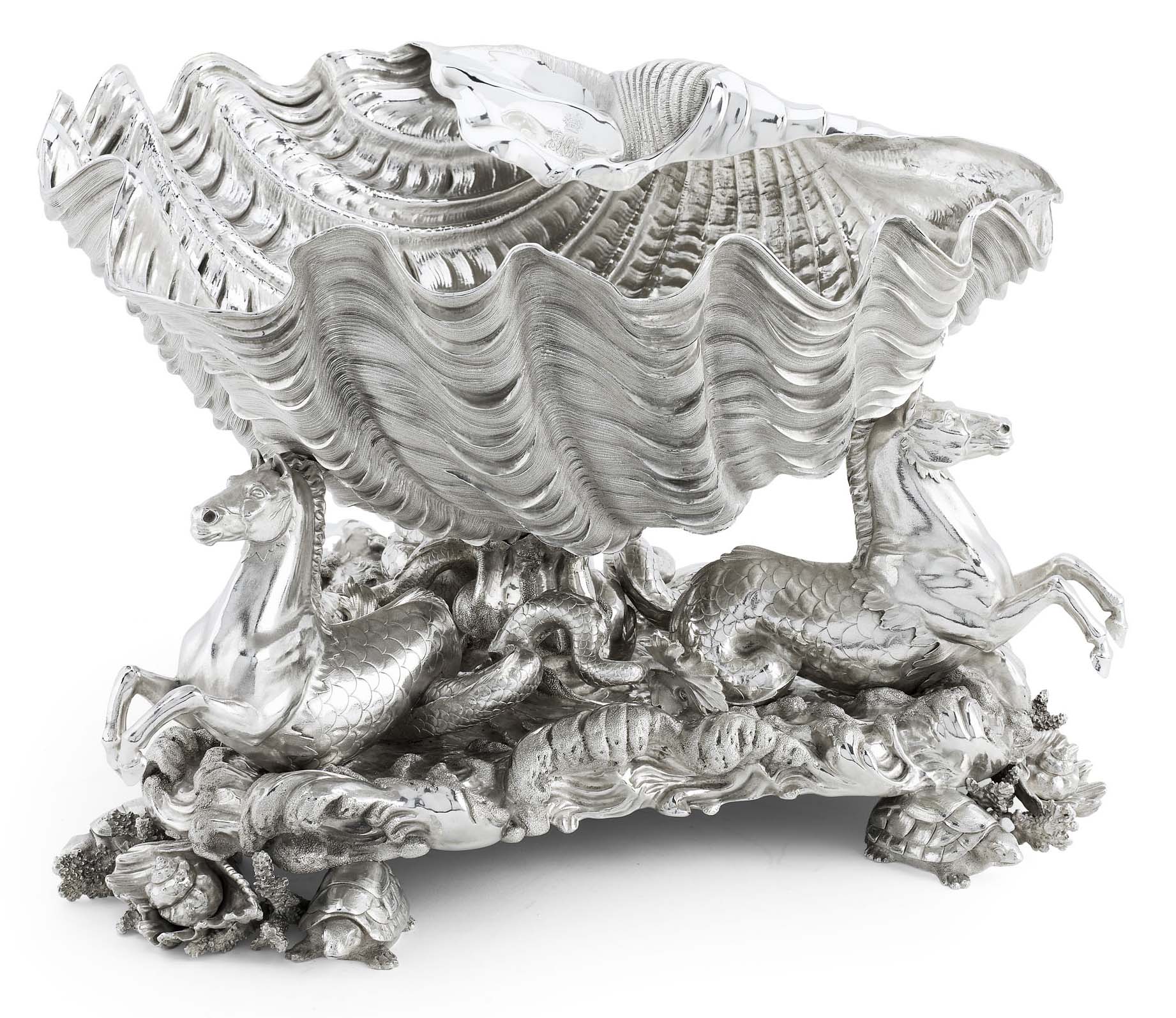
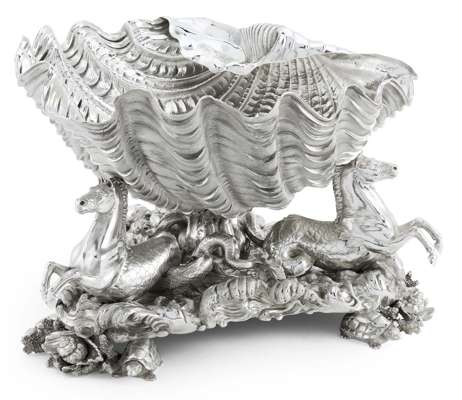
An impressive George IV silver dessert bowl
Philip Rundell for Rundell, Bridge and Rundell, London 1821-22
Auction: 23 November 2008 at 15:00 GMT
Description
the large well-modelled clam shell supported by three hippocamps in a wild sea setting and supported by three groups of clam shells and turtles, engraved with the crest and monogram of Harriet Duchess of St. Albans
27cm high, 40cm wide, 39cm deep, weight 298oz/rNote:
A similar set of four silver-gilt dessert bowls with covers were made for the Royal Collection by John Bridge 1826-27.
Footnote
Literature:
Jones, Windsor, p.160, pl. LXXXI; Bury, ‘Rundell’s’, I, p.152 (one of a set)
Exhibited:
Royal Goldsmiths: The Art of Rundell & Bridge 1797-1843, Christopher Hartrop, exhibition by Messrs Koopman Rare Art Ltd. 2005
Heraldry:
The monogram AGBC is for Angela Georgina Burdett-Coutts, granddaughter of the banker Thomas Coutts and heiress to Harriet, Duchess of St Albans.
Literature:
J. B. Hawkins, The Al-Tajir Collection of Silver and Gold, London 1983, vol.1, p.164-65
Note:
Similar set of eight exhibited Christie’s,’ The Glory of the Goldsmith: Magnificent Gold and Silver from the Al-Tajir Collection’, London, 1989, no.151.
The design for these salt cellars is attributed to the painted and sculptor William Theed (1764-1817), on the basis of its close similarity to the artist’s bronze ‘Thetis returning form Vulcan with Arms for Achilles,’ in the Royal Collection and exhibited in the Royal Academy of Arts Bicentenary Exhibition, fig. 171, p.50.
Theed supplied designs and worked as the chief modeller for Rundell, Bridge & Rundell, and a design drawing for these salt cellars from an album belonging to Rundell’s is now in the Victoria and Albert Museum (see A. Phillips and J. Sloane, Antiquity Revisited: English and French silver-gilt from the Collection of Audrey Love, 1997, pp.48-49)
There are at least three variations of this model, each with a differing base:
A set of twenty four with oval bases by Paul Storr of 1810 is in the Royal George IVs Palace, 1991, cat. No.95, p.133; a set of four salt cellars with oval base, by William Pitts of 1813, is illustrated in Antiquity Revisited, cat. No.6, p.47;
A set of four, each on rectangular plinth with chased vitruvian scroll border, by Paul Storr from 1812, sold from the collection of Charles and Fay Plohn, Sotheby’s, New York, July 16, 1970, lot. 138.
A set of four salt cellars, each with a base similar to the present lot, was produced by John Samuel Hunt in 1855 and sold at Christie’s, London, March 17, 1999, lot.50.
As a successor to Paul Storr, Hunt evidently retained and continued to use the moulds.