

Lot 180
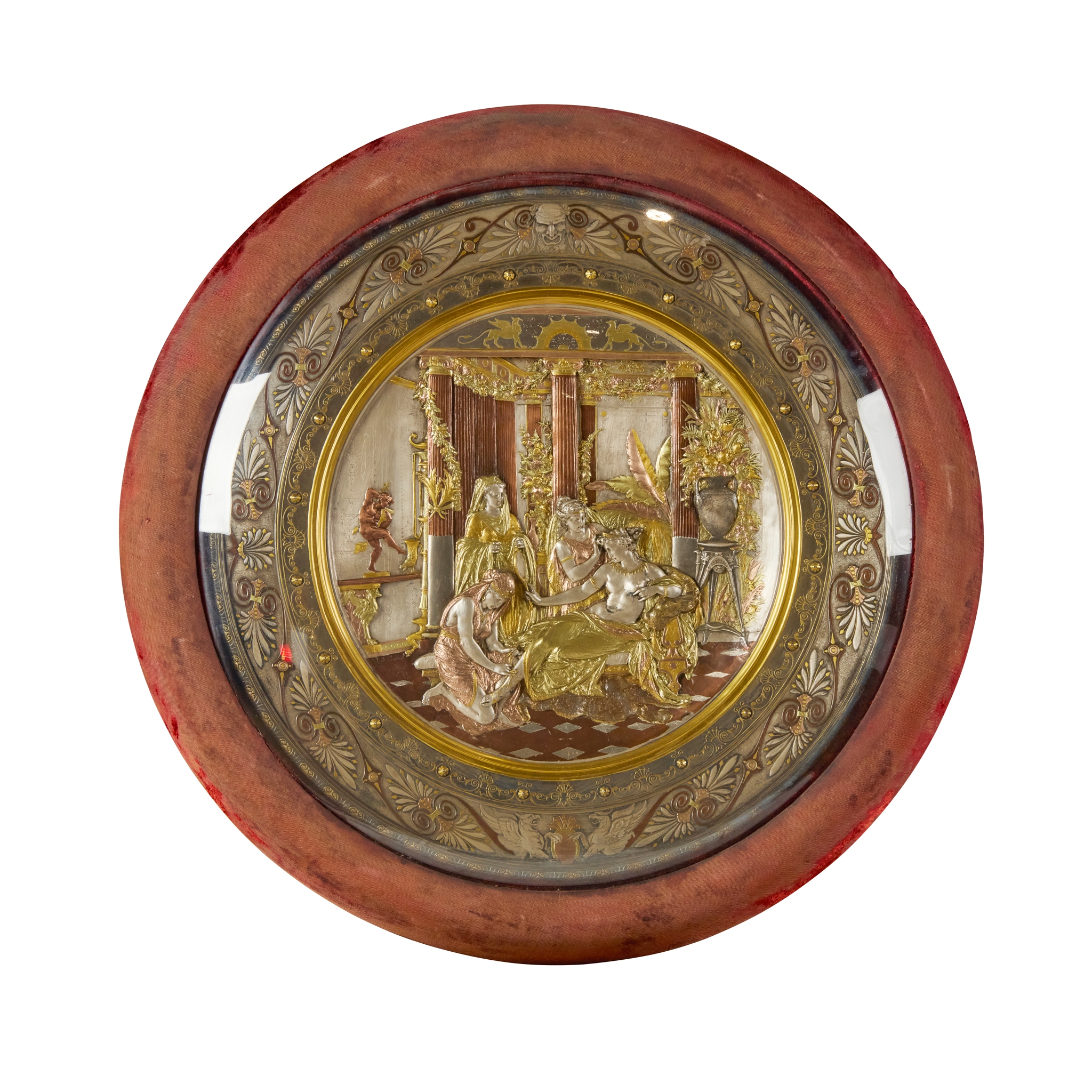
'A POMPEIAN LADY AT HER TOILET' - A VICTORIAN ELECTROTYPE AND COPPERED PLAQUE
BY LEONARD MOREL-LADEUIL (1820-1888) FOR ELKINGTON & CO., LONDON 1876
Auction: 03 March 2026 from 10:00 GMT
Description
Of circular outline, decorated with a Neoclassical scene depicting ‘A Pompeian Lady’ reclining on her couch with her three handmaidens, signed and dated 'Morel-Ladeuil, inv Fecit 1876', registration mark, all within a decorative border on a black, contained in its original convex glazed frame
Dimensions
61cm diameter (overall), 49cm diameter (plaque within frame)
Footnote
The Victorian era brought much invention and discovery, both industrial and for the arts. The firm Elkington & Co. were the epitome of innovation and were at the forefront of developments of electro-metallurgy.
Elkington & Co. honed their skills to create electroplate masterpieces and in particular electrotype facsimile copies of museum quality artefacts. They were also the only British company to consistently win the highest awards at all seven of the International Exhibitions held from 1851-1878.
Founded by cousins, George Richards Elkington and Henry Elkington, and financed by the steel pen magnate Josiah Mason the company formed a relationship with the pre-cursor to the Victoria and Albert Museum, the South Kensington Museum to produce facsimile copies of museum artefacts for educational purposes known as a ‘type pattern’.
In order to re-produce these type patterns, a mould is first made of the original piece and then sprayed with a silver paint to help conduct electricity, dipped in a solution with copper wires this first helps connect the copper and then the silver. The complex process produces a product that can be handled and examined for further research.
Elkington & Co. was a commercial enterprise and did sell their electrotype wares. The purpose of their exercise was to provide educational tools, but with Elkington's success, they began to use the elements of the original 'type patterns' such as a handle, for other designs. This created a conflict of interest and may have been a contributing factor to why the relationship between the V & A and Elkington ended.
The plauque was originally produced in silver and damascened steel by the great French artist Leonard Morel-Ladeuil for Elkington, after the painting by Lawrence Alma-Tadema (1836-1912). He was approached in 1859, to work for them for three years in Birmingham, assuring him a free hand. The silver and steel prototype was produced as the showstopper for the Elkington stand at the Philadelphia Exhibition of 1876. There are 105 sa;es pf tje Pompeian Lady electrotype recorded in Elkington's sales ledger at the 1876 exhibition. The first to be held in the United States, which coincided with the centennial anniversary of the Declaration of Independence in Philadelphia on the 4th July 1776.
Currently the V & A museum holds over 400 items relating to the firm Elkington and holds and has accessioned a copy of the plaque. The whereabouts of the original are unknown.
Literature: Grant A. & Patterson A., The Museum and the Factory, pg 99