

Lot 310
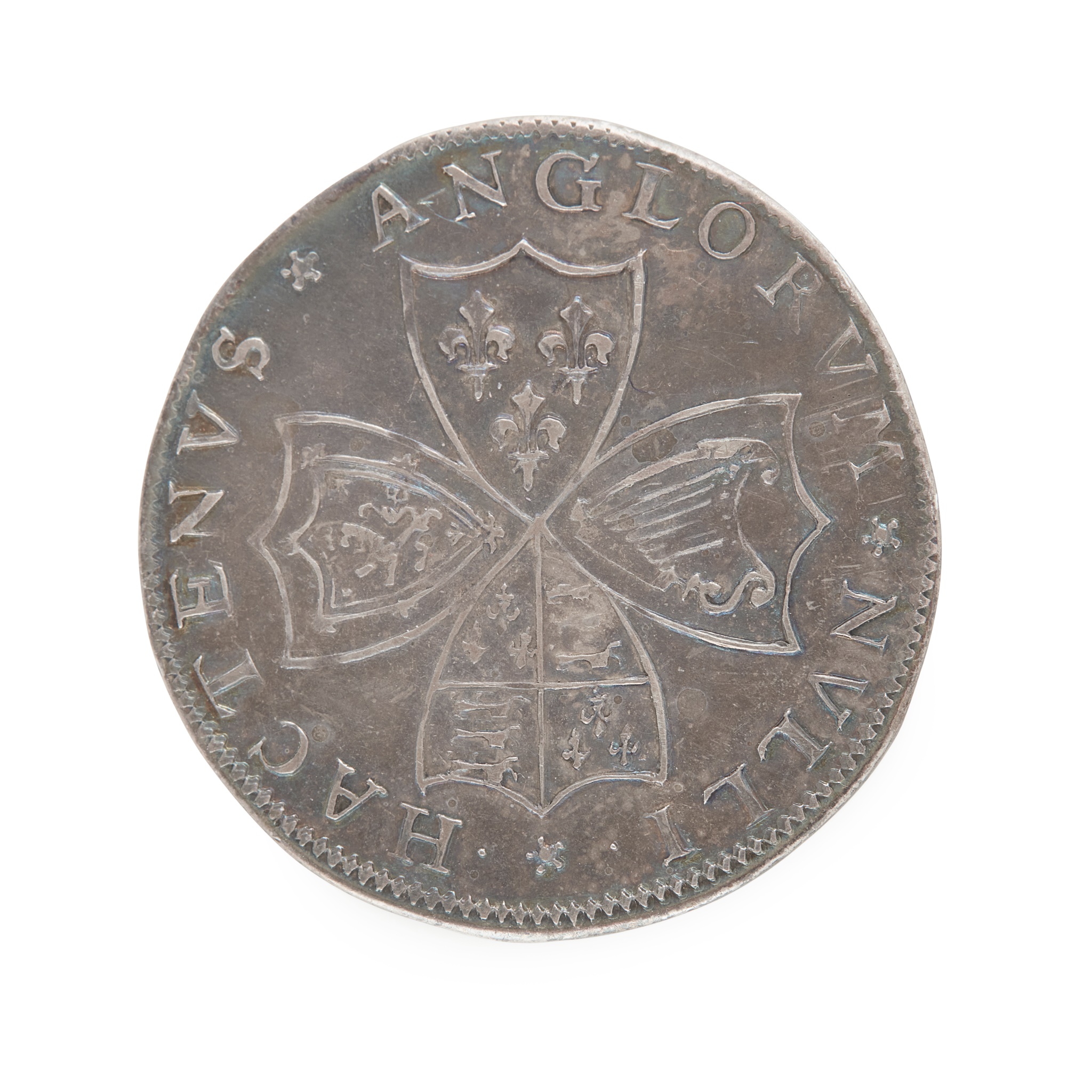
A SILVER BIRTH OF PRINCE CHARLES MEDALLION
ENGRAVER UNKNOWN, STRUCK 1630


Scottish Works of Art & Whisky
Auction: 16 August 2023 at 11:00 BST
Description
obverse, four shaped shields with England and France, Scotland, France, and Ireland Royal arms within, the motto HACTENVS. ANGLORVM. NVLLI around, the reverse with motto HONOR’, PRIN’, MAG’, BRIT, FRA’, ET, HIB’, NAT, 29, MAI’, ANN’ 1630, within a decorative tablet
Dimensions
30mm diameter, 4.5g
Provenance
Provenance:
Property of a Gentleman – Previously from the collection of Sir Colin MacRae (1869-1952) of Feorlinn and Lady Margaret Crichton Stuart (1875-1964)
Lady Margaret Crichton-Stuart was the daughter of John Patrick-Stuart, the 3rd Marquess of Bute, and her daughter Gwendolin was named after her own mother. It is through Gwendolin’s daughter, Daphne Battine, that the collection descends to the current vendor.
Lady Margaret Crichton-Stuart married Colin MacRae of Feoirlinn in 1909. A Colonel in the British Army, he was appointed Commander of the British Empire (C.B.E.), and held the office of Deputy Lieutenant (D.L.) as well as the office of Justice of the Peace (J.P.). MacRae was a member of the prestigious Royal Company of Archers. In 1935 he received his knighthood and served with distinction throughout his Army career, the National Portrait Gallery houses his portraits, NPG x152976, showcasing his rank in full dress uniform.
MacRae was a huge enthusiast of pipe music and in particular Piobaireachd. As a patron of this art it encouraged his Highland heritage - both he and Lady Margaret were well-regarded supporters of the Highlands. Their links to the highland heritage seems to have driven their appetite for collecting such artefacts. An article in the Scotsman of August 20th 1945 shows that MacRae accepted the invitation to the bicentenary of the ‘Forty Five at Glenfinnan. Perhaps this allegiance to the Highland cause shaped their collecting of Jacobite works of Art, which can be seen particularly in their Jacobite quaich. This quaich is purported to be a gift to Prince Charles Edward Stuart’s servant, Ronald MacDonald, after the battle at Culloden, and a pocketbook relating to the executed Lord Lovat perhaps shows sympathies to well-known Jacobite supporters. The collection also includes a group of commemorative medallions, including two rare pendants showing support for the Stuart King Charles.
Keen to collect items of Scottish importance after the death of Sir Colin, in 1955 parts of the collection would ultimately be on long-term loan to the National Museum of Antiquities of Scotland, continuing some time into the 1980s.
Footnote
References:
Eimer, C., 'British Commemorative Medals, and their values', item 115
Note:
Struck in both gold and silver there are various die pairings recorded for its production. Indeed two distinct versions of the obverse are recorded, this being the slightly simpler version. This number of variations suggests that the medallion would have been widely distributed at the birth of Prince Charles (later King Charles II) throughout the kingdoms.