

Lot 353

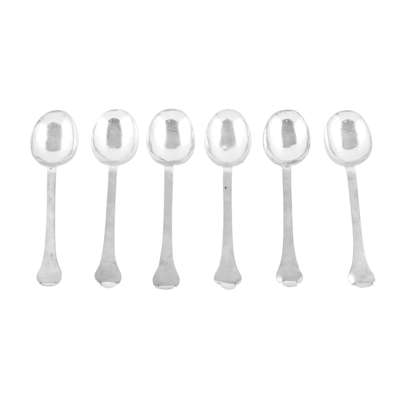
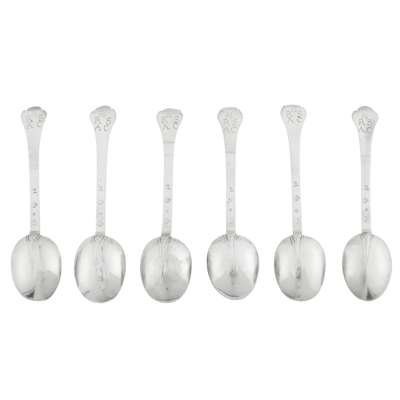
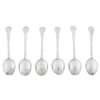
GLASGOW - A RARE SET OF SIX SCOTTISH PROVINCIAL TREFID SPOONS
GEORGE LUKE CIRCA 1686
Scottish Works of Art & Whisky
Auction: Lots 1 - 412 | 20 August 2024 at 10am
Description
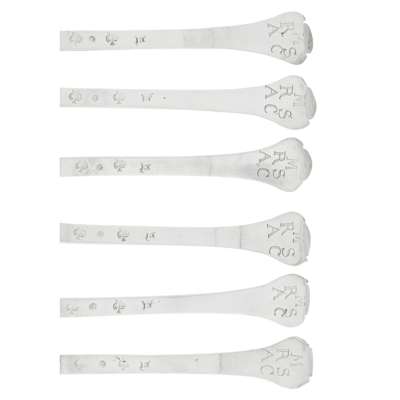
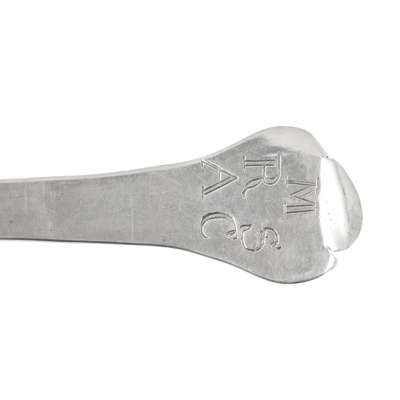
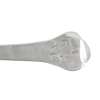
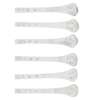
each with a trefid terminal, the reverse engraved with initials 'M/ R S/ A C', the reverse of bowl with moulded ribbed rat tail
Dimensions
20cm long, 11oz
Provenance
By descent
The current vendor believes that the spoons were acquired when the Reverend Robert Stewart married Anne Campbell from Edramuckie
Footnote
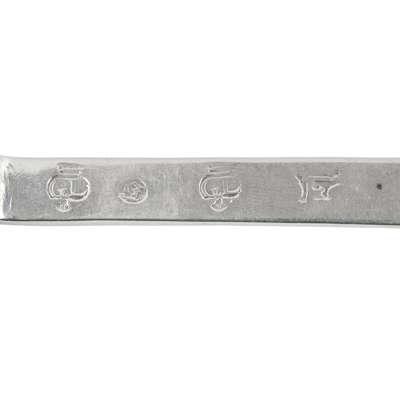
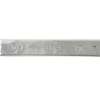
This remarkable set of six Trefid spoons are not only amongst the earliest Glasgow made spoons recorded but also appear to be the only extant work by George Luke. Bearing the pseudo date letter F, which had only been conjecture in Jackson’s Silver & Gold Marks, is here illustrated for the first time. This unofficial but apparently closely followed pseudo cycle would therefore place these spoons manufacture to 1686 only six years after George Luke is admitted a Freemen. This likely date is further backed by family provenance to the married of the original owners in 1683.
Little is known about George Luke but it seems safe to assume he was a family member, perhaps brother (?), to John Luke I who is mentioned c1670. Therefore, placing him as one of the earliest members of this long and illustrious Glasgow goldsmithing family.
George Luke is first admitted as a Freeman of the Hammermen of Glasgow 14th September 1680. He is recorded taking one apprentice, William Hodgert in 1684 by whom only a single quaich now within the Burrell Collection (43.103) is known to survive.
Why work by George Luke should be so rare compared to his contemporary makers and indeed family is unclear. It is tempting to think he worked under / closely with John Luke in his likely large workshop but this cannot be proven.
Not only are these spoons remarkable in their survival from Glasgow but that until now they have been in the same direct family lineage. The engraved initials must date these spoons to 1683 or after upon the marriage of Reverend Robert Stewart and Anna Campbell of Edramuckie.
Robert was the youngest son of James Stewart of Wester Clunie and was born 1st May 1650. He was educated in holy orders at St. Leonards College St Andrews gaining is MA on 23rd July 1672. By 1679 he was given the Parish of Killin, a post he would hold until his death in 1727.
Although a man of the church it seems that his career was not without controversy and perhaps some financial irregularities. It is recorded that within his parish after he was installed by Rev Alexander Comrie that ‘he neither kept register or scrolls, and monopolised all the dues payable to the Clerk, Bedal and Poor Box, all the time he stayed there’ these registers being a duty he was bound to keep. The fortune he appears to have amassed, some no doubt spent on silver, was enough to buy large estates for each of his four sons. His family estates now extended within Strathay to Killiechassie, Blackhill and Cluny, Cloichfoldich and Derculich.
Rev Stewart married on 23rd January 1683 Anna Campbell of Edramuckie. Robert died in March 1729 leaving his estate to is wife (who would later re marry and survive him less than a year) and left provision for a Chapel to be built in Killiechassie his honour his body interred there to the amount of 500 merks.
Although a man with, perhaps, dubious financial dealings to the detriment of the local economy and church Robert Stewart was remembered fondly within his family. In 1879 it was written of him ‘He was a man of great prudence, force, and decision of character, commanding in consequence the greatest respect throughout the district, and being also of more than average height and strength, was in every way a most worthy representative of his race. Indeed, amongst many family traditions still handed down respecting him, it is said that in the more tumultuous periods of his ministry he frequently conducted service with his broadsword by his side, ready for any emergency. This precaution would seem to have been highly needful, for on one occasion, when proceeding to perform the service in Strathfillan, the western part of his parish, he was suddenly attacked by M’Gregor, a noted freebooter of that powerful clan. After a short but exceedingly fierce struggle, the worthy ecclesiastic as usual prevailed, and caused M’Gregor to “lick the dust,” warning him in future to measure his man before he made his attack’