

Lot 552
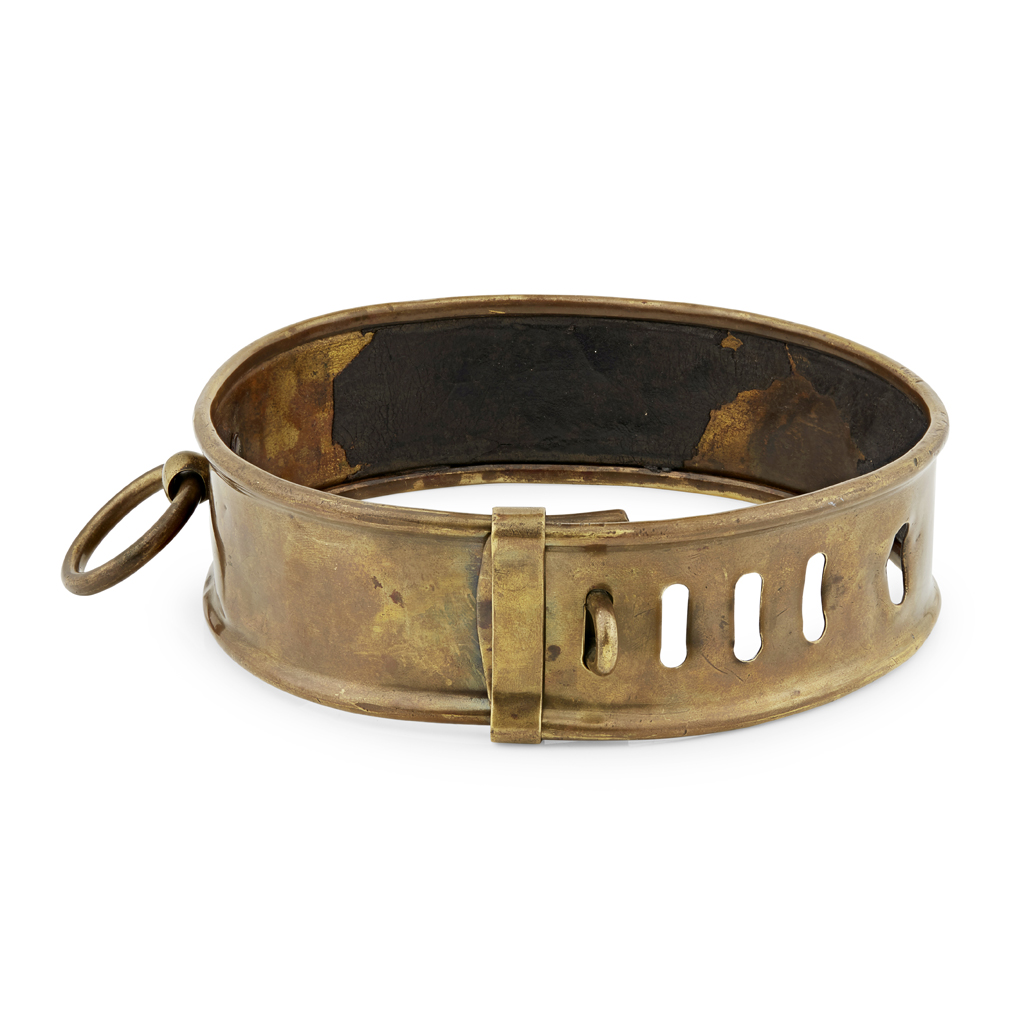
A LARGE EIGHTEENTH CENTURY BRASS DOG COLLAR
CIRCA 1780
Scottish Silver & Applied Arts
Auction: 15 August 2018 at 11:00 BST
Description
The simple collar with moulded rim and five spaced settings and large brass lead ring, engraved in script 'Her Grace the Duchess of Buccleuch, Montagu House, White Hall, London, Dalkeith Palace, Edinburgh'
Dimensions
Diameter approx. 20cm
Footnote
Elizabeth Scott was born Lady Elizabeth Montagu in 1743. She was the daughter of George Montagu, the 1st Duke of Montagu and Mary Montagu, Countess of Cardigan and later Duchess of Montagu. After Mary’s father died, her husband was named Duke of Montagu, taking her father’s title. Elizabeth married Henry Scott, 3rd Duke of Buccleuch in 1767 to become Duchess of Buccleuch. In 1767, her portrait was painted by well-known artist Thomas Gainsborough. She died in 1827, at the very advanced age of 84. Sir Walter Scott wrote about her, saying “she was a woman of unbounded beneficence to, and even beyond, the extent of her princely fortune. She had a masculine courage, and great firmness in enduring affliction, which pressed on her with continued and successive blows in her later years.”
There were two Montagu houses in London. Both are now demolished. The first one was given to the British Museum when the area of Bloomsbury became unfashionable. The first house, after a fire in the late 17th century that destroyed the original on the first site, was designed by Pierre Pouget in a French inspired design with Mansard roof and French interiors and gardens. The second house, where Elizabeth Scott would have grown up, was on the Thames in Whitehall, London. It was a relatively modest mansion when compared with grand period houses and had seven bays and a pediment. In 1767, Elizabeth Scott married in the Whitehall house. It was demolished in the mid-19th century and replaced with a Victorian house which was demolished in 1950.
Dalkeith Palace in Edinburgh was built in 1702, on the site of an earlier palace. It served as the seat of the Montagu family until the 1920’s. It was designed by James Smith, the preeminent classical architect in Scotland at the time. It was based on William of Orange’s Netherlands palace and the engravings were done by Grinling Gibbons. Today, the palace is a historical site.