

Lot 429
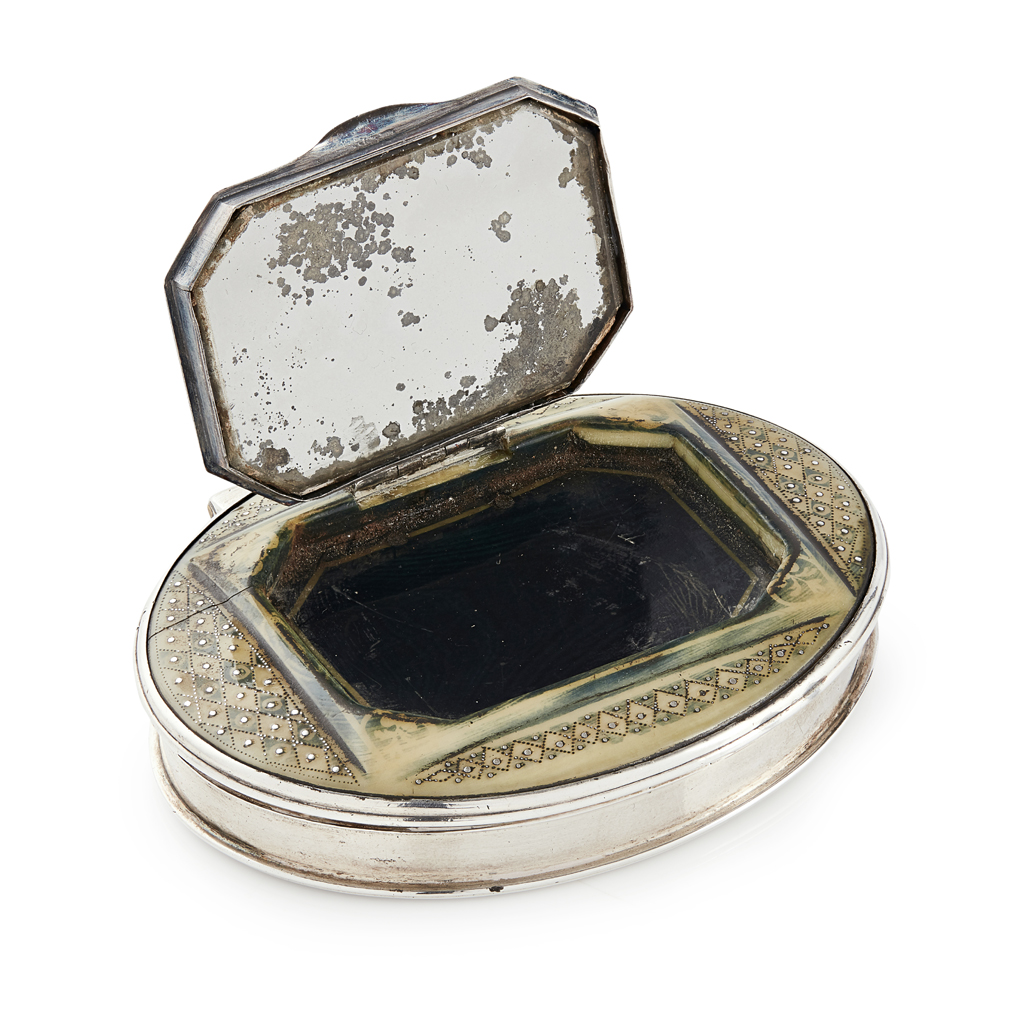
JACOBITE INTEREST - AN UNUSUAL EARLY/ MID 18TH CENTURY DOUBLE SNUFF BOX Y
UNMARKED, CIRCA 1720/ 1730
Scottish Silver & Applied Arts
Auction: 16 August 2017 at 12:00 BST
Description
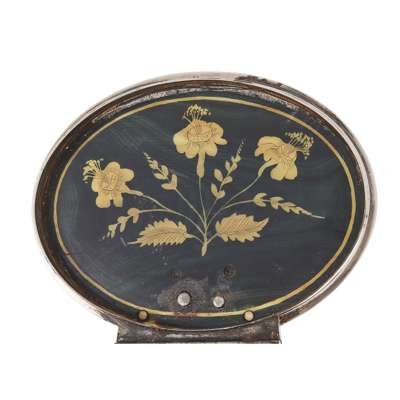
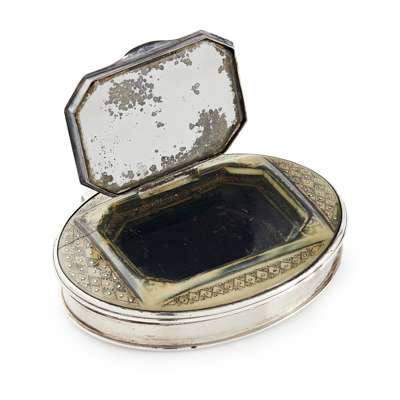
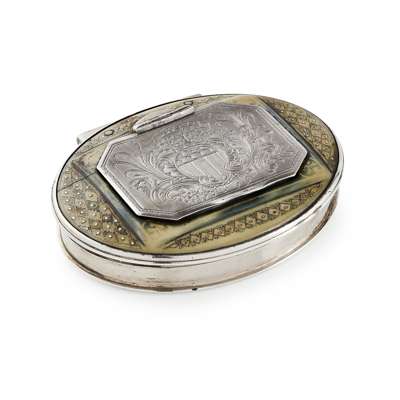
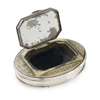
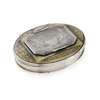
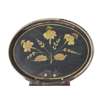
of oval outline, the plain straight sided silver body with reeded rims, the hinged ivory cover with traces of blue staining and inlaid lattice and pins, the centre set with an almost flush hinged silver cover with finely engraved armorial with rococo scroll mantling, when open reveals a mirror to interior and blue stained ivory inner, the inside of the main cover with three displayed open rose heads on a greenish blue background, the base of similar colour with foliate scroll to outside
Dimensions
Width: 9cm
Footnote
Heraldry: Belsches of Innermay (or Invermay) in the County of Perthshire (the arms and crest as found on the lid) and the crest of the family of Robertson of Lude in the County of Perthshire (as found on the side of the box). They may be blazoned as follows:
Arms and Crest of Belsches of Innermay
Arms: Or three pallets gules a chief vair a crescent for difference
Crest: A trunk of oak eradicated sprouting leaves proper
Motto: Revirescit [It flourishes again]
Note: The Belsches originally held lands at Tofts in Berwickshire, but some of the family moved to Perthshire in 1717. The most likely original owner of this snuff box is Thomas Belsches of Greenyards (baptised on 1st October 1702). He served as Depute Sheriff Clerk for Edinburgh and was admitted a Burgess of the city by right of his father, and for his good services to the city, on the 25th July 1739. He was the second son (hence the use of the cadency mark of a crescent upon the arms) of Alexander Belsches of Innermay (the 1st of Innermay) and Emelia Murray, the daughter of Sir Thomas Murray of Glendoik. Thomas firstly married Margaret Hepburn of Baads, the daughter of Robert Hepburn of Baads on the 8th November 1741, and later, his cousin, Helen Belsches of Tofts, the daughter of John Belsches of Tofts.
The fact the eradicated oak tree is used as the crest of the Belsches is interesting and may suggest early Jacobite leanings and support. Such an oak tree was a badge employed by the Royal House of Stuart and there are certainly strong connotations with the Jacobite cause. This symbol is regularly depicted in medallions, glass and other forms of Jacobite art, almost exclusively in connection with the motto, as seen with this example.
Although ascertaining the Belsches Jacobite support has proved almost impossible, the family through marriage are later very closely connected with Alexander Forbes, 4th Lord Pitsligo (1678 - 1762). He was a staunch Jacobite who not only fought in the 1715 uprising, but also in the 1745 uprising. His support for the ill-fated '15 saw him flee to the safety of the continent and the Jacobite court, but his stay would not last long: by 1720 he was travelling back to Scotland. This support of his countrymen would be seen some 25 years later with Prince Charles Edward Stuart's return to Scotland, when Forbes raised a regiment of over 100 men and fought closely with the Prince until their eventual defeat at Culloden.
After the defeat of Culloden, Forbes went into hiding on and around the estates of Pitsligo. However, the house and farms were not safe so he created a hidden lair in a cave underneath a bridge, where he lived for many years disguised as a beggar. Throughout this time he was a wanted man and local legend tells of him - in full disguise - helping Hanoverian troops look for himself and even give away the location of his hiding place, feigning assistance. This daring attitude and continued disrespect for the Hanoverian rule in the staunchly Jacobite North East created a man of legend, whose daring acts live up to the stories told.
Please be aware that this lot contains material which may be subject to import/export restrictions, especially outside the EU, due to CITES regulations. Please note it is the buyer's sole responsibility to obtain any relevant export or import licence. For more information visit http://www.defra.gov.uk/ahvla-en/imports-exports/cites/