

Lot 426
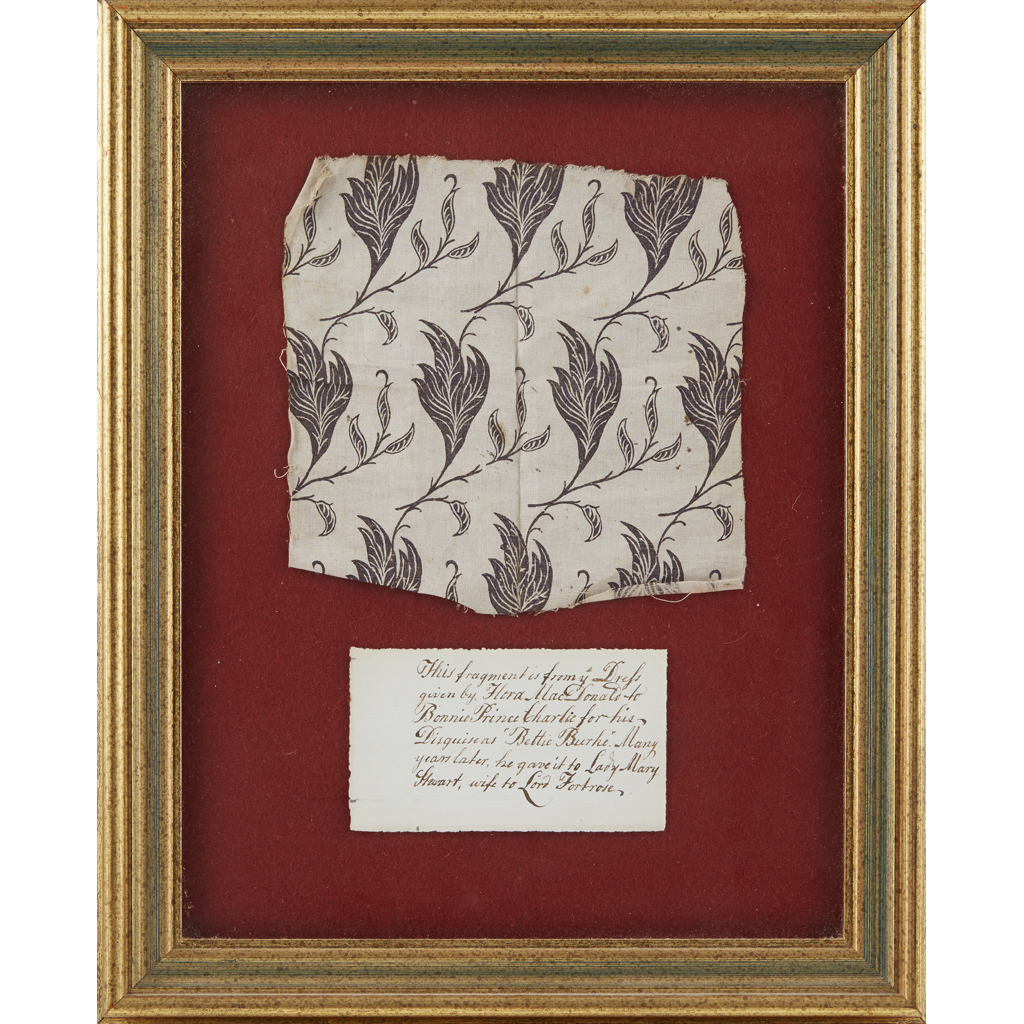
A FRAMED SECTION OF PRINTED FABRIC
18TH CENTURY
Scottish Silver & Applied Arts
Auction: 16 August 2017 at 12:00 BST
Description
the torn section of fabric printed with foliate sprigs on a natural ground, framed on a red background with handwritten label reading THE FRAGMENT FROM A DRESS GIVEN TO BONNIE PRINCE CHARLIE FOR HIS DISGUISE AS BETTIE BURKE, MANY YEARS LATER HE GAVE IT TO LADY MARY STEWART, WIFE OF LORD FORTROSE
Dimensions
Fabric 16.5cm x 16cm (approx), frame 30cm x 37cm
Footnote
Note: Charles Edward was fleeing for the safety of the continent after the defeat at Culloden. His escape from the mainland via the Isle of Skye has been immortalised in song, poem and art since the 18th century, however the period where, with Flora MacDonald's help, Charles dressed as her maid Betty Burke to escape detection, is often overlooked for the more romantic idea of the gallant Charles retreating.
Relics and propaganda of Flora MacDonald are scarce, despite the fact that she is considered such a famous supporter of the Jacobite cause to the modern mind. Some confusion has surrounded the imagery of Flora/Betty Burke in the past and a how famous print of Flora was, for a long time, considered to be of Prince Charles as Burke. A small handful of engraved glasses showing Charles dressed as Betty Burke survive, giving an insight into the importance the contemporary Jacobites held for this event, which has almost been forgotten.
Flora MacDonald was born in 1722 to a tenant farmer on the island of South Uist in the Outer Hebrides of Scotland. Her father died when she was a child, and her mother was abducted and then married by Hugh MacDonald of Skye, leaving Flora to be brought up by the chief of her clan, the MacDonald's of Clanranald. She was later educated in Edinburgh.
After his defeat at Culloden in 1746, Bonnie Prince Charlie fled to the island of Benbecula in the Outer Hebrides, where the 24-year old Flora was visiting her brother. Charles persuaded Flora to help him escape the island undetected, and she was granted, via her step-father, the commander of the local militia, a pass by boat to reach the mainland for herself, two servants and a crew of six. The Young Pretender was disguised in a dress as Irish spinning maid, Betty Burke, until he reached Skye where Flora was able to find him help; and thus she became the quintessential heroine of the Jacobite cause.
However upon arriving in Skye, people became suspicious, and although Bonnie Prince Charlie was able to escape, Flora was arrested and sent to the Tower of London. She was allowed to live outwith the confines of the tower for a time under the watch of a gaoler, until her release in 1747. She later married, and moved with her new husband to North Carolina for a period, before her husband was captured whilst fighting for the Hanoverian forces during the War of Independence. Upon his release they returned to Scotland via a short stay in Nova Scotia. The voyage home was anything but quiet, and after their ship was attacked by privateers, she was injured after refusing to take shelter below deck.
Flora and her husband took up residence on the Isle of Skye and she remained there until her death in 1790. During her time in Skye she met Samuel Johnson, the English essayist who was travelling in Scotland for a period, who recorded that ''her name will be mentioned in history, and if courage and fidelity be virtues, mentioned with honour."