

Lot 210
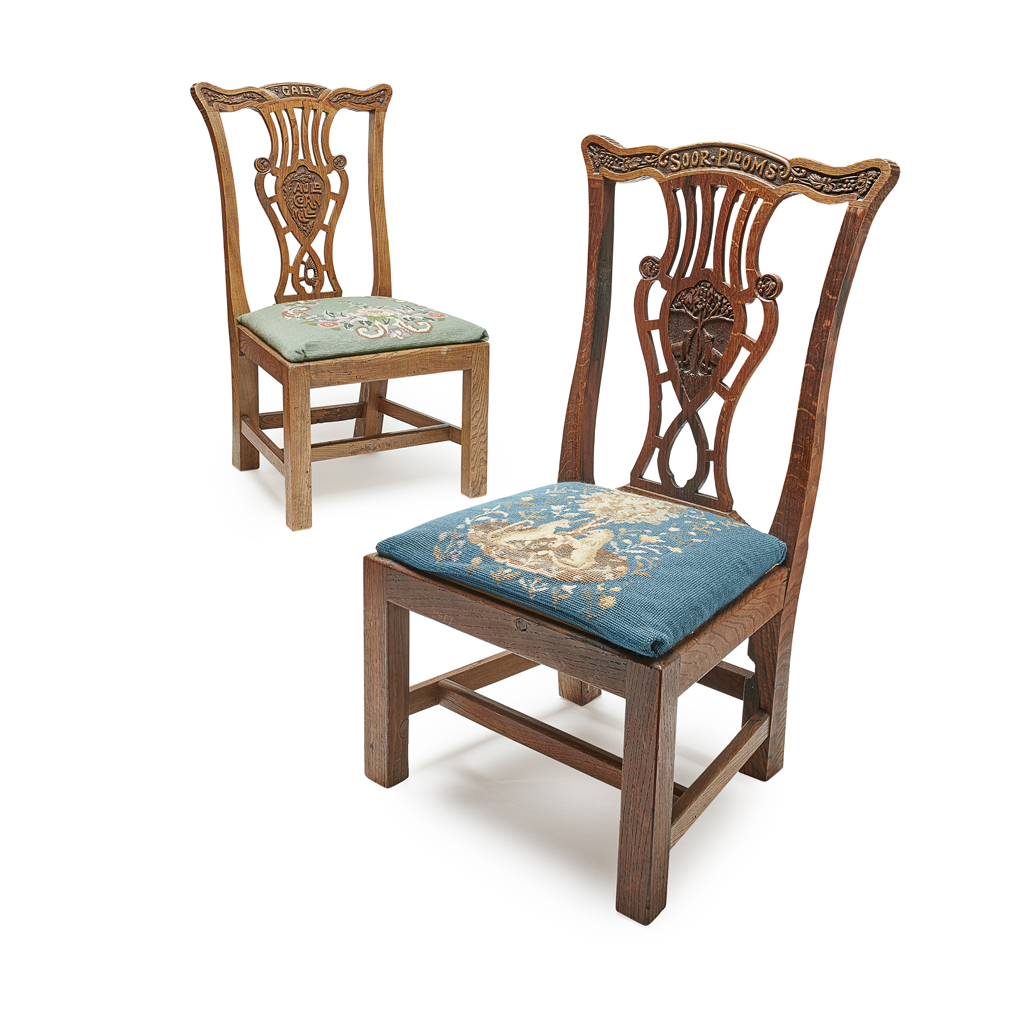
SCOTTISH BORDERS & GALASHIELS INTEREST: TWO ARTS & CRAFTS ELM LOW CHAIRS
EARLY 20TH CENTURY

Scottish Silver & Applied Arts
Auction: 16 August 2017 at 12:00 BST
Description
carved by Tom Hislop and en suite with the previous lot, each with carved top rails, one inscribed GALA with pierced splat below carved with the inscription AULD CORN MILL, 45cm wide, 82.5cm high, 41cm deep; and the other inscribed SOOR PLOOMS with splat carved with two foxes by a plum tree, 45cm wide, 80cm high, 37cm deep (2)
Footnote
Note: In 1337 a group of men from the border town of Galashiels came across some English raiders resting in a field, eating unripe wild plums. The Galashiels men attacked and killed them and, in doing so, saved their town from raids.
In commemoration of this event, not only was a boiled sweet created and sold, called a 'soor ploom', but the town's motto also became 'soor plooms' and the crest became an image of two foxes reaching for the fruit of a plum tree.
It is also this event that is celebrated during Galashiels' annual Common Riding. This is a tradition in many border towns, whereby a principle townsperson is elected who leads a procession to celebrate historical events during which individuals risked their lives to protect the town. These principles have different titles depending on the town; in Galashiels they are known as Braw Lads or Lasses, which was taken from Robert Burns' poem 'Braw Lads o' Galla Water.'
The tradition of Common Riding originated in the thirteenth and fourteenth century. At this time, the principle would be selected by the local lord to patrol the town boundaries in order to protect it from raiding parties, which were common at the time. After the necessity for this practice diminished, it was carried on ceremonially to celebrate local legends and history. Galashiels' current tradition began in 1930. The 'Braw Lads Gathering' has also come to commemorate three other historical events: the engagement of James IV to Margaret Tudor (1503), whose descendants brought about the union of the crowns (1603) and the Treaty of Union (1707); the granting of a Charter as Burgh of Barony to the people of Galashiels (1599), thus establishing the town as an independent unit; and as an homage to the war memorial for those from Galashiels that died in the First World War 1914-1918.