

Lot 364
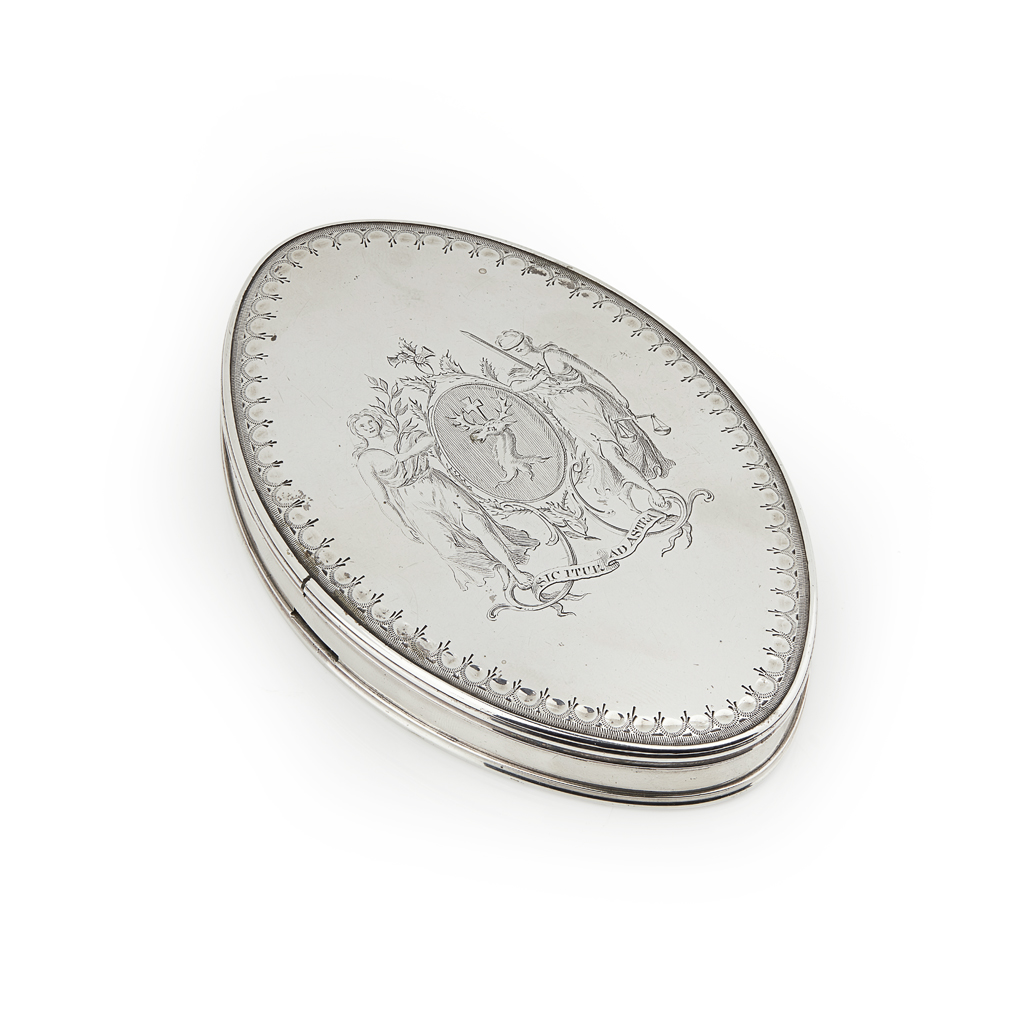
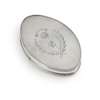
THE HENRY DUNDAS CANONGATE FREEDOM BOX
SCOTTISH, CIRCA 1795
Scottish Silver & Applied Arts
Auction: 17 August 2016 from 12:00 BST
Description
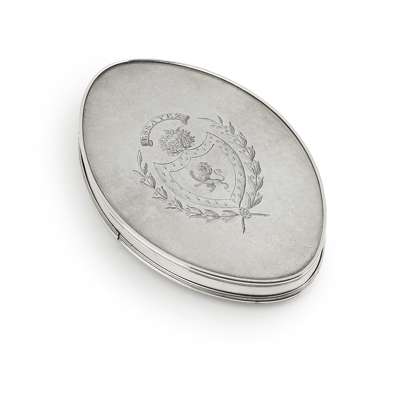
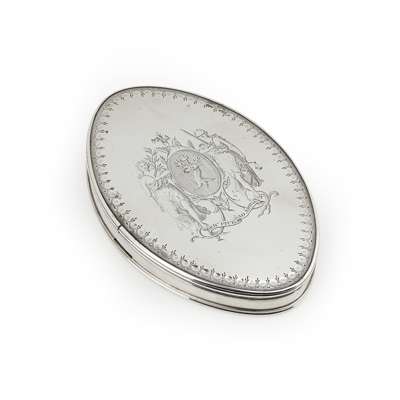
unmarked, of navette form with straight sides and reeded rims, the finely engraved cover with bright cut border and with armorial of the Burgh of Canongate, the base with engraved armorial of Sir Henry Dundas
Dimensions
13cm long, 4.2oz
Footnote
Note:
The Arms of the Families of Bellenden and Dundas
The arms as engraved on this freedom box are those of the families of Bellenden and Dundas. They may be blazoned as follows:
Bellenden
Arms: Gules a hart's head erased between the attires a cross crosslet fitchy or
Supporters: (Dexter) A lady holding in her hand a branch of palm all proper
(Sinister) A lady blind folded holding in her right hand a sword erect and in her left hand a pair of scales all proper
Motto: Sic itur ad astra [Such is the way to immortality]
Some authorities state that the hart's head is couped rather erased as shown here as well as its head is set between three cross crosslets fitchy rather than one cross crosslet fitchy between its attires.
These supporters whether official or not are similar to those borne by the Lords Bellenden of Broughton (created 1681) although they are placed the other way round.
Dundas
Arms: Argent a lion rampant gules a bordure ermine
Crest: A lion's head full-faced gules looking through a bush of oak proper
Motto: Essayez [Try]
An examination of the available pedigrees pertaining to the families of Bellenden and Dundas shows no immediately obvious genealogical connection between the two families. There is, therefore, a likelihood that this freedom box may have been in the ownership of two members of this family as some time and each caused their arms to be engraved thereon. Of course, we could also conjecture that it was gift from one of the families to the other.
This freedom box forms part of a small yet important group of Freedom boxes awarded to one of Scotland's most important and influential politicians of the post Culloden 18th century era, Henry Dundas, 1st Viscount Melville.
Henry Dundas was born on the Royal Mile in 1742 and originally educated at Dalkeith Grammar School. His education was interrupted by a case of smallpox and he re-started his education latterly at Edinburgh's Royal High School. He studied Law at Edinburgh University and would hold positions as Solicitor General and Lord Advocate of Scotland before becoming the MP for Midlothian in 1744.
He was a close ally of Prime Minister William Pitt and served in various roles including that of War Secretary.
He was a hugely powerful figure in Scottish politics and society at a time when Royal connections with Scotland were at their most removed, and he virtually ran the country on his own accord in their absence.
He was a great supporter of the Enlightenment and a figure well-known in Edinburgh. He was instrumental in the development and improvements around the New Town of the city, which brought many benefits to those who were moved out of slum conditions in the Old Town at the time. Dundas is immortalised atop the 150 foot column standing centrally in St. Andrews Square today.
However the important group of freedom boxes and presentation items awarded to Dundas were for his work in repeal of the coal tax in 1793. The exportation of coal from Scotland, mainly by sea, was a major part of the country's economy and fortunes were reliant on its sale to the highest levels of society. It also it provided work and wages for the greater community as well. Due to the poor peat harvest of 1792 the price for coal had been pushed higher and by 1793 the addition of further taxes created a further price rise, proving not only difficult for exporters but for the end users in heating their homes.
Dundas's repeal of the taxes was hugely popular as can be seen in the various presentations including this freedom box and others from Dumfries (National Museum of Scotland collection) and a gold example from Montrose (Montrose Museum collection) and further afield around Scotland.