

Lot 270
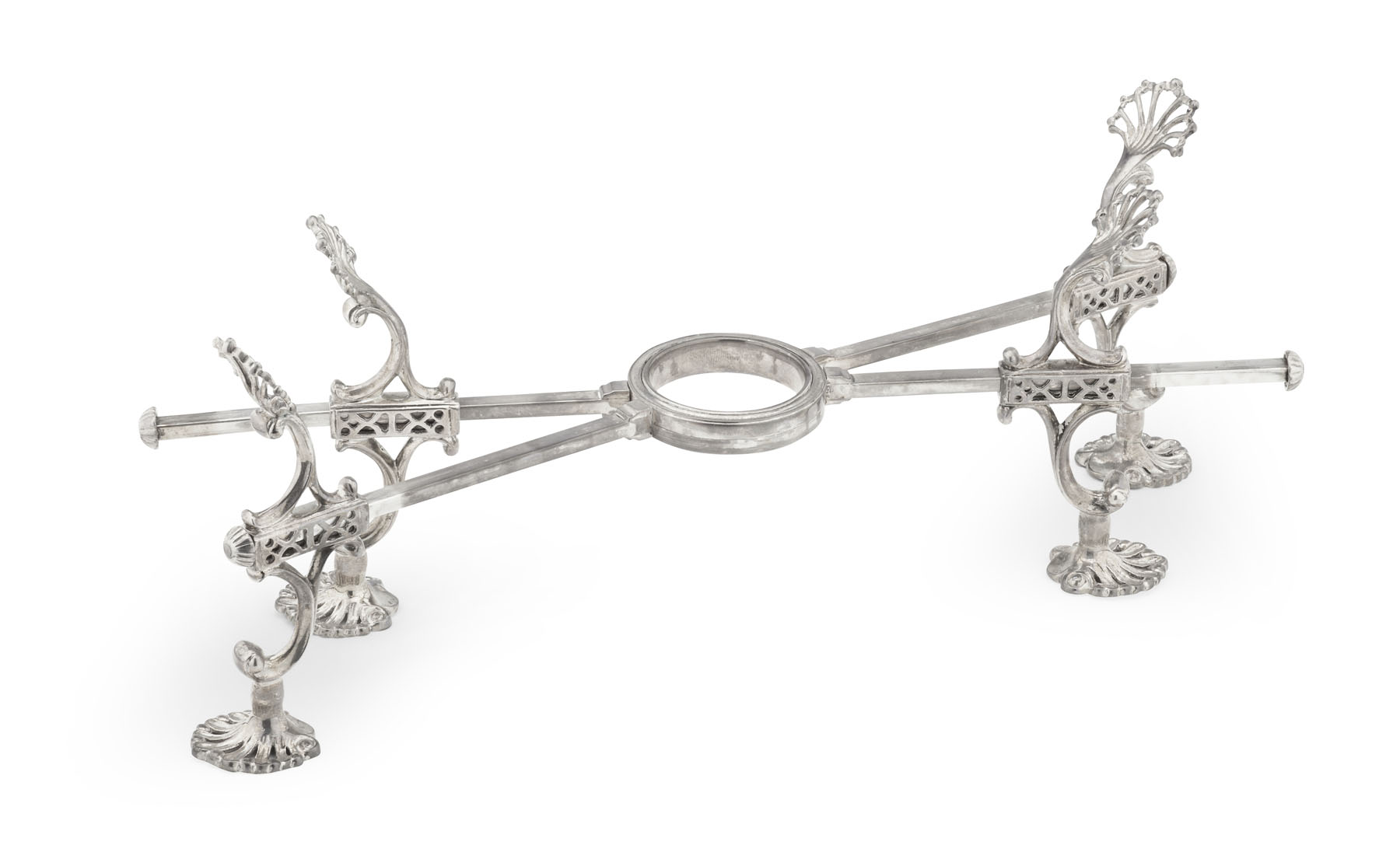
A George III dish-cross
Auction: 16 August 2010 at 15:00 BST
Description
William Dempster, Edinburgh 1767 - 1768, of conventional hinged form, with central circular section with four square section supports, each with sliding pierced mount with S scroll leg to gadrooned and pierced shell feet, the upper section with curved arm and pierced and beaded shell terminal
Dimensions
33cm wide, 21oz
Footnote
Notes: while the earliest Scottish dish ring is dated Edinburgh 1693 - 1694, the dish cross under discussion does not appear within Scottish examples until 1751, and from this does not seem to become a standard of design and manufacture until mid 1760's. After this point they appear (as with England) to become a standard on the upper classes table.
Their use as with dish rings, or Irish ring dishes, is simple, to keep hot plates from damaging the surface of highly polished wooden tables. It is for this reason that while available as standard the addition of a burner was at the choice of the buyer and not necessarily issued as a standard with the piece.
While it has often been debated that examples such as this are lacking burners, this would seem unlikely as such a high proportion of Scottish examples are found this way. The lack of a burner would not necessitate a change in design and when the central loop section also provides the hinging action it seems highly likely that these would be left in rather than have to re design a whole item.
Provenance:
Sotheby's Gleneagles, 28th August 1985 lot 148
References:
'Compendium of Scottish Silver II' R & J Dietert, illustrated plate 21, listed page 212