

Lot 254
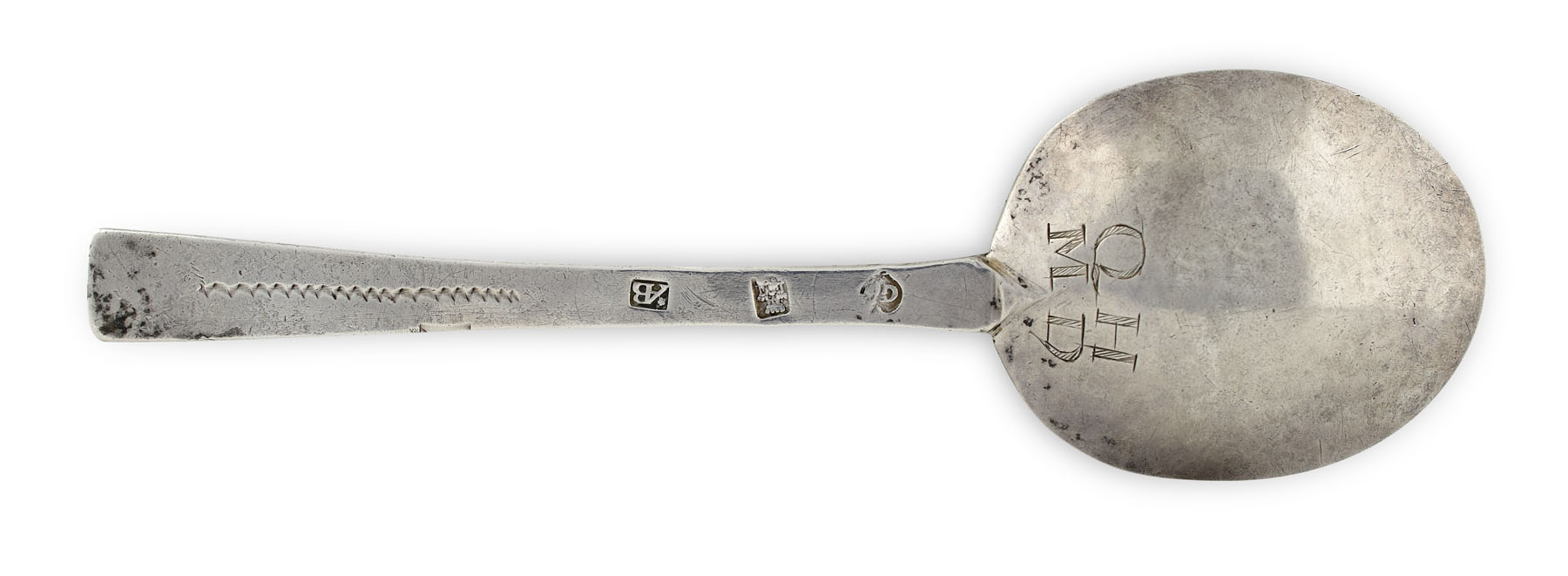
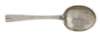
'The Barncleuch' Puritan spoon - an important Scottish 17th century puritan spoon


Auction: 16 August 2010 at 15:00 BST
Description
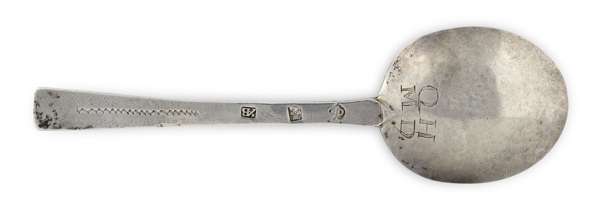
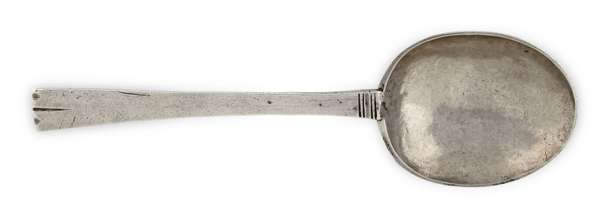
by George Cleghorne, Edinburgh 1653 - 1655, Deacon Andrew Burrell, the tapered stem with three V cut notches to terminal and incised decoration to stem above large oval bowl, the reverse with large zig zag assay scrape and bottom marked, the reverse of the bowl with short V shaped rat tail and engraved with contemporary initials 'QH / MD'
Dimensions
19.2cm long, 65g
Footnote
Provenance:
Reputedly found in the gardens of Barncleuch House
Thence by descent
Sotheby's Gleneagles, 30th August 1982 lot 483 (front and back illustrated)
How of Edinburgh, 1993
Private Collection
Exhibitions:
Silver; Made In Scotland' item 3.47, National Museums of Scotland 2008
References:
Compendium of Scottish Silver, volume 1 page 239, R & J Dietert
Silver; Made In Scotland' page 52 item 3.47, piece and marks illustrated, G Dalgleish & H Steuart Fothringham
Notes:
The survival of Scottish Puritan spoons is surprisingly rare when compared to the same style and period of English examples. To date only nine hallmarked or provincial examples are known and this example being the earliest.
It is unknown why this pattern should be so rare in Scotland when it is such a standard and comparably common pattern in English silver. It must be considered that a large number have been melted down and re fashioned throughout their history and lost. However even when compared to the other patterns of early Scottish flatware their survival still seems remarkably small.
Even within such a small survival fashions and trends can be noticed. While following the English examples the Scottish made pieces do show variation.
Due to its early manufacture this piece must be considered one of the plainer examples, virtually without additional decoration to the stem, other than the almost standard three V cut notches to terminal. The addition of the simple incised decoration above the bowl being it's only additional adornment and unique to this spoon.
For a full listing of currently recorded Scottish Puritan spoons see 'An important new discovery in early Scottish silver' The Finial September / October 2008.
Another interesting angle to this spoon are the engraved owners initials to the reverse of the bowl; with the original source of Barncleuch, it does appear that the upper initials 'QH' stand for Quintin Hamilton of Barncleuch and it must be assumed the lower set 'MD' for Marion Denham his wife, the date of marriage so far remains untraced but is presumably roughly contemporary to the spoon.
Little is known about Quintin Hamilton other than he succeeded his father James Hamilton and took over the house and gardens at Barncleuch which had been constructed by his grandfather John Hamilton of Barncleuch, Commissary of Hamilton and Campsie in 1583. While the house at Barncleuch was of no great note within Scottish stately home architecture it was the gardens created by John Hamilton that really stood out.
These terraced gardens he created with great vision and ambition carving five terraces into the steep hillside from the house to the river Avon and carried out large amounts of structural work. His visions and creations were no doubt inspired by his experiences travelling the world which consumed a large part of his life.
Quintin and Marion are believed to have had five children and upon Quintin's death in circa 1680 he was succeeded by his eldest son John who in turn died on 21st February 1705 without direct heir.
References:
'Historical and Genealogical Memoirs of the Branches of the House of Hamilton', John Anderson 1825 pages 221 - 3 and supplement page 420 - 2