

Lot 168
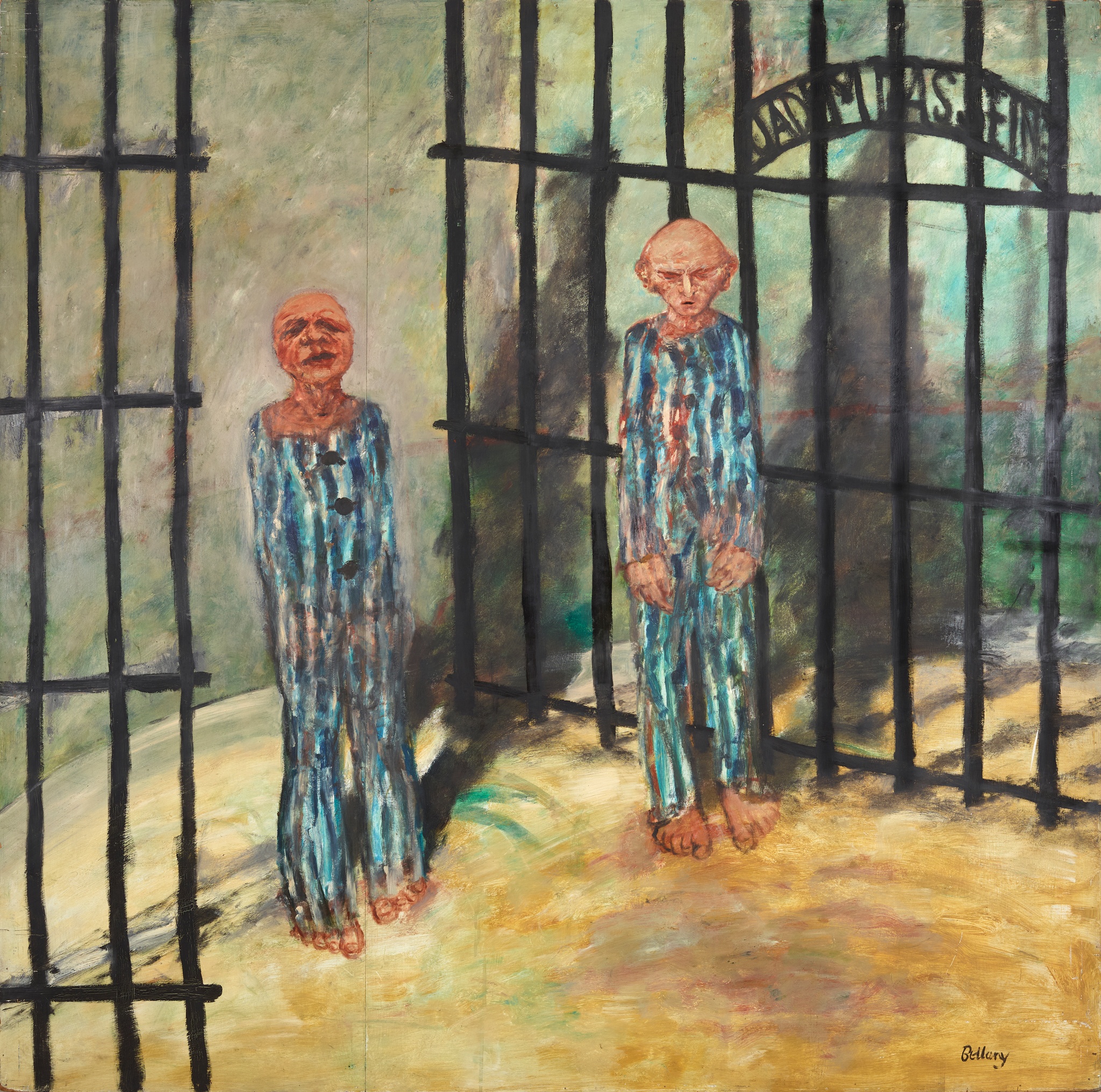
JOHN BELLANY C.B.E., R.A., H.R.S.A. (SCOTTISH 1942-2013) §
BUCHENWALD PORTRAIT
Scottish Paintings & Sculpture
Auction: Evening Sale ft. A Century of Scottish Colourists Part II | Lots 90 to 169 | Thursday 03 December 2026 from 6pm
Description
Signed, oil on conjoined boards, unframed
Dimensions
183cm x 183cm (72in x 72in)
Provenance
Estate of John Bellany
Footnote
‘I think that was one of the most traumatic experiences of my life, actually seeing that place, seeing what one human being can do to another … It was frightening beyond words.’ (John Bellany, recalling his visit to Buchenwald in 1967 in Bellany: A Film Retrospective, in which the present painting features)
In 1967, John Bellany travelled to East Germany with the painter Alexander (Sandy) Moffat and the poet Alan Bold. The journey followed a chance meeting with composer Ronald Stevenson on a train between Glasgow and Edinburgh. Stevenson suggested that they accompany him as delegates of the Federation of Composers in Scotland, attending the Handel Festival in East Germany. During the trip, they visited Dresden, Halle, Weimar and East Berlin.
A visit to the former concentration camp at Buchenwald proved to be one of the most profound experiences of the trip. Bellany was deeply affected by what he saw, describing the experience as ‘frightening beyond words’. He spoke of the prisoners' extraordinary courage, but also of the horror of witnessing what one human being could do to another. The trip also brought him into contact with German art, including Otto Dix's Der Kreig (The War) triptych of 1929-32 (Collection Galerie Neue Meister, Dresden) which made a strong impression on him. Moffat later recalled that, after attending a performance of Janáček's Jenůfa at the Komische Oper in Berlin, Bellany spoke of wanting to return to painting immediately. This also reinforced for the group the importance of art in confronting human suffering. For Bellany, the paintings that followed became a way of addressing what he had witnessed at Buchenwald and the questions of cruelty, suffering and evil that it raised.
The impact of the visit was soon apparent in a series of darker and more confronting works, including Pourquoi? and Pourquoi? II, both of 1967, in which Bellany turned to the suffering of concentration camp prisoners. The striped uniforms they wore became a recurring motif, appearing again in paintings such as The Bellany Family of 1968 (Collection Culture Perth & Kinross). Here, Bellany depicts himself with his pregnant wife, Helen, alongside the faces of Holocaust victims. The position of their son Jonathan, whose head appears directly beneath the faces of the prisoners, is particularly unsettling. His presence brings childhood and family life into close proximity with the suffering of the victims, creating a disturbing contrast between innocence and the brutality of the concentration camps. Helen later recalled how the experience had affected her husband's religious outlook, saying that he no longer had such a clear sense of heaven and had become preoccupied with ‘the other side of things’. The striped figures continued to appear in works such as Lost Soul of 1968, showing how the experience at Buchenwald continued to occupy the artist.
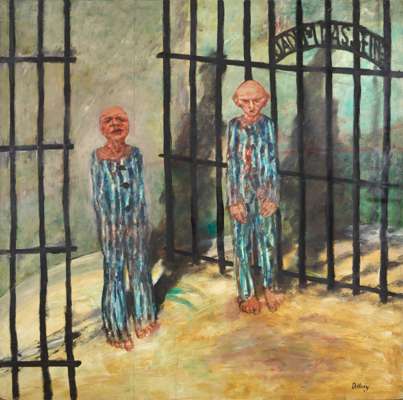
In the present work, Buchenwald Portrait of 1968, the iron entrance gate to the camp occupies the upper right of the composition, bearing the wrought-iron inscription JEDEM DAS SEINE. The phrase, usually translated as ‘To each his own’, also carries the sense of each person receiving what is due to them. Originally associated with the idea of justice, it was appropriated by the Nazis and installed on the gate in 1938, where it was intended to be read by prisoners inside Buchenwald. In this setting, the words take on a particularly sinister meaning, suggesting that the prisoners were receiving what they deserved.
Two figures stand behind the iron bars, dressed in the aforementioned striped uniforms. Their gaunt faces, pale features and elongated bodies convey a sense of physical suffering, while their arms hang limply at their sides. The shadows are particularly striking: alongside those cast by the iron bars, each figure appears to cast one of its own, stretching across the ground and extending beyond the body. These dark forms give the figures an additional, unsettling presence and may suggest the lasting effects of the suffering they have endured. By placing the viewer on the other side of the gate, looking towards the prisoners through the bars, Bellany creates a strong sense of separation and confinement.
