Lot 132
FRANCIS CAMPBELL BOILEAU CADELL R.S.A., R.S.W. (SCOTTISH 1883-1937) ‡
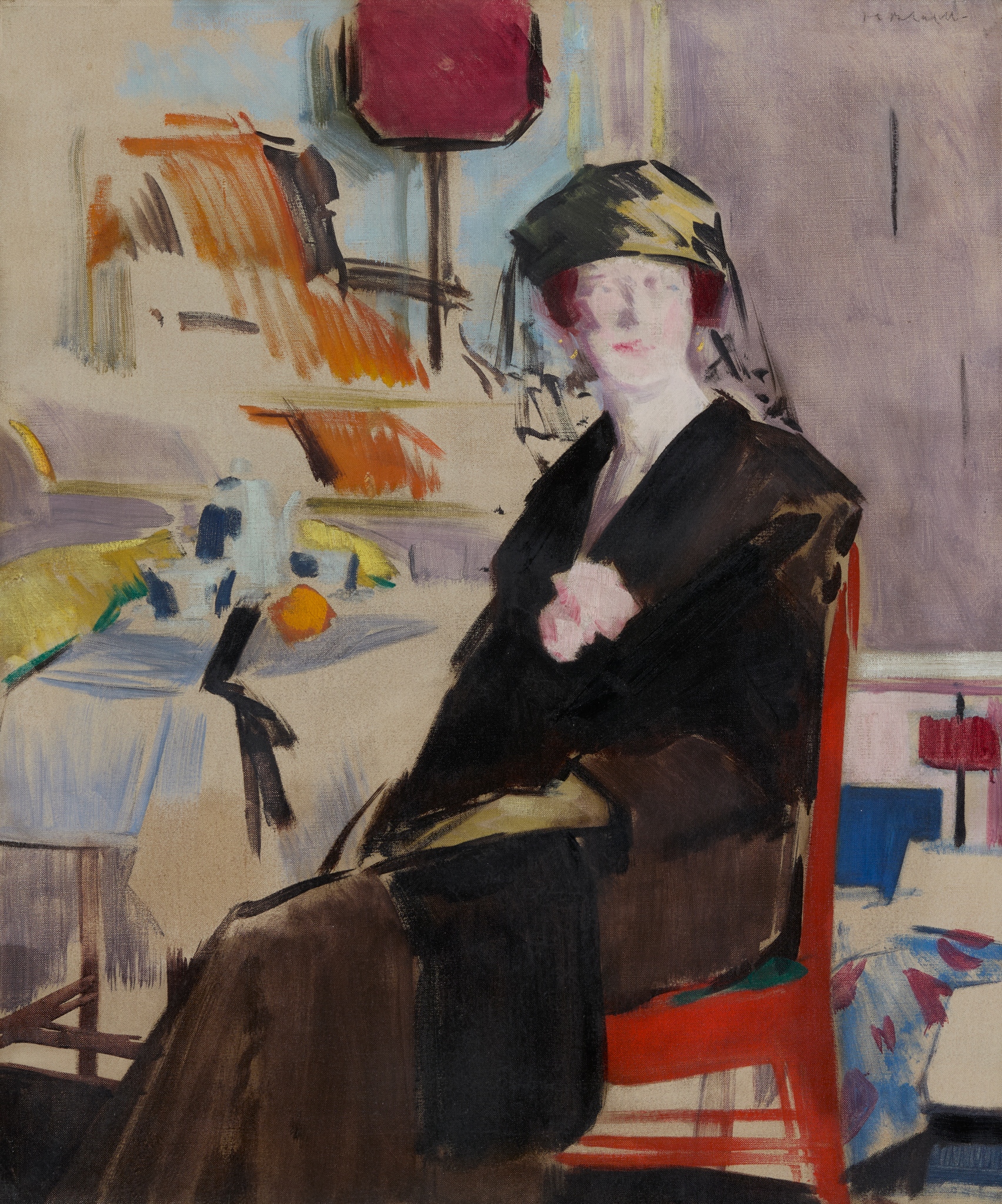
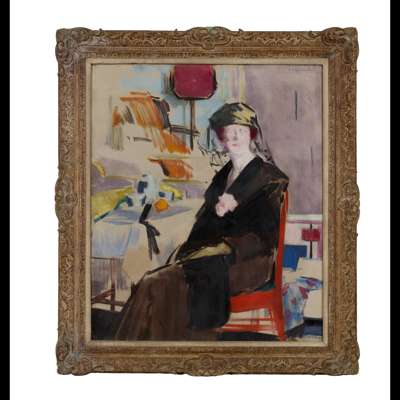
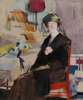
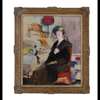
INTERIOR: THE LADY IN BLACK
Scottish Paintings & Sculpture
Auction: Evening Sale ft. A Century of Scottish Colourists | Lots 88 to 168 | Thursday 04 June 2026 from 6pm
Description
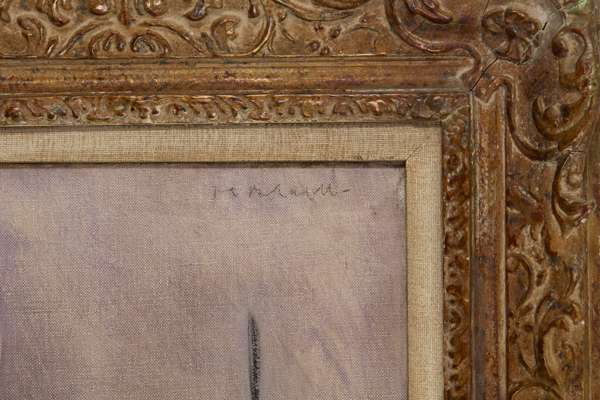
Signed, oil on canvas
Dimensions
62.2 x 75cm (24.5in x 29.5in)
Provenance
FROM A DISTINGUISHED PRIVATE AMERICAN COLLECTION
Christie's London, 18th March 1966, lot 41 (incorrectly titled ‘Portrait of Miss Don Wauchope’), sold to Des Roches for £21
Acquired by the present owner in New York in 1966
Footnote
Francis Campbell Boileau Cadell is one of the four artists now known as the Scottish Colourists, along with John Duncan Fergusson, George Leslie Hunter and Samuel John Peploe. They shared an early immersion in the developments of progressive French art in the late 19th and early 20th centuries, a love of a brilliant palette and the use of expressive brushwork. The quartet exhibited together in London and Paris in the 1920s and 1930s and are recognised as not only the most important and revered Scottish artists of the modern period, but ones who also played an important role within British and European art history of the time.
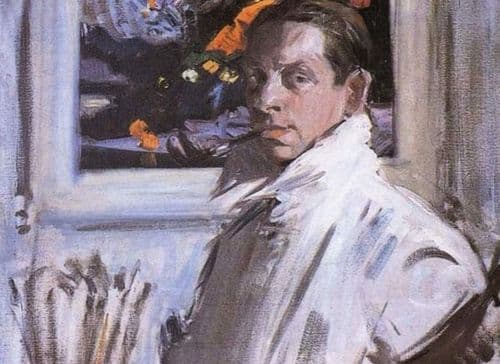
Cadell can be considered the most Scottish of the group. He was born in Edinburgh, trained there, in Paris and in Munich and lived for most of his life in the Scottish capital. He was proud to be a Scot and often wore a kilt. Moreover, he and his work are inextricably connected with Edinburgh, whose light, architecture and society provided inspiration for much of his practice. The sculptor Pittendrigh Macgillivray summed up Cadell’s artistic achievements thus: ‘It seems to me … that your forte lies in a gift of colour and light – these seen in a joyous mood.’ (Letter from Macgillivray to Cadell of 23 February 1915, National Library of Scotland, Acc.11224)
Interior: The Lady in Black dates from the most important and successful period in Cadell’s career. After making a name for himself with solo exhibitions in London and Edinburgh before the First World War, he was demobilised from the army in 1919. The following year he purchased 6 Ainslie Place, in Edinburgh’s Georgian New Town, across the road from his childhood home at number 22. Cadell’s new quarters were magnificent and extended over six floors. He painted his front door bright blue to annoy his neighbours and lived there until 1931.
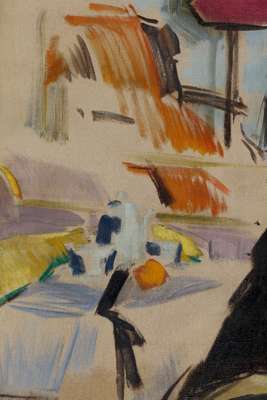
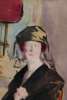
Interior: The Lady in Black depicts the artist’s north-facing studio on the first floor, with a view over to Fife. It encapsulates Cadell’s stylish decoration of his home, which became the subject matter of a remarkable series of works created in the 1920s. His signature lilac walls and highly-polished black floor set the scene which he dressed with mirrors as seen at the upper left, furniture like the Louis XV-style armchair and pole screen glimpsed within it and props such as the blue and white coffee set and closed, be-ribboned black fan laid out on the white tablecloth.
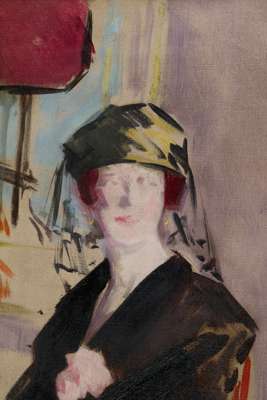
Indeed, the present painting is a splendid bringing together of many of Cadell’s most celebrated props and motifs, as an interior with his elegant model May Easter at the centre of its composition. She and Bethia Hamilton Don Wauchope were Cadell’s most distinguished sitters. Miss Don Wauchope was in her seventies by the time the current painting was made and the younger Miss Easter’s distinctive red hair drew Cadell’s Colourist eye, as can be seen in Pink and Gold, which Lyon & Turnbull sold from Paisley Art Institute’s collection in 2024. His most successful images of her, as here, revel in the combination of her hair colour, fresh complexion, the shimmer of the golden turban and the transparency of its veil that he preferred to present her wearing. Cadell’s use of black is a pronounced and effective characteristic of his oeuvre, seen here in Miss Easter’s chic clothing and set off by the placement of a pink rose at the base of her neckline.
Cadell’s modernity is clear in the bright red chair on which Miss Easter sits, one of several that appear as brilliant focal points in paintings such as The Studio, in the collection of Lillie Art Gallery, East Dunbartonshire (acc.no. MINAG:1984.13). Such was its visual impact that Peploe featured it in some of his post-First World War paintings at a time when the artists’ friendship was at its closest. The coffee set is the subject of works in its own right and elements of it appear in paintings such as Still Life (Grey Fan) in the National Galleries of Scotland (acc.no. GMA 1311), in which a be-ribboned fan can also be seen.
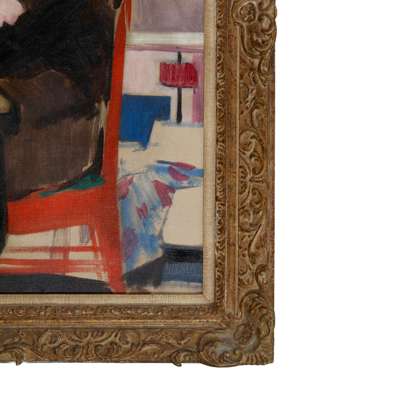
A particular conceit of Cadell’s was to include a painting within a painting. In Interior: The Lady in Black this is represented by the bright blue rectangle at the lower right, positioned beside the blue and pink fabric seen to full effect in The Embroidered Cloak in Ferens Art Gallery, Hull (acc.no. KINCM:2005.4791). Throughout, Cadell’s expressive brushwork, which verges on the abstract is some passages, plays upon the canvas as he simplified form, teased the viewer with hints of description and used areas of brilliant colour to create rhythm across the image. Yet this energy is contained within the calm majesty of Miss Easter’s poise. She glances beyond the confines of the support to the studio beyond, part of which is visible in the mirror, revealing Cadell’s skilful manipulation of space.
Interior: The Lady in Black is a tour de force example of Cadell’s painting, created at the height of his career. It epitomises why he is one of Scotland’s most revered artists and why his work is so highly sought after for private collections and so admired in public collections.