Lot 120
GEORGE HENRY R.A., R.S.A., R.S.W. (SCOTTISH 1858-1943)
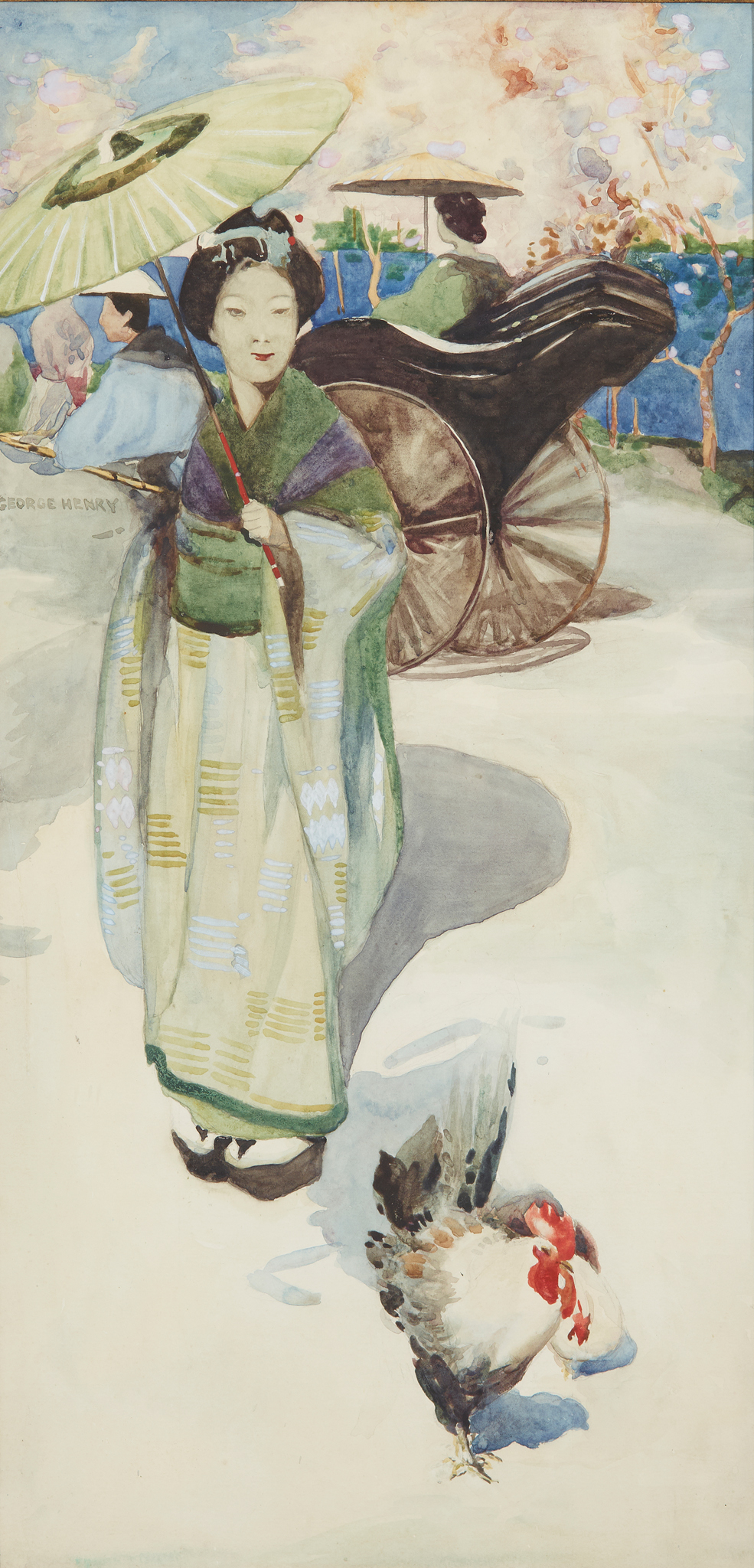
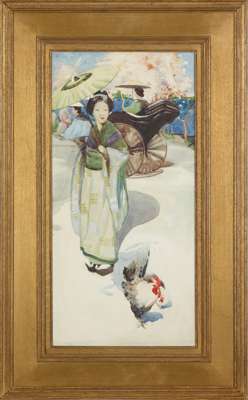
GEISHA AND RICKSHAW


Scottish Paintings & Sculpture
Auction: Evening Sale ft. A Century of Scottish Colourists | Lots 88 to 168 | Thursday 04 June 2026 from 6pm
Description
Signed, watercolour
Dimensions
53cm x 25.5cm (21in x 10in)
Provenance
Alexander Reid; John Tattersall, (1859-1935), grocer, collector and dealer, Dundee
Lyon & Turnbull, Edinburgh, 30 May 2013 as Blossom Time referred to in Professor Kenneth McConkey notes as Afternoon Promenade, Tokio
Exhibited:
Glasgow, Royal Scottish Watercolour Society, 1900, no 91
Dundee, Victoria Art Galleries, Loan Collection of Paintings, Watercolours & Engravings, 1912, no 113 (lent by John Tattersall Esq, as The Promenade, Tokio)
Glasgow, Empire Exhibition, 1938, no 206
William Buchanan et al, Mr Henry and Mr Hornel visit Japan, 1978-9, Scottish Arts Council Touring Exhibition, no 67 (illus GH 60, p. 25 in catalogue)
Literature:
‘Exhibition of Watercolours: Royal Scottish Society’, Glasgow Herald, 31 March 1900, p. 9
'Royal Scottish Watercolour Society’, North British Mail, 31 March 1900, p. 4
‘Exhibition of the Royal Scottish Society of Painters in Water Colours’, The Gentlewoman, 7 April 1900, p. 454
AH Millar LLD, Illustrated Catalogue of a Loan Collection of Paintings, Watercolours & Engravings, 1912 (Victoria Art Galleries, Dundee with the British Association), opp. p. 64 (illus)
‘British Association’s Art Legacy’, Dundee Courier, 13 September 1912, p. 4
J Taylor, “Some watercolour drawings by George Henry ARA’, The Studio, vol 68, 1916, p. 78, 79 (illus in colour)
‘Miscellaneous Publications’, Sheffield Daily Telegraph, 27 July 1916, p. 2
Footnote
When he returned to Glasgow from Japan in July 1894, George Henry reported to his travelling companion, Edward Atkinson Hornel, that when he unrolled his canvases, he discovered that ‘with a few exceptions, they are simply one mass of cracks and the full-length portrait of the wee Kanazawa Geishas which I rolled up rather carefully … is utterly destroyed’. He was despondent. Their pact, to stage a joint exhibition of Japanese pictures, at Alexander Reid’s gallery in Glasgow was now in jeopardy, and Henry saw no way to recoup his finances after the costly seventeen-month adventure. The situation did not immediately improve and in a further undated letter, probably written at the beginning of October, he confesses that things were so difficult, he was ‘going to send two small drawings to the watercolour society’s show this month.’ The larger of these, O Mura-Saki San, Shinjuku, was sold, but debts continued to mount, and Henry was obliged to draw again on his Japanese watercolours.
Being compelled to break ranks effectively scuppered the joint enterprise and Hornel’s ‘Japan’ exhibition in the following spring was a solo affair. Henry’s finances only began to improve when he received portrait commissions in 1895-6. Throughout the following five years he was at liberty to release his own Japanese works into exhibitions in Glasgow and Edinburgh, and one of the best of these, Afternoon Promenade, Tokio, (sic) was held back and only finally relinquished in 1900.
This striking composition reveals Henry at his finest. Other works had featured mousmés, well-dressed Japanese children, conversing in the street, but here the visual conversation is between a girl with a parasol and an unpredictable cockerel that struts towards the spectator – a little drama that fails to draw the attention of a passing rickshaw. The painting’s undoubted charm drew praise from reviewers who, using words such as ‘delightful’, concluded, in one instance, that in Afternoon Promenade, Tokio, ‘Henry’s art is … seen at its best’. So memorable was it that in 1916 it featured as a colour plate in The Studio with the following encomium:
The Promenade, Tokio (sic), in conception, scale, composition, technique and harmony, is surely the highest expression in the gentle art of watercolour drawing. Mark the unrivalled sensitiveness in the green and pink in parasol a kimono, the depth of tenderness in the distance blue, and the invigoration in that note of red in the cock’s comb, a spot of incalculable value. This drawing should have found a place in a public collection; it is too valuable an asset in the humanising process that lies ahead to be buried in the seclusion of a private collection.
A work of museum quality without doubt, and of great charm, the present watercolour must have reminded readers of The Studio in time of war, of the fascination for a distant country and culture that had, more than any other, dominated aesthetic thinking in art and design in Britain for fifty years since the time of James McNeill Whistler. The United Kingdom and Japan were allies in the Great War. Since the Iwakura Mission of 1871-3, the establishment of an embassy in Edo (Tokyo), and a ‘Japanese village’ in Kensington, things Japanese became sources of great curiosity. Artists and designers led the way in this. Following the visits of Mortimer Menpes, Alfred East, John Varley, Percy Sturdee and Alfred Parsons, that of Henry and Hornel in 1893-4, marked out the aesthetic innovation that could only result from such an exchange. Henry’s role as innovator in this had been foreshadowed in the new design-consciousness evident in his radical Galloway Landscape, 1889.
Striking compositions such as that in Afternoon Promenade, Tokio, were of course ideally explored in watercolour, a medium that encouraged the swift translation of the thing seen into two dimensions. Notes made in the street might be worked up in the studio accentuating the unique character of a mousmé and an errant fowl. Nothing could be more vivid than the light and air conveyed in the serpentine shadow cast by the girl and echoed in miniature in the creature she observes. By the time Henry exhibited Afternoon Promenade, Tokio, he, like John Lavery, James Guthrie and Edward Arthur Walton, had sufficient patronage to risk moving to London. The Scottish painter would later become a respected Academician, but to see his work at its best there was no doubt in 1916 that the present watercolour was the place to start.
We are grateful to Professor Kenneth McConkey for writing this catalogue entry.