

Lot 79
GEORGE WALTON (1867-1933)
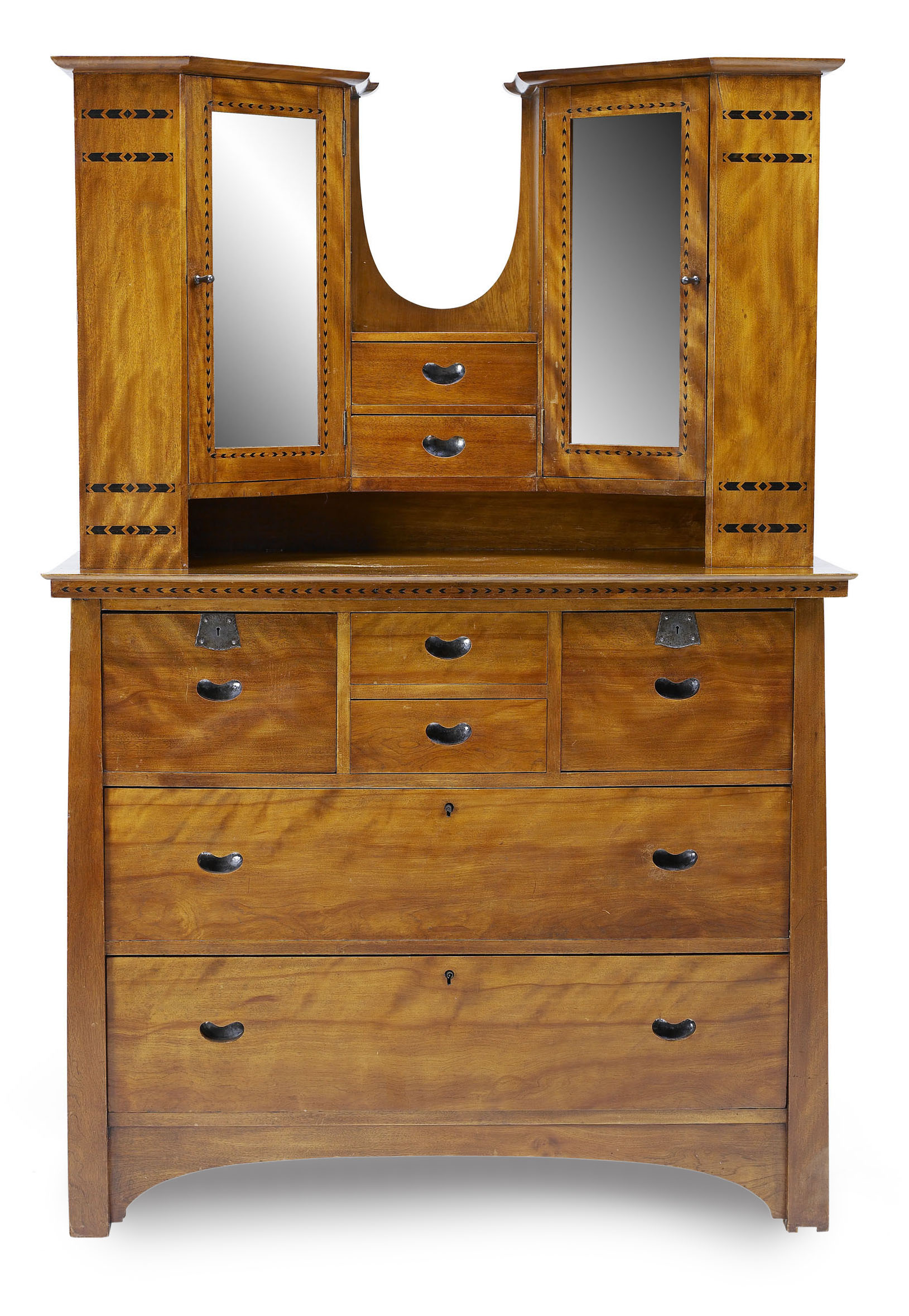
SATIN BIRCH SIDE CABINET, CIRCA 1898
Auction: 19 August 2013 at 12:00 BST
Description
decorated with chevron banding, the surmount with opposing mirrored doors centred by two drawers, above a rectangular top and an arrangement of four short over two long drawers, each with cut out handles and beaten silvered backplates, the whole raised on bracket feet, label aperture to rear (label now lacking)
Dimensions
114cm wide, 172cm high, 60cm deep
Footnote
Literature: Moon, Karen, 'George Walton, Designer and Architect', pub. Oxford 1993, pages 64-70
Agius, Pauline, 'British Furniture 1880-1905', pub. Suffolk 1978, page 102, pl. 105
Note: George Walton was born in Glasgow on 3 June 1867, the youngest of twelve children. The painter, Edward Arthur Walton, born in 1860, was his elder brother and the flower painter, Constance Walton, his sister. His father died in 1873 leaving the family in reduced circumstances and Walton had to leave school aged thirteen to become a clerk with the British Linen Bank, but while working there he also studied at Glasgow School of Art (as the School of Design had become in 1869).
In 1888 Miss Catherine Cranston commissioned Walton to re-design the interiors of the tea rooms at 114 Argyle Street, Glasgow. Walton gave up banking and opened showrooms entitled George Walton & Co, Ecclesiastical and House Decorators, at 152 Wellington Street. The Walton firm quickly expanded into woodwork, furniture making and stained glass. In 1896 Walton received a further commission from Miss Cranston to decorate the Buchanan Street premises. His collaborator was C. R. Mackintosh, for whom Walton made some early pieces of furniture. In 1897 Walton moved to London and, as well as retaining his Glasgow showroom, opened a branch in York.
The present lot is characteristic of the furniture produced at Elm Bank, York by Walton & Co. in 1898 for Sydney Leetham. The furniture is inlaid with bold geometric chevron banding, a type of decoration which had been revived and popularised by George Jack at Morris & Co., however the use of this technique at Elm Bank was altogether bolder and more expansive.