Lot 220
ELIZABETH BLACKADDER D.B.E., R.A., R.S.A., R.S.W., R.G.I., D.LITT. (SCOTTISH B.1931) §
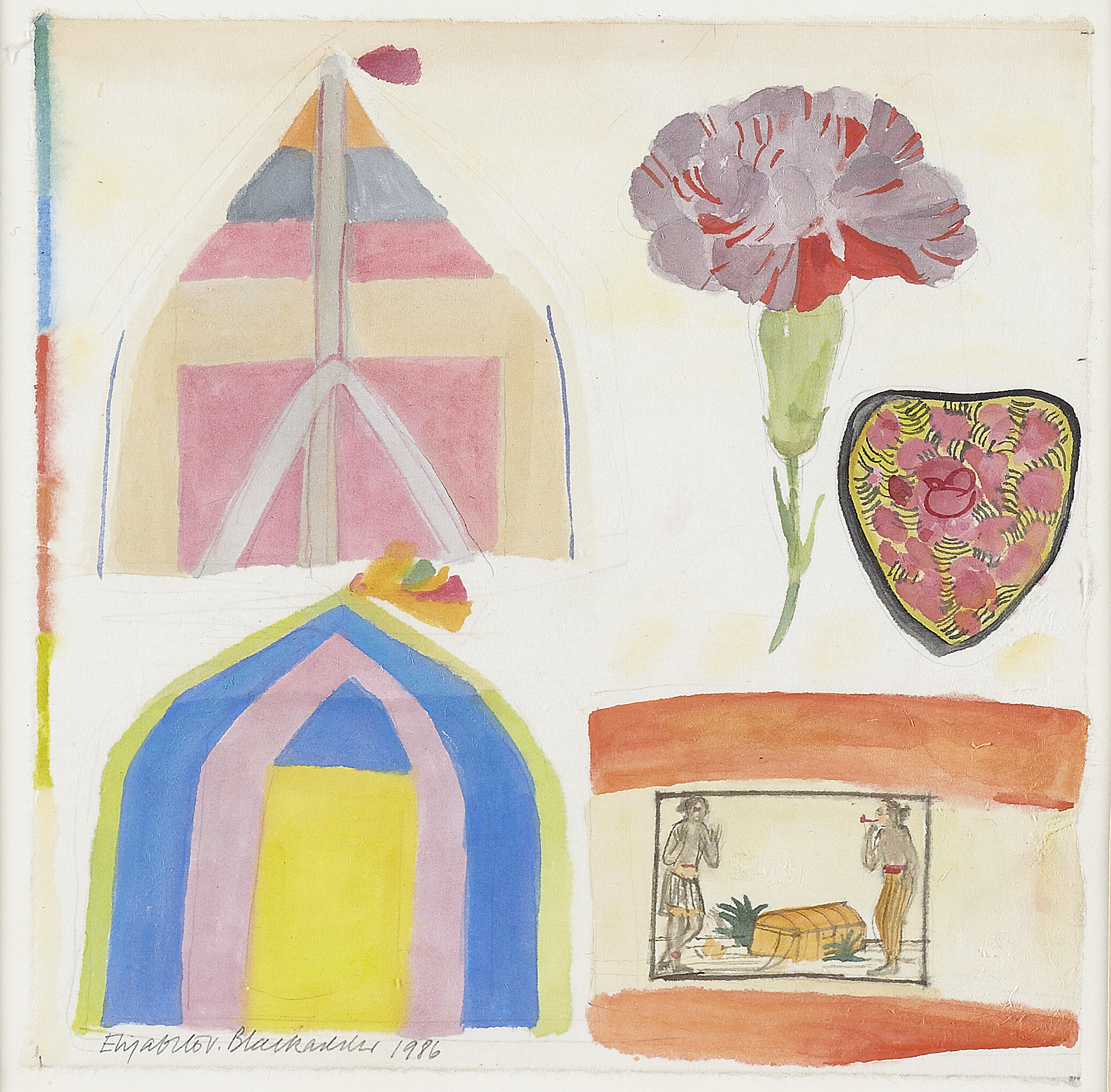
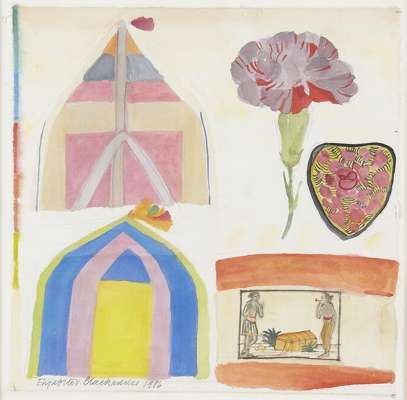
INDIAN PURSES AND CARNATION
Scottish Contemporary & Post-War Art
Auction: 25 August 2011 at 10:00 BST
Description
Signed and dated 1986, and inscribed label verso, watercolour with bodycolour on paper laid down
Dimensions
20.5cm x 17.5cm (8in x 6.8in)
Footnote
Provenance: Provenance: Christmas Festival, Fair Maids House Gallery, Perth, cat. no. 16
Born in Falkirk in 1931, Elizabeth Blackadder graduated with First Class
Honours in the joint Fine Art Degree awarded by the University of Edinburgh and Edinburgh College of Art. She is the first female artist to have been elected both R.S.A. (in 1971), and R.A. (in 1976), and in 1982 was appointed O.B.E. (later promoted to D.B.E.). Her long and fruitful artistic career is currently being celebrated by a retrospective exhibition at the National Galleries of Scotland. Blackadder's oeuvre is channelled into three distinct genres that nevertheless all display her idiosyncratic artistic style: landscape, still life, and flower painting. In each we observe her
engagement with questions of space, and the symbiotic relationship between direct observation and memory. The daughter of an engineer, Blackadder seems to have inherited her father's skills as a draughtsman, capturing the glorious and fragile beauty of flowers with a near scientific realism that is nevertheless differentiated from botanical drawing through its empathy and expression. Although flowers first appeared in her still lifes early in her career, Blackadder's focus on flower
painting truly emerged after she moved to Fountainhill Road with her husband John Houston, where they cultivated the tulips and irises that would later feature so prominently in her work. It was here, while convalescing from illness in the 1970's that she would turn away from oil
painting, and turn instead to the subtlety of watercolour, capturing the delicate beauty of the flowers in her garden with a skill that makes her
studies instantly recognisable. Along with his graphic skills, Blackadder also inherited her father's love of travel, and propensity to collect exotic
objects. These knick-knacks, from kimonos to kites, chosen for their vibrant colours or intriguing forms would be explored in still lifes composed of grid patterns that reflect the artist's early fascination with Mondrian; works that acknowledge Western art's obsession with
perspective whilst simultaneously embracing an alternative approach to space. Indeed, by the 1980's Blackadder was nurturing a growing fascination with Japanese art, and in 1985 she and Houston embarked on an artistic pilgrimage to Japan that echoed that of their Scottish forebears George Henry and Edward Atkinson Hornel. While this trip undoubtedly marked a turning-point in her artistic development, it proved too
brief, and so the pair returned for a longer sojourn in 1986. She would return not only with a revitalised portfolio of fresh motifs (such as the
impish mouse in this work, which seems to reach out beyond the picture plane to taunt her famous cats), but with a new, flowing approach to space.