

Lot 237
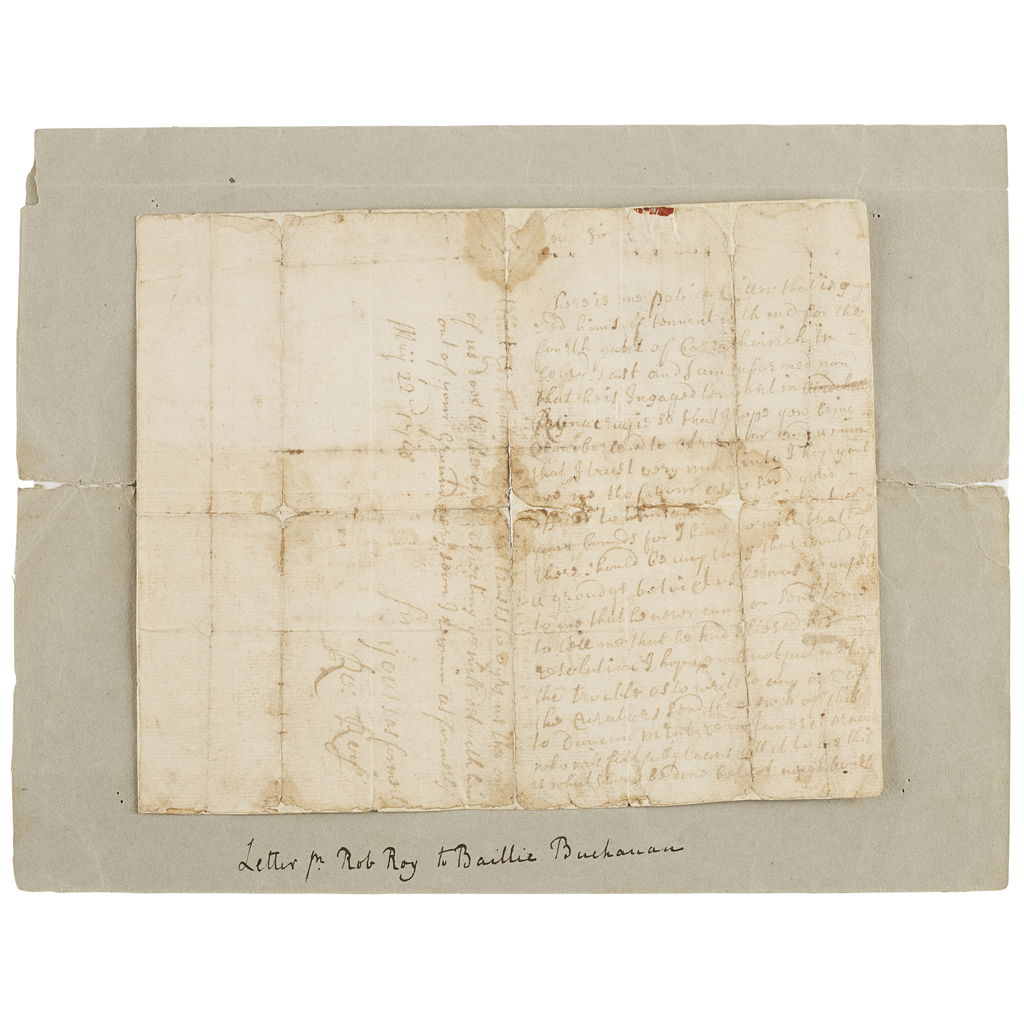
ROB ROY MACGREGOR (1671 - 1734), SCOTTISH OUTLAW AND FOLK HERO.
AUTOGRAPH LETTER SIGNED "RO. ROY" TO BAILLIE BUCHANAN,
Rare Books, Maps, Manuscripts & Photographs
Auction: 19 June 2019 at 12:00 BST
Description
chamberlain to the curators of Buchanan of Arnprior, 22 May 1718 . The letter is signed "Rob Roy ", an exceptionally rare form for him to use as virtually all Rob Roy's known letters and contracts bear his formal signature "Ro: Campbell.
The letter is approximately 15.5 x 9 cms and has been folded once. The letter has been backed at some stage and docketed as "Letter from Rob Roy to Baillie Buchanan."
The text of the letter is as follows:
Dear Sir
There is one Patrick Cotter that ingag- l ed himself tennent with me for the l fourth pairt of Corriecheirrich in l febry. last and I am informed now l that he is Ingaged tennent in Airdcheil l Rynaerugie so that I hope yow being l Chamberland to Arnprier and a man l that I trust very much unto I hop youl l doe me the favour as [to] send your l officer to him and [put?] him out of l your bounds for I have no will that l there should be anything that could be l a groudge betuixt us that was so unjust l to me that he never came or sent to me l to tell me that he had altered his l resolution I hope ye will not put me to l the trouble as to write to any other of l the Curators send answer of this l to Duncan McIntyre in Innerchernach l who will faithfully transmitt it to me this l is what should be done betuixt neighbours l and especially [p ] as trusts to others as the one l of us does to the other expecting you will del with him l out of your Ground very soon I remain as formerly l Maij 22nd 1718
sir
yours as formerly Ro: Roy
The letter asks that a cotter called Patrick may be removed from a tack of land in Rynaeurugie [in Menteith, the placename Airdcheil has been erased], as the man previously engaged in February last with the writer for a fourth part of the lands of Corriecheirrich [in Glendochart]. The writer wishes the recipient to send his officer to put the cotter out of bounds of Arnprior's lands, and adds, a little threateningly, that "I have no will that there should be anything that should be a groudge between us." The cotter never told Rob Roy that he had changed his resolution. If the recipient refuses to deal with the matter, Rob Roy is prepared to write to any of the curators, but does not wish to be put to this trouble. An answer is to be sent to Donald McIntyre in Innerchernach who will transmit it to the writer. The writer observes that this is what should be done between neighbours, especially when one of them, in this case Bailie Buchnanan, is in a position of trust.
It is rather unexpected to find a brigand, even if a semi retired one, complaining of anything as petty as the unexpected removal of a cotter. Rob Roy's past conduct leads one to assume that he would have taken a more direct method of dealing with the man. Possibly this was a particularly useful tenant, or, more likely, one as well known as Rob Roy, preferred not to be defied so publicly? On the whole, one's sympathies are with the cotter. It is even possible that the young laird of Arnprior might have been less likely to proceed to extremes. With Rob Roy as landlord, a tenant might all too easily find himself involved in the theft of cattle or even removed to prison accused of consorting with broken and landless men as the Macgregors had been for generations.
It is possible that this letter is part of a much larger struggle between four great powers - the Dukes of Atholl, Montrose and Argyll and the Earl of Breadalbane. The last two as Campbells should have hung together, but they seldom did. Argyll's family had been whig for generations whereas a lifetime of sitting on any available fence had made Breadalbane's position less clear until his final declaration of support for the Jacobite cause in the '15, and even here the evidence is slight, probably due to a frenzied clear out of incriminating papers by his son, the second earl, who succeeded his father in 1717. John, 1st Earl of Breadalbane, who died, aged 81, in 1717 after a long illness, was mostly, as far as anyone so slippery could be accurately claimed as a supporter, on Rob Roy's side in his perpetual difficulties with Atholl and Montrose, one or other, or sometimes both, the inadvertent suppliers of cattle and hence, subsistence, to the Clan Gregor. Both the latter Dukes had failed to capture, or at least to capture and retain, Rob Roy, and it is generally agreed, they had both treated him very unfairly, making him landless, homeless and bankrupt.
The lands of Corriecheirrich belonged to Breadalbane, lying in the parish of Kenmore, and the lordship of Disher and Toyer, were presumably included in the tack given by Breadalbane to Rob Roy of the lands of Auchinsicallan in Glen Dochart in 1713. Deprived of a protector by the death of Breadalbane [ the second Earl being firmly Hanoverian, disliked him strongly and said so], and having his house there burned down in April 1716, Rob Roy returned to Inversnaid, where his house at Craigrosten was also burned down in September 1716, six months later. Thereafter, he retired to a house in Glen Shira, on the Argyll lands, and appears to have remained there unmolested in spite of being forfeited for his part in the Jacobite rebellion. However, he was still writing from Auchinsicallan in April 1719 explaining that money difficulties prevented him from supplying the desired cattle. Relations with Montrose and Argyll remained uncertain, the former being among the creditors who claimed debts totalling over £1,000 stg. due [they said] when Rob Roy was forfeited in 1720, and he may have been seriously annoyed at the defection of a tenant from Breadalbane's Corriecheirich to Montrose's Rynarugie.
Nothing is known of this particular cottar: Patrick is an Ayrshire surname, associated with Kilwinning, and while it was a common forename in Breadalbane, it has not been found among the tenants there. It is just possible that Rob Roy was referring to the man by his Christian name, assuming that the place would identify him in the mind of Bailie Buchnanan. By 1725, the lands of Corriecheirich were let to Patrick McVean, and three years later he was being prosecuted by the bailie of Disher and Toyer for cutting an ash tree and some alder for chairs. If Rob Roy was successful in his efforts to have the cotter removed from Arnprior's lands, perhaps this may be the same family.
Most of Rob Roy's surviving letters and contracts are signed "Ro: Campbell." After all, when you are a proscribed Macgregor on the lands of a Campbell, it makes sense to adopt this style, especially when the Campbell in question is John, 1st Earl of Breadalbane. All the letters from Rob Roy in the Breadalbane collection in the National Archives of Scotland are signed thus. When other letters in the National Archives refer to him in the third person they generally talk of "Rob Roy" or "the villain Rob", or in similar denigratory terms. Bonds registered in the Register of Deeds describe him as "Rob Roy Campbell of Inversnaid" or "Rob Roy Campbell in Glengyle", but he also signs them simply as "Ro: Campbell". There is some evidence that Rob Roy signed himself thus when there was no need to adopt a Campbell cover or claim kinship with the recipient. What is clear is that surviving letters signed "Rob "Roy" are extremely rare.
We should like to thank Dr. BLH Horn, formerly of the National Archives of Scotland, for examining the letter and for her valuable assistance with preparing this catalogue entry. Sold in our Rooms, 8 July 2003, lot 16