

Lot 362
Cowper, William
Rare Books, Maps & Manuscripts
Auction: 10 September 2014 at 12:00 BST
Description
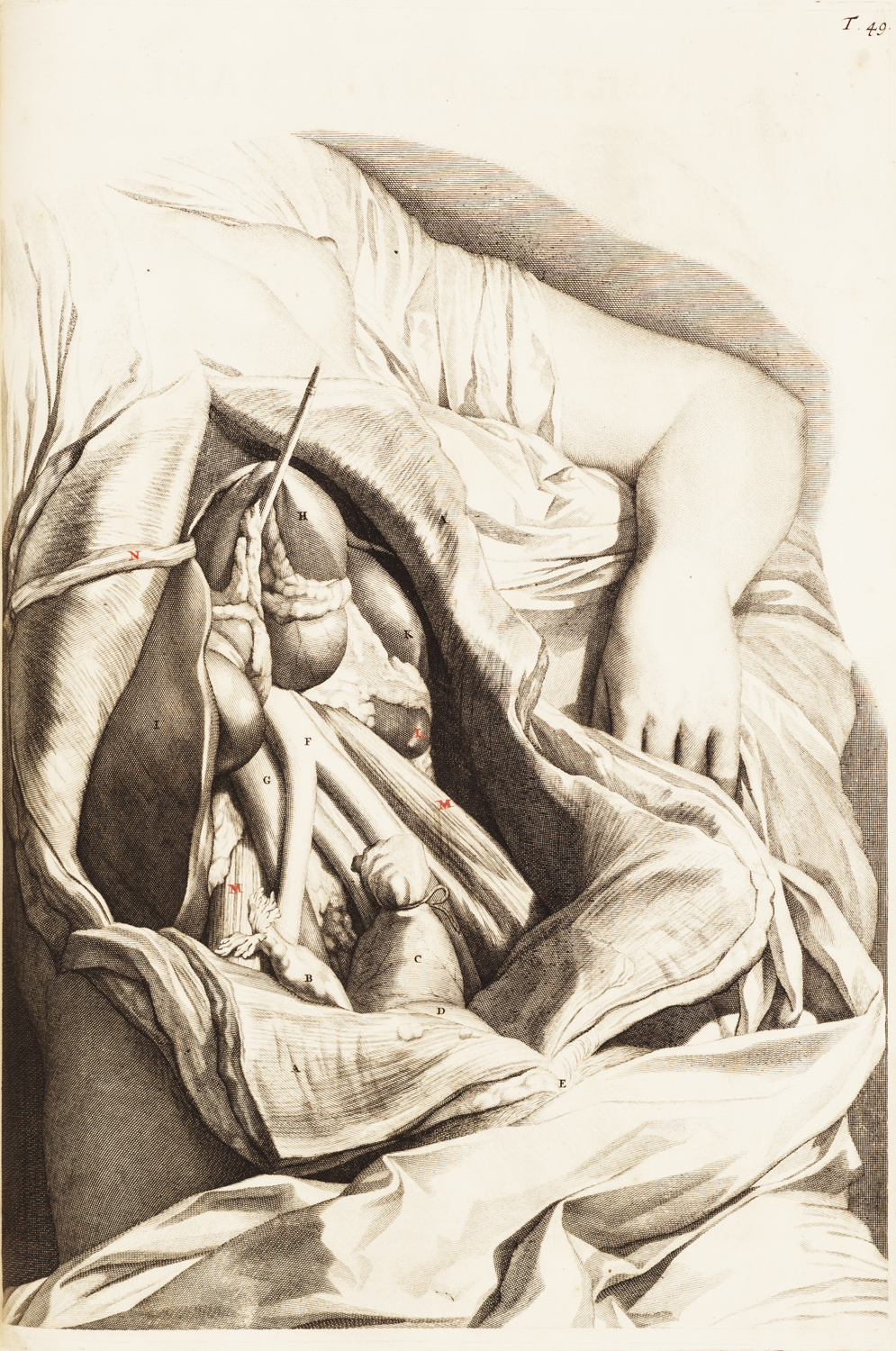
The anatomy of humane bodies … to which is added, an introduction, explaining the animal oeconomy, with a copious index. Oxford: printed at the Theater for Sam. Smith and Benj. Walford, 1698 [with] Supplementum. [s.l., n.d.]. First edition, folio, 2 engraved title-pages, the first with the title in English pasted down over the original title cartouche, the second title engraved to resemble letterpress with a vignette, engraved portrait of Cowper by Smith after Closterman, with 114 engraved plates of which 2 are folding and a further 4 plates in the Supplementum, the Supplementum printed on slightly smaller sheets, with a number of plates in the main work letter-keyed in red ink to the text, contemporary calf, spine decorated gilt in compartments, pieces missing from head and tail of spine, edges rubbed, upper board detached (but present), short tear to the fold of plate 10 (but with no loss), plate 66 bound after plate 90, occasional slight offsetting from the plates, a couple of plate edges slight ragged (due to the edges being proud of the others)
Footnote
Note: Wing C 6698; Welcome 530149; ESTC R1002. The first series of plates is after Lairesse, probably by Bloteling, the inventor of the mezzotint rocker, the second series by Michael van der Gucht after Henry Cook. Either Cowper or his publishers obtained 300 sets of impressions of the engraved title and plates from the publishers of Govard Bidloo's Anatomia humani corporis soon after publication of the second Dutch edition in 1690. Cowper supplied the English text, and published the whole work under his name with the only reference to Bidloo lurking in the Preface and the text. Cowper's English text was largely original and based on his own observations. The nine additional plates of the appendix illustrate "the external muscles, and divers parts of the humane bodies which are either omitted, or not well exprest in the preceeding tables." The Supplementum which is devoted to the male reproductive gland is printed on different paper and the engravings are by J. van der Spyk. We have not been able to identify the source of these additional pages and they are not found with copies in the Welcome, the ESTC or the British Library.