

Lot 38
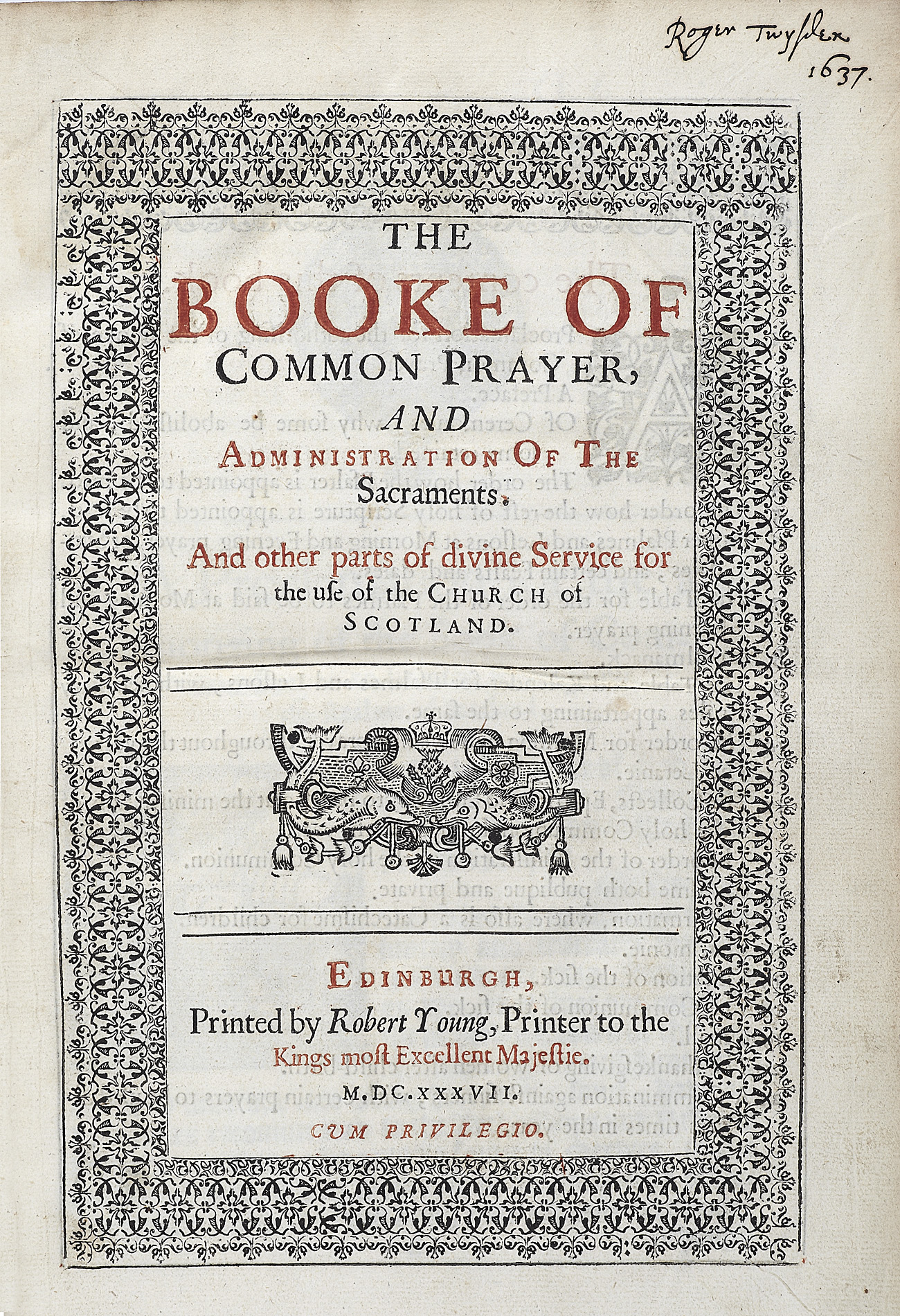
Book of Common Prayer
Rare Books, Maps and Manuscripts
Auction: 29 August 2012 at 12:00 BST
Description
Edinburgh: Robert Young, 1637. First edition, folio, title printed in red and black, 2 cancelled leaves at end, contemporary calf, joints skilfully repaired, half morocco folding case, Roger Twysden' s copy with his signature on the title page
Footnote
Provenance: Viscount Strathallan, Stobhall, Perthshire
Note: The first Scottish Prayer Book, prepared for the Episcopal Church of Scotland under the direction of Archbishop Laud, and thus commonly known as "Laud's Liturgy", or "Laud's Book". This was an extremely controversial book. Laud first visited Scotland in 1633, and was shocked by ecclesiastical conditions there. Laud was the guiding force behind a proposal by Charles I to issue new canons and a new prayer-book for the Scottish church. The work was entrusted to Scottish bishops, but their final text was sent to the king for revision, and once again Laud played a major role. When the book was published the Presbyterian Scots regarded it as an imposition, and it soon led to the first Bishops' War, a step towards the Civil War and the eventual death of Laud and Charles. The sensitive nature of this volume can be inferred from the numerous signs of last-minute changes; for a description of press corrections, suppressed settings, etc. see The Bibliotheck, V (1967), pp.1-23. The most noteworthy change in plans was the decision to cancel a final part of the Psalter headed "Certaine Godly Prayers". Copies of the first edition retain the catchword "Certaine" at the foot of the last leaf, though the Psalter was soon reset, and the catchword cropped. In fact two further leaves (kk7-8) were actually printed, but they have been cancelled in almost all known copies. The present copy is one of a very few which survive with these leaves present; they have been neatly crossed through in ink, but were never removed. Only two other such copies are noted by the STC, at the Bodleian and Morgan Library.
Sir Roger Twysden served in the Short Parlament until its dissolution in October, 1640. He became a prominent participant in the royalist cause and was imprisoned for several years. [STC 16606]