

Lot 219
Grey, Elizabeth, Countess of Kent
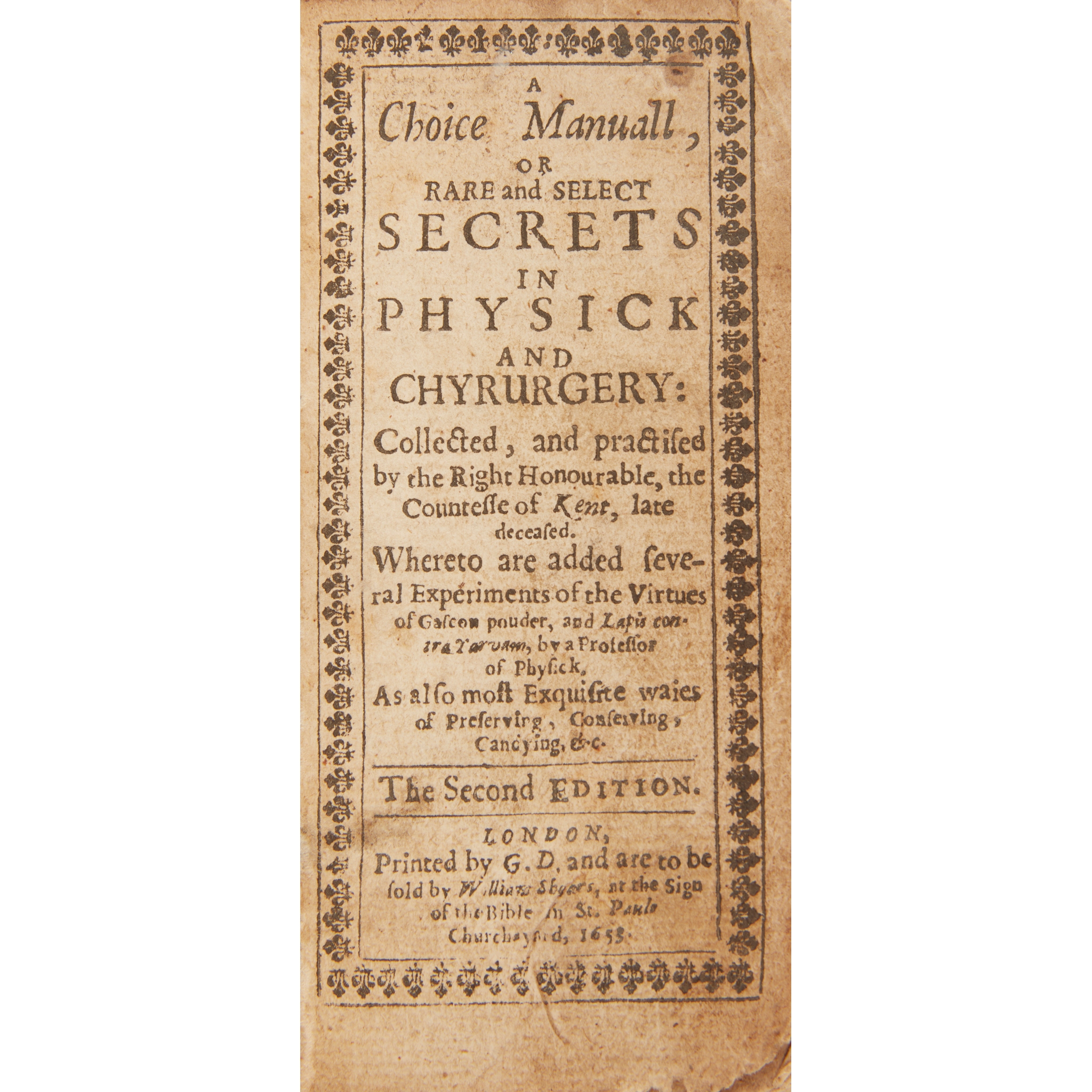
A choice manuall or rare and select secrets in physick and chyurgery
Rare Books, Manuscripts, Maps & Photographs
Auction: 07 February 2024 from 10:00 GMT
Description
collected and practised by the Right Honourable the Countesse of Kent... whereon are added several Experiments of the Virtues of Gascon pouder and Lapis contra Yaruam by a Professor of Phisick. As also most exquisite ways of Preserving, Conserving, Candying, &c. London: printed by G.D. sold by William Skears, 1653. 2 volumes in one, second edition, 16mo, [16], 1-206; [16], 140, lacking the first leaf (frontispiece) of part 1, page 1 of part 2 somewhat soiled; a little light worming to a few leaves in part 2, occasional loss to a letter of fore-margin, a few headlines shaved, some light soiling or spotting
Footnote
A hugely popular work of medicinal receipts that went through 22 editions between 1653 and 1728. Especially popular was the Countess of Kent's receipt for a ‘cure-all’ powder, ‘good against all malignant and pestilent Diseases, French Pox, Small Pox, Measles, Plague, Pestilence, malignant or scarlet Fevers, [and] good against Melancholy, dejection of Spirits’:
Take the Magistery [essence] of Pearles, of Crabs eyes prepared, of white Amber prepared, Hartshorn, Magistery of white Corral, of Lapis contra Parvam of each a like quantity, to these pouders infused put of the black tips of the great clawes of Crabs, to the full weight of all the rest, beat these all into very fine pouder, and searce [sieve] them through a fine Lawn Searce, to every ounce of this pouder adde a drachm of true Oriental Bezar …
An explanation of each of these ingredients – all chosen for their supposed curative powers – would require an essay in itself. ‘Crabs eyes’, for example, were small stones composed mostly of lime found in the stomachs of crayfish, which were powdered for medicinal use.
Such ‘cure-alls’ were immensely popular at the time, and ‘The Countess of Kent’s Powder’ received consistently good reviews, the 17th century diplomat Sir William Temple declaring that ‘Of all Cordialls, I esteem my Lady Kent’s Powder the best, the most innocent, and the most universal’.