

Lot 126
![[Palatine Refugees]](https://media.app.artisio.co/media/104cbde6-0d38-43cb-9e0f-bb721ef57bcf/inventory/ac0b1ee4-2e65-4ddd-8130-11aff74bf4c5/a41efd00-077a-4f92-a7ca-f99aa73695ea/0001_UMYgko_original.jpg)
[Palatine Refugees]
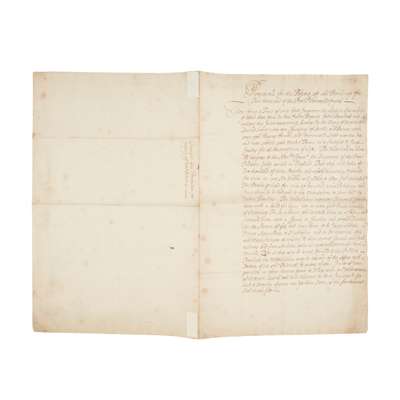
Proposal for the Taking off and Providing for Two thousand of the Poor Palatine Refugees
Rare Books, Manuscripts, Maps & Photographs
Auction: 21 September 2023 at 10:00 BST
Description
Draft manuscript in 30 lines: "There being a tract of very good improveable Land in Lancashire of about 6000 Acres in One Entire Property Extra Parochial...in a fruitful and cheap Country for all the necessaries of Life; The Undertakers humbly propose to the Honble. Commrs. for Disposing of the Poor Palatine lately arrived in England, That they will take off Two thousand of them Entirely, and wholly maintain and provide for them...", bifolium leaf 30 x 19cm, the date 1773 added later in pencil to the upper right corner, with two small purple Tudor rose stamps, possibly a copy of an earlier document
Footnote
Note: The Palatine refugee crisis began in 1709, as thousands of Protestants (and some Catholics) fled poverty, famine and religious persecution on the continent. Many of these people were from the Palatinate region of today's Germany, however others came from across Central Europe. Known as the "Poor Palatines", many of these refugees wished to travel on to America, however they soon began to arrive in such large numbers that this became impossible. Although Protestant refugees had been welcomed by Queen Anne, the British State struggled to provide for all the arrivals. Much like today, debate raged about the status of these refugees, with some arguing that they would become a burden on the economy and others, such as Daniel Defoe, suggesting that they would contribute to society and productivity. Eventually, 3000 refugees were given passage to America, over 2000 were sent to Ireland and further refugees were resettled in England. In the Autumn of 1709, ships carrying German immigrants were banned from coming to Britain. This document (probably a later copy if the 1773 attribution is correct) proposes resettling 2000 refugees in Lancashire, where they would be given land to farm and a Church to congregate in. The proposed site is Martin Mere - described in the document as "Draind several years ago". Today, this is a wetland bird reserve surrounded by arable land. The area was not successfully drained until the 1780s, although various attempts had been made prior to this.