

Lot 247

Marine Engineering - Russell, John Scott
The Modern System of Naval Architecture

Rare Books, Manuscripts, Maps & Photographs
Auction: 21 June 2023 at 11:00 BST
Description
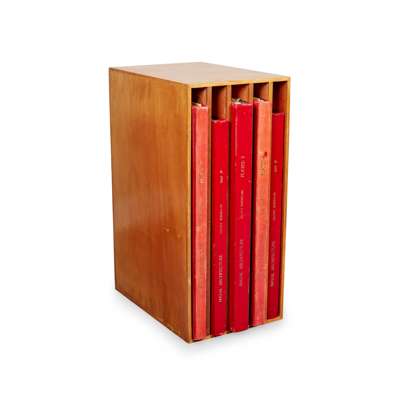
London: Day and Son, [1865], First edition, large folio, 3 volumes in 5, the text bound in 2 volumes; folding frontispiece in volume 1 and 168 engraved plates [numbered 1-79, 80-123, 124-165, and 4*, ?26* and 119*], many folding or double-page, (some very large), red half calf retaining original black cloth boards, the five volumes housed in a specially made wooden cabinet, a few plates slightly dampstained, plate 100 dampstained and with tear not affecting image, title of volume 1 creased, slightly soiled and laid down
Footnote
Note: John Scott Russell (1808–1882) was a Scottish civil engineer, naval architect and shipbuilder. In 1834, while conducting experiments to determine the most efficient design for canal boats, he discovered a phenomenon that he described as the wave of translation. In fluid dynamics the wave is now called Russell's solitary wave. The wave of translation, or solitary wave, gave birth to the modern study of solitons, and developed the wave-line system of ship construction.
His work is an extensive guide of nineteenth-century naval architecture of iron steamships with 168 plates that include detailed plans for a variety of ocean and river steamers, monitors, and warships. Notably, a foldout lithograph of The Great Eastern, the largest vessel of its era, built by the author, J. S. Russell. The construction and saga of the Great Eastern was chronicled in James Dugan's The Great Iron Ship.
"...this work naturally divides itself into three great parts, each of which may be said to form an independent treatise. The First Part [Naval architecture] will be devoted to the purely scientific branch of the profession—that which may be called pure naval architecture. In this part the scientific principles which must regulate the construction of the perfect design of a ship will be laid down with such exactness, as to enable the student of naval architecture to frame a design, which shall exactly fulfil the intended purpose...The Second Part of the work [Ship-building] will form a treatise requiring, perhaps, less science than the foregoing, but no less skill, thought, and knowledge...The Third Part of the work [Marine engineering] passes from the consideration of the mere ship, or sailing vessel, driven by the wind, to the self-acting and self-moving steam-ship." - Russell. Marine Engineering. Introduction, p.xxxvi