

Lot 397
![[Binding Forgery] - Icilio Federico Joni](https://media.app.artisio.co/media/104cbde6-0d38-43cb-9e0f-bb721ef57bcf/inventory/e3ac3479-9153-44dd-bd29-5553c7234a32/7b261590-e1af-4d93-9d64-c59f9cc11680/0001_jIlcJB_original.jpg)
[Binding Forgery] - Icilio Federico Joni
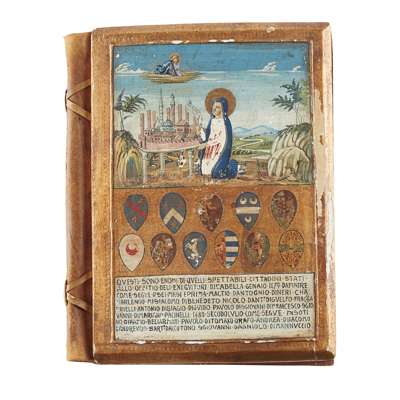
Two painted 'tavolette' book covers in Biccherna style
Rare Books, Manuscripts, Maps & Photographs
Auction: 19 February 2020 at 10:00 GMT
Description
Siena, c.1890-1900, two painted boards attached by a leather pseudo-spine, the front panel of the present binding comprising, within a gilt border, an upper section of a kneeling figure within a landscape setting holding up a model of the city and a scroll bearing the words “This is my city”, Christ appears to the figure in the sky above, below are 11 coats-of-arms set in a gold background and 8 lines of text naming the tax officials for the period January 1479/80 to July 1480, the rear panel is divided into sub-panels, the two central containing a large Christogram and the lower containing what may have been a coat-of-arms, round these are panels of gilt sprays of flowers on a green background, all within gilt borders, the panels measuring 10 x 29cm, some flaking and chipping, particularly at the edges, some of which may have been by Joni who was in the habit of distressing his bindings
Footnote
Note: The binding purports to be one of the famous Sienese Tavolette di Biccherna, which were produced for accounts from the 13th to the 17th century. The Biccherna was the magistrate or chancellery of Finance from the 13th to the 18th century for the republic, and then city, of Siena. The early wooden boards for the account volumes were simple and had no intention of being masterpieces. Subsequently, however, the paintings became more elaborate and rich.
By his own admission, Joni never visited the city archives to inspect the originals, and his bindings are in fact anachronistic. From 1459 the accounts were bound in leather, and the tavolettes, although still painted, had evolved to become paintings framed for hanging. Joni's bindings, however, all bear dates after 1459; the present example, for instance, is dated 1479-1480. Note too that Joni’s boards are simply glued onto a rough leather spine as he apparently did not know how to replicate a fifteenth-century sewing structure.